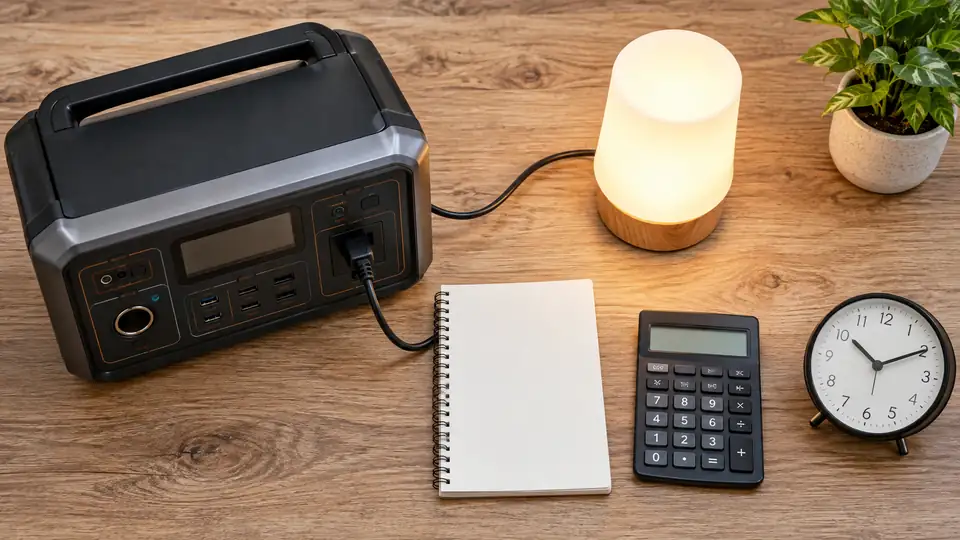
How to Calculate Portable Power Station Runtime starts with dividing the station’s battery capacity in watt-hours by the device’s average power draw in watts. The ideal estimate is runtime in hours ≈ battery capacity in Wh ÷ average load in W. Actual runtime is usually shorter because AC inverter losses, DC conversion losses, the station’s own electronics, reserve capacity, temperature, battery age, and load behavior reduce the energy delivered to the device.
Identify the Two Numbers You Need
A runtime estimate requires the station’s energy capacity and the connected device’s average power consumption.
- Watt-hours (Wh): The amount of stored energy specified for the battery.
- Watts (W): The rate at which a device uses power.
- Average load: The device’s typical consumption over the period being estimated.
Do not substitute watts for watt-hours. A station rated at 1,000 W describes its output capability, while a battery rated at 1,000 Wh describes its stored energy. A 1,000 W inverter may support a high-power appliance, but that rating does not mean the battery stores 1,000 Wh.
Amp-hours require a voltage before they can be meaningfully converted to energy. A simplified relationship is Wh ≈ V × Ah. The exact result depends on how the battery specification defines voltage and capacity, so a station’s published Wh rating is usually the more useful figure for runtime calculations.
Use the Basic Runtime Formula
For a roughly steady load, use this ideal upper-bound calculation:
Runtime in hours ≈ nominal battery capacity in Wh ÷ average load in W
For example, suppose a power station has a nominal capacity of 500 Wh and a device averages 50 W:
500 Wh ÷ 50 W = 10 hours
This is an ideal estimate before system losses. It does not guarantee 10 hours of operating time from the AC outlet or any other output.
A more practical estimate uses an explicitly stated usable-energy assumption:
Runtime in hours ≈ nominal capacity in Wh × assumed usable-energy fraction ÷ average load in W
If the same 500 Wh station is evaluated with an assumed usable-energy fraction of 0.85, the calculation becomes:
500 Wh × 0.85 ÷ 50 W = 8.5 hours
The 0.85 figure in this example is an assumption for illustration. It is not a universal efficiency value or a verified specification for every power station. For a precise estimate, use measured energy data or a usable-energy figure supplied for the exact model and output type.
Calculate Runtime Step by Step
- Find the station’s capacity. Check the specification label or manual for battery capacity in Wh. Use the exact model and version.
- Identify the device’s power draw. Check its label, power adapter, manual, or display. A plug-in watt meter can help measure an AC device under actual operating conditions.
- Determine whether the load is steady or variable. A lamp may draw nearly constant power, while a refrigerator, compressor, pump, or computer can cycle through different power levels.
- Add simultaneous loads. If several devices run at the same time, add their relevant average watts for energy calculations and their peak or startup demands for output compatibility.
- Apply the formula. Divide Wh by average W for an ideal estimate, then apply a clearly labeled usable-energy assumption when a more practical estimate is needed.
- Check output limits. Confirm that the station supports the device’s continuous power, startup demand, voltage, connector, and operating mode.
Why Actual Runtime Differs From the Calculation
Nominal battery capacity is measured at the battery level. Energy reaching a device can be lower after passing through the station’s inverter, DC converters, wiring, control electronics, and protection systems.
- AC inverter consumption: An AC-connected device can use energy through the inverter even when its own demand is small.
- DC conversion losses: USB and DC outputs may use internal conversion electronics that affect delivered energy.
- Station idle consumption: The display, control system, cooling equipment, and active output circuits may draw some power.
- Battery reserve and cutoff behavior: The station may stop an output before the battery reaches a fully empty state.
- Temperature: Very hot or cold conditions can affect battery behavior and output availability.
- Battery age: Capacity can decline through cycle aging and calendar aging.
- Load variation: A device’s label may show a maximum or nominal value rather than its average consumption.
A low-power device can therefore have a shorter runtime than a simple Wh-to-W calculation suggests. The effect may be more noticeable when the connected load is small and the station’s own consumption represents a larger share of total energy use.
Estimate Variable and Cycling Loads
Devices such as refrigerators, freezers, heat pumps, pumps, and some computers do not draw the same wattage continuously. Use average energy over time rather than multiplying a nameplate wattage by the entire operating period.
The general daily-energy formula is:
Daily energy in Wh ≈ average power in W × 24 hours
For a device used for a shorter period, use:
Energy in Wh ≈ average power in W × operating hours
For example, if a device averages 40 W for 12 hours, its estimated energy use is:
40 W × 12 hours = 480 Wh
That calculation still needs an allowance for power station losses if the device is connected through AC or a conversion stage.
Refrigerators and Freezers
A household refrigerator may draw more power while its compressor runs and little or no compressor power while it cycles off. Ambient temperature, thermostat setting, insulation, door openings, contents, and compressor startup behavior affect energy use.
Use a measured daily energy figure when possible. A short observation may not represent every day, particularly during hot weather. Also check the station’s continuous AC output and surge capability. A sufficient Wh rating does not guarantee that the inverter will start every compressor.
Computers and Communications Equipment
Laptops, monitors, routers, satellite communications equipment, and networking devices can change their power draw based on workload, signal conditions, display brightness, and operating mode. Check the exact device, adapter, and connector requirements. A USB-C port does not automatically support USB Power Delivery or a particular wattage.
Check Power Output Before Relying on Runtime
A station can have enough stored energy and still be unable to operate a device. Runtime concerns energy capacity, while compatibility also depends on output power and electrical characteristics.
- Continuous output: The power level the inverter or output can support over its specified operating conditions.
- Surge or peak output: A temporary rating that may help with some startup events. It is not a normal continuous-power rating.
- Voltage: The device and output must use compatible voltage.
- Current: The output must provide the required current without exceeding its limit.
- Connector and polarity: A matching plug shape does not prove electrical compatibility.
- Protocol: USB-C devices may require a particular USB Power Delivery profile.
Motors, compressors, pumps, heaters, microwaves, kettles, hair dryers, and induction cookers can place substantial demands on the inverter. For a high-draw load, check both its continuous input wattage and its startup behavior. A 1,500 W heater running for one hour nominally uses about 1,500 Wh before losses, so a 1,000 Wh station cannot provide that load for a full hour from its battery.
AC, DC, and USB Runtime Differences
The same device may have different runtime results depending on how it connects to the station. An AC adapter requires the station’s inverter, while a compatible DC or USB connection may avoid some conversion steps. The difference depends on the exact equipment and should not be represented with a universal efficiency percentage.
For each output, verify:
- Output voltage and current
- Maximum power rating
- Connector type and polarity
- USB charging protocol, such as USB Power Delivery where required
- Whether the output must be switched on manually
- Whether multiple outputs share a combined power limit
Some stations also consume power through active output circuits. Turning off unused AC, DC, or USB outputs can reduce unnecessary drain if the manual permits that operating practice.
How to Improve the Estimate
A measured load usually produces a better estimate than a label value. For an AC device, use a suitable plug-in energy meter and observe the device over a representative period. Record energy in Wh rather than relying only on a momentary watt reading.
For a variable device, calculate the average from measured energy:
Average power in W ≈ measured energy in Wh ÷ measurement time in hours
Then use the measured average in the runtime formula. If the device uses 300 Wh during a six-hour observation, its average load is:
300 Wh ÷ 6 hours = 50 W
Apply that average to the power station calculation, while still allowing for the station’s conversion losses and its own consumption.
Build a margin into any plan involving medical equipment, refrigeration, communication, or emergency use. A calculated runtime is an estimate, not a guarantee. For a CPAP or other medical device, check the exact device, power adapter, humidifier, heated tubing, approved DC options, and operating mode. Test the complete setup before relying on it, and maintain an appropriate backup plan for essential medical use.
Quick Runtime Examples
| Nominal Capacity | Average Load | Ideal Estimate | Illustrative Estimate at 0.85 Usable Energy |
|---|---|---|---|
| 500 Wh | 50 W | 10 hours | 8.5 hours |
| 1,000 Wh | 100 W | 10 hours | 8.5 hours |
| 1,000 Wh | 200 W | 5 hours | 4.25 hours |
These figures are hypothetical calculations. The 0.85 usable-energy fraction is an explicit illustration, not a specification that applies to every station. Actual results require the exact station, output type, load profile, temperature, battery condition, and operating settings.
Frequently Asked Questions
Does a 1,000 Wh power station run a 100 W device for 10 hours?
It provides a 10-hour ideal estimate before losses. Actual runtime is likely shorter when the device uses an AC inverter or another conversion stage. The result also depends on whether the device truly averages 100 W.
How do I calculate runtime for several devices?
Add the devices’ average watts, then divide the station’s Wh capacity by the combined average load. Separately check the total continuous output and any startup demands. A station must support both the energy requirement and the simultaneous power requirement.
Can I use the device’s maximum wattage for the calculation?
You can use it for a conservative estimate when the device may operate near that level continuously. For cycling or variable loads, maximum wattage can substantially overstate energy use. Measured average consumption is more useful for refrigerators, computers, and similar equipment.
Does a larger watt rating mean longer runtime?
No. A watt rating describes output capability. Runtime primarily depends on watt-hours and the connected load. A station with a high inverter rating may run a powerful device, but its runtime depends on its battery capacity and the device’s actual consumption.
Why does my station shut down sooner than the calculated runtime?
Possible causes include inverter consumption, a higher-than-expected load, startup demand, low-temperature protection, high-temperature protection, battery aging, an active output mode, or an inaccurate capacity assumption. Check the display, error message, operating conditions, and exact manual before diagnosing a battery fault.
For dependable planning, use the exact station’s Wh rating, measure variable loads when possible, apply a clearly labeled usable-energy assumption, and verify output compatibility separately. This produces a practical runtime range without treating nominal battery capacity as guaranteed delivered energy.
