
Solar CPAP backup needs an overnight battery plan and a daytime refill plan. A panel in the box is useful only when its size and the available daylight can replace the energy used by the exact machine and settings.
The larger Jackery 1000 v2 kit provides substantially more reserve than the compact packages. Explorer 300 and EnginStar are reviewed once each, with their included-panel arrangements made explicit rather than ranked as duplicate base stations.
For an illustrative 30W average over eight hours, the load uses 240Wh before conversion losses. A small panel must replace more than that over the next day if the battery is to begin the following night with the same reserve; the calculation is not a therapy-runtime guarantee.
Quick Answer
- Best Overall: Jackery Solar Generator 1000 v2 for its 1,070Wh capacity, 1,500W continuous AC output, LFP battery, and 200W solar panel.
- Best Station-and-Panel Kit: EnginStar 300W Power Station with 60W Solar Panel for its compact format, 296Wh capacity, and included charging kit.
- Best for USB-C CPAP Accessories: ALLWEI 300W Portable Power Station for its 60W USB-C PD output and 256Wh LiFePO4 battery.
Best Solar Generator For CPAP Comparison Table
| Product | Best For | Capacity | Continuous AC Output | Weight | Solar / Recharge Details |
|---|---|---|---|---|---|
| Jackery Solar Generator 1000 v2 | Best Overall | 1,070Wh | 1,500W | 23.8 lb | Verify current specification |
| Jackery Solar Generator 300 with 40W Panel | Best Portable Kit | 292Wh | 300W | 7.5 lb | Verify current specification |
| EnginStar 300W Power Station with 60W Solar Panel | Best Station-and-Panel Kit | 296Wh | 300W | 6.5 lb station | Verify current specification |
| ALLWEI 300W Portable Power Station | Best for USB-C and DC Accessories | 256Wh | 300W | 6.4 lb | Verify current specification |
| ENOFLO 300W Portable Power Station | Best for Multiple Low-Power Devices | 228Wh | 300W | Verify current specification | Verify current specification |
| Jackery HomePower 3000 with 2x200W Solar Panels | Best for a Larger CPAP Reserve Kit | 3,072Wh | 3,600W | Verify current specification | Verify current specification |
| Jackery HomePower 3600 Plus with 2x200W Solar Panels | Best for Extended Vehicle-Supported Backup | 3,584Wh | 3,600W | Verify current specification | Verify current specification |
| EF ECOFLOW DELTA 3 Classic with 220W Solar Panel | Best AC-Adapter Solar Alternative | 1,024Wh | 1,800W | Verify current specification | Verify current specification |
| BLUETTI Solar Generator Elite 100 V2 | Best Higher-Output Compact Solar Package | 1,024Wh | 1,800W | Verify current specification | 200W panel included, up to 1,000W solar input |
The reviews below focus on the practical CPAP trade-offs, including capacity, output choices, solar package contents, and the limits buyers should verify before relying on a station overnight.
1. Jackery Solar Generator 1000 v2 — Best Overall

For CPAP users who want breathing room in their backup setup, this Jackery is the most capable choice in the group. Its 1,070Wh battery is substantially larger than the compact 228Wh to 296Wh stations listed here, and its 1,500W continuous AC output leaves considerable headroom for a CPAP power brick plus phones, lights, or a small refrigerator. The listing also specifies three pure sine wave AC ports, two USB-C ports, one USB-A port, and a 12V car port, giving buyers several ways to build a setup around their equipment.
The included 200W solar panel makes the package more useful for extended off-grid use, although the listing says the generator and panel may ship separately. Jackery also lists a 100W USB-C PD output, an LFP battery, and 4,000 cycles while retaining more than 70 percent of original capacity. Those are useful published specifications, but they do not guarantee a particular CPAP runtime. AC runtime will depend on the machine, humidifier, heated hose, inverter losses, and other loads, so medical-device requirements still need a careful check.
Pros
- Large 1,070Wh nominal battery capacity
- 1,500W continuous AC output with 3,000W surge peak listed
- Includes a 200W solar panel
- LFP battery and 4,000-cycle claim to more than 70 percent capacity
- 100W USB-C PD, three AC ports, and a 12V car port
Cons
- At 23.8 pounds, it is substantially heavier than the compact stations
- The one-hour charging mode requires activation through the Jackery app, and the listing says the default mode is 1.7 hours
This is the sensible pick for long trips, household backup planning, or anyone who wants capacity beyond a single small device. It may be excessive for a minimalist campsite where portability matters more than reserve energy. Buyers should also confirm the exact CPAP adapter path before choosing AC or USB-C, since a high output rating does not establish compatibility with every medical device.
To buy this product, click here.
2. Jackery Solar Generator 300 with 40W Panel — Best Portable Kit

This bundle uses the same compact Explorer 300 format as the station-only listing, but adds a 40W Air Solar Panel. The station is listed at 292Wh, 300W AC output, 600W peak surge, and 7.5 pounds. Its two AC outlets, 100W USB-C PD port, two USB-A ports, and 120W car port cover a wide range of small travel electronics, while the integrated handle keeps the package easy to move from a vehicle to a tent or guest room.
The smaller 40W panel is aimed at maintaining the kit away from an outlet rather than delivering a large solar input. The listing gives an approximate 80 percent charging figure of 7.5 hours with the 40W panel, while its faster 2.8-hour figure uses a 100W panel, which is a different setup. That distinction matters for CPAP planning. This bundle provides useful solar independence, but the published details do not guarantee that it can replenish the station at the same pace as overnight energy use.
Pros
- Includes a 292Wh Explorer 300 station and 40W solar panel
- 7.5-pound station with an integrated handle
- 100W USB-C PD port
- 300W rated AC output with two AC outlets
- LiFePO4 battery and published 4,000-cycle claim
Cons
- The included 40W panel is slower than the 100W panel referenced in the listing’s faster charging claim
- Nominal capacity may be limiting for high-demand CPAP accessories
This bundle suits travelers who want a compact solar-ready package and value simple transport. It is less compelling for extended CPAP backup where a larger station or higher solar input would provide more reserve. Check whether the panel’s charging connection is appropriate for the station and whether your CPAP can use one of the listed outputs without an unsuitable adapter.
To buy this product, click here.
3. EnginStar 300W Power Station with 60W Solar Panel — Best Station-and-Panel Kit

This EnginStar package is appealing for buyers who want the station and a foldable panel in one purchase. The power station is listed at 296Wh, 300W AC output, and 6.5 pounds, with two AC outlets, two regulated DC outputs marked 12V/24V, USB-A, and an 18W USB-C port. That gives a CPAP camper several connection paths to investigate, while the small footprint should be manageable beside a sleeping area or inside a vehicle.
The included 60W monocrystalline panel folds down to a compact package and has DC, USB-A, and USB-C outputs of its own. The listing states that the station accepts compatible 12V to 25V solar panels and can also charge from an AC outlet or a 12V car socket. The kit includes an AC charger, car charger cable, connectors, and hooks. The panel’s connector and the station’s electrical limits still need to be checked together, and the CPAP manufacturer should confirm whether the AC or DC route is appropriate.
Pros
- 296Wh capacity with 300W AC output
- 6.5-pound station with 9 by 5.5 by 7.5 inch dimensions
- Includes a 60W foldable monocrystalline solar panel
- Offers regulated 12V/24V DC outputs and an 18W USB-C port
- Includes AC, car, and solar charging options
Cons
- The listing describes the battery as lithium-ion rather than LiFePO4
- The published material does not specify CPAP runtime or the panel’s full electrical ratings
This is a practical choice for a small solar kit, especially for car camping where the 6.5-pound station and folding panel can travel together. It may be a weaker fit for several nights of CPAP use with heated accessories because its nominal capacity is under 300Wh. Treat the supplied panel as a charging component, not as proof of a particular overnight runtime, and verify the complete connection path before relying on it.
To buy this product, click here.
4. ALLWEI 300W Portable Power Station — Best for USB-C and DC Accessories
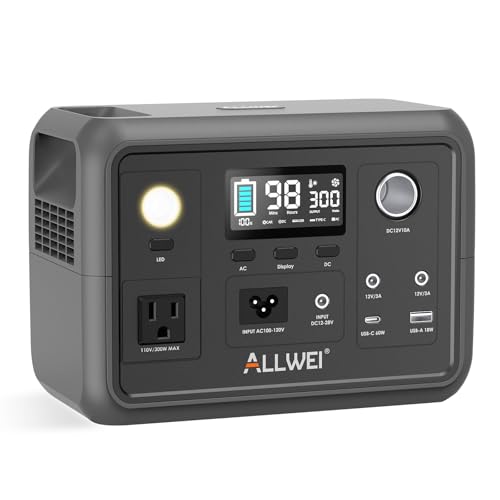
ALLWEI takes a slightly different approach to compact CPAP backup by pairing a 256Wh capacity with a 60W USB-C PD port. That port is more substantial than the 18W USB-C outputs listed on the EnginStar units, although a USB-C connector alone never proves that a particular CPAP can run from it. The station also includes one AC outlet, two DC5521 ports, a 12V car port, and an 18W USB-A port, allowing a buyer to build a setup around the equipment already in the bag.
The 6.4-pound unit measures 9.25 by 5 by 6.81 inches and uses a LiFePO4 battery according to the listing. ALLWEI states a 3,000-cycle claim and includes a three-level LED light with SOS mode. Solar charging with a 100W panel is listed at four to five hours, while AC and 12V car charging are listed at 3.5 to four hours. The solar panel is sold separately, and the supplied material does not identify the station’s exact solar voltage limits, so panel selection needs care.
Pros
- 256Wh capacity with 300W continuous output
- 60W USB-C PD port
- LiFePO4 battery with a listed 3,000-cycle claim
- 6.4-pound compact design
- Supports AC, car, solar, and listed dual AC plus solar charging
Cons
- Solar panel is sold separately
- The published specifications do not establish direct CPAP compatibility through USB-C or the DC ports
This is a good fit for users whose travel kit includes USB-C equipment and who want a light station with several compact outputs. It is less suited to a high-demand CPAP routine that includes heated accessories for multiple nights. Before buying a cable, match the CPAP’s voltage, current, connector, and required charging protocol rather than relying on the port label alone.
To buy this product, click here.
5. ENOFLO 300W Portable Power Station — Best for Multiple Low-Power Devices

ENOFLO offers the smallest stated capacity in this selection, at 228Wh, but it provides an unusually broad collection of outputs. The listing gives two 300W pure sine wave AC outlets, two DC outputs, a 12V/8A cigarette-lighter port, two USB-A ports, a USB-C port, and wireless phone charging. That mix could be useful beside a CPAP machine when the same station must also keep a phone, light, camera, or small fan running.
The unit includes a display showing operating status, a large rear LED light, and a built-in MPPT controller. Solar charging with an ENOFLO 30W or 60W panel is listed at roughly six to seven hours, while AC and car charging are listed at roughly six to eight hours. Those are seller-published charging claims, not independent measurements. The CPAP references in the listing do not establish guaranteed medical-device operation, and the USB-C details do not identify a full PD profile, so the AC route may be the more straightforward starting point if the machine’s adapter is suitable.
Pros
- 300W output with 600W surge listed
- 228Wh capacity in a compact station
- Two AC outlets, two DC ports, and a 12V/8A car-style port
- Wireless phone charging and multiple USB outputs
- Built-in MPPT controller and status display
Cons
- Lowest stated battery capacity among the clearly rated stations here
- Solar panel is sold separately
ENOFLO is a reasonable niche choice for short trips where the CPAP is one of several small loads and the buyer values port variety. It is a weaker candidate for long backup periods or heated-hose use because 228Wh leaves less nominal reserve. Check the machine’s actual input requirements, and treat the published charging times as conditional claims rather than a guarantee of replenishment in every solar setup.
To buy this product, click here.
6. Jackery HomePower 3000 with 2x200W Solar Panels — Best for a Larger CPAP Reserve Kit

HomePower 3000 with two 200W panels holds 3,072Wh of nominal energy. For CPAP planning, that reserve is more relevant than its 3,600W inverter, since the exact machine and overnight settings determine how much energy is required.
The kit is a vehicle-supported arrangement rather than a lightweight bedside travel battery. Solar collection can replenish use, but the panel package does not guarantee repeated nights under cloud or shade.
Pros
- 3,072Wh capacity for a broad essential-load setup.
- 3,600W AC output and 7,200W surge claim.
- Published UPS switching specification of up to 20ms.
- Includes a TT-30 RV port.
- Two 200W solar panels are listed with the kit.
Cons
- The stated 20ms switching time does not guarantee compatibility with every sensitive device.
- Solar panels and station may arrive separately.
Consider it when a substantial reserve is justified by the approved setup.
To buy this product, click here.
7. Jackery HomePower 3600 Plus with 2x200W Solar Panels — Best for Extended Vehicle-Supported Backup
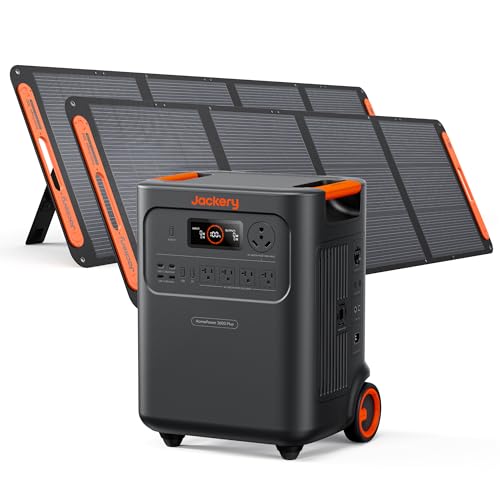
The 3600 Plus solar package brings 3,584Wh of base storage and two 200W panels. It is a larger CPAP reserve option for trips where the battery can travel by vehicle and serve other selected equipment as well.
Its 3,600W output does not certify a medical connection or uninterrupted therapy. Use the machine’s approved power route, budget heated accessories separately, and distinguish optional expansion from the capacity supplied in this package.
Pros
- 3,584Wh battery capacity for substantial essential-load backup.
- 3,600W AC output with 7,200W parallel output listed.
- Expandable to 21kWh per unit according to the published specifications.
- Wheels and a telescoping handle improve repositioning.
- Includes two 200W solar panels in the listed kit.
Cons
- The station and panels may ship in separate packages.
- 120V and 240V use in parallel should be checked against the exact setup and connected load.
The package fits a reserve-heavy plan with transport space available.
To buy this product, click here.
8. EF ECOFLOW DELTA 3 Classic with 220W Solar Panel — Best AC-Adapter Solar Alternative

DELTA 3 Classic with a 220W panel stores 1,024Wh and supplies 1,800W AC output. For a CPAP using its approved AC adapter, it provides a substantial battery reserve without requiring a direct-DC modification.
This Classic design has no 12V car output, so it should not be purchased for an assumed DC CPAP route. Its transfer function remains equipment-dependent; the included panel’s refill rate also depends on actual sunlight.
Pros
- 1,024Wh capacity in a compact home-backup class.
- 1,800W continuous output and 3,600W surge listed.
- Includes a 220W solar panel.
- Under-10ms UPS switching is specified.
- LiFePO4 battery and 10-plus years of daily-use rating are listed.
Cons
- Its 1,024Wh capacity is much lower than the 2,000Wh and 3,000Wh options.
- Actual solar charging depends on conditions and the panel’s electrical setup.
An approved AC-adapter arrangement is the appropriate reason to compare it.
To buy this product, click here.
9. BLUETTI Solar Generator Elite 100 V2 — Best Higher-Output Compact Solar Package

Elite 100 V2 with a 200W panel supplies a 1,024Wh battery in a solar package. That is considerably more reserve than the small kits, with other campsite electronics able to share the station only within its system limits.
The 1,800W inverter is not proof of medical suitability. Calculate the CPAP night from the actual settings, then plan replenishment around the included 200W panel rather than the station’s larger solar-input ceiling.
Pros
- 1,024Wh stated battery capacity suits longer road-trip use.
- 1,800W rated AC output covers a wider class of loads than the compact units here.
- Includes a 200W solar panel in the listed package.
- Supports app monitoring through Wi-Fi and Bluetooth.
- Uses stated LiFePO4 chemistry with a seller-listed cycle claim of over 4,000 cycles to 80 percent.
Cons
- Its weight is not clearly specified in the product listing.
- The included panel is shipped separately, so package timing may vary.
It is a transportable solar reserve for a verified, approved connection.
To buy this product, click here.
Buying Guide
Start With the CPAP’s Actual Power Path
Before comparing battery sizes, find out how the CPAP receives power. Some setups use a standard AC adapter, while others may support a manufacturer-approved DC cable or voltage conversion system. An AC outlet is often the simplest route, but it uses the station’s inverter. A DC route can be more efficient in some arrangements, yet the voltage, current, connector, and polarity must match exactly. A matching plug shape is not enough.
Separate Battery Capacity From Expected Runtime
The larger Jackery HomePower kits supply substantially more reserve than the compact stations. Nominal Wh still does not establish overnight CPAP operation; the exact machine, approved connection, humidifier, and heated hose determine the energy budget.
Humidifiers and heated hoses deserve special attention. They can materially change demand compared with a CPAP running without heat. If a full-night backup is medically important, verify the setup with the equipment manufacturer or clinician rather than treating a simple Wh-divided-by-watt calculation as proof.
Check Continuous AC Output, Not Peak Output
Continuous output is the figure that describes the load a station is intended to support over time. Peak or surge output describes a temporary ceiling under stated conditions. Most products here list 300W continuous output, while the Jackery 1000 v2 lists 1,500W. A larger peak number does not automatically make a station better for sustained CPAP use, and it does not prove compatibility with every adapter or accessory.
Review Solar Input Before Buying a Panel
A panel’s wattage and connector do not prove that it is electrically compatible with a power station. Buyers should compare the panel’s voltage and current information with the station’s accepted solar input range, maximum current, maximum voltage, and connector requirements. The EnginStar listings identify a compatible 12V to 25V panel range, while several other listings provide less complete electrical detail. If those figures are missing, ask for them rather than guessing.
Included panels range from the compact 40W and 60W packages to larger Jackery and BLUETTI arrangements. Compare the exact included panel with the energy to replace and the station input limits; the package is not a daily refill guarantee.
Compare AC, DC, and USB-C Outputs Carefully
USB-C is a connector format, not a universal power specification. The ALLWEI listing identifies a 60W USB-C PD port, and the Jackery compact models list 100W USB-C PD. EnginStar lists an 18W USB-C output, while the ENOFLO listing gives USB-C voltage and current figures without establishing a full PD profile. Match the CPAP’s required protocol and voltage before choosing a direct USB-C connection.
Likewise, a 12V car port or DC5521 port should not be treated as universal. Check the CPAP’s adapter specifications and use only a suitable, approved connection. A station’s many ports are helpful for a travel setup, but the individual ratings still govern what each port can support.
Decide How Much Portability You Need
The compact stations weigh roughly 6.4 to 7.5 pounds where the listings provide weight information. They are easier to carry between a vehicle and sleeping area, but their smaller batteries provide less reserve. The Jackery 1000 v2 weighs 23.8 pounds and offers far more capacity, which may be worthwhile for longer trips or additional devices. Think about where the station will sit, how often it will move, and whether a solar panel must travel with it.
Do Not Confuse Pass-Through With Medical UPS Backup
ALLWEI lists pass-through charging, meaning the station can charge while powering devices. That does not establish UPS behavior, zero-interruption transfer, or compatibility with a CPAP that cannot tolerate an interruption. None of the supplied product information proves a particular transfer time or medical backup certification. If uninterrupted operation is required, verify the complete arrangement with the CPAP manufacturer and use an appropriate backup plan.
Best Solar Generator For CPAP FAQ
What size solar generator is suitable for a CPAP?
There is no single size that suits every CPAP setup. The machine’s power draw, humidifier, heated hose, operating duration, inverter losses, and other loads all affect the result. The products here range from 228Wh to 1,070Wh. A larger nominal capacity provides more reserve, but it still does not guarantee a particular number of nights.
Is a 300W power station enough for CPAP?
A 300W continuous output rating may be sufficient for a CPAP’s instantaneous load, but output wattage and battery capacity answer different questions. The 300W figure describes power delivery, while the 228Wh to 296Wh capacities of the compact models describe stored energy. Confirm the CPAP adapter’s requirements and calculate expected demand using the manufacturer’s information.
Should CPAP users run from AC or DC?
Use the connection method approved for the specific CPAP and adapter. AC may be simpler because it can use the machine’s standard power supply, while a compatible DC pathway may avoid some conversion stages. The correct choice depends on voltage, current, connector, and device guidance. Do not assume that any 12V port or USB-C PD port is suitable.
Can solar panels run a CPAP all night?
Solar panels produce power during suitable daylight conditions, not through the night. Their role is to recharge the station or support daytime loads. The station’s stored energy must cover the nighttime CPAP demand. Panel wattage, sunlight, angle, shading, electrical limits, and charging losses all affect replenishment, so a listed panel rating does not guarantee a full recharge.
Is the Jackery Solar Generator 1000 v2 suitable for CPAP backup?
The 1000 v2 kit offers 1,070Wh with an included 200W panel in a more movable arrangement than the larger HomePower kits. Choose between them from the measured overnight budget and transport plan, with medical equipment compatibility checked separately.
Does a pure sine wave listing guarantee CPAP compatibility?
No. A pure sine wave claim describes the listed AC output characteristic, but it does not verify every CPAP model, adapter, heated accessory, or backup requirement. The CPAP manufacturer remains the appropriate source for approved power arrangements. The station’s capacity and output must also match the planned duration and load.
Can I use a power station’s pass-through charging as a CPAP UPS?
No. Pass-through charging means the product can charge while powering a device, but it does not establish uninterrupted transfer, UPS behavior, or a particular switchover time. ALLWEI lists pass-through operation, but the listing information does not establish medical-grade continuity. Verify the complete backup design before relying on it.
Final Verdict
The 1000 v2 solar package is the stronger reserve option for an uncertain overnight demand. The compact Jackery and EnginStar kits are more manageable to carry but need a lower measured energy budget and realistic solar replenishment.
Do not treat an included 40W or 60W panel as a guarantee of another full night. Check the approved machine connection and keep a backup plan appropriate to the medical equipment.
