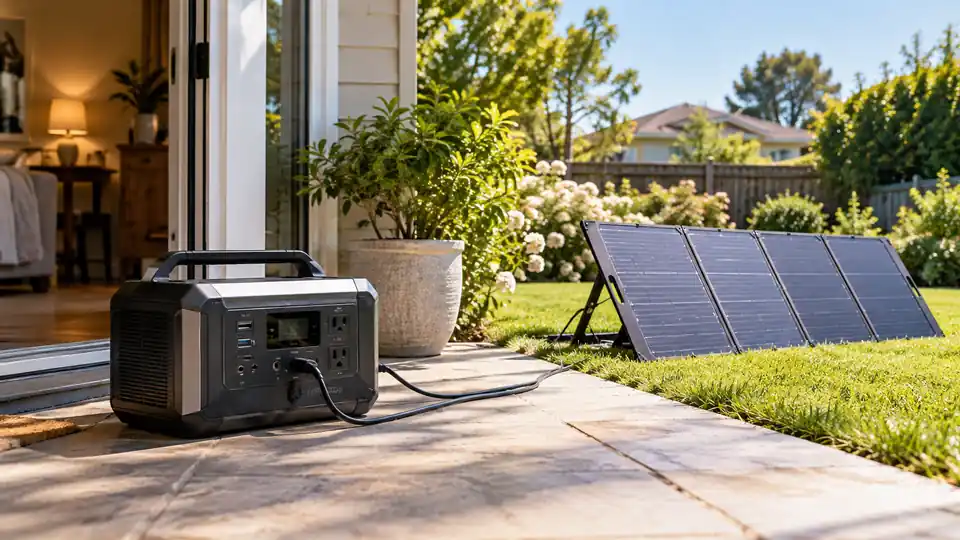
A home backup power station has to do more than keep a phone alive. During an outage, one household may need a refrigerator, Wi-Fi router, lights, medical equipment, or a sump pump running, while another may simply want a quiet battery for laptops and small appliances. That difference makes capacity, continuous AC output, recharge options, and transfer behavior far more important than a flashy peak-watt number.
A common mistake is treating the battery’s Wh rating as the exact energy available from the AC outlets. In practice, inverter consumption, load changes, battery limits, and charging conditions affect what you receive. Buyers also overlook package details. A solar-generator kit may include panels that ship separately, while an expandable station may require additional batteries before its advertised maximum capacity is available. The Jackery HomePower 5000 Plus is the strongest high-capacity choice here, while the HomePower 3600 Plus offers a more manageable balance for many homes.
Different households need different forms of backup. A large home with high-wattage appliances may prioritize 120V and 240V output, while an apartment resident may care more about quiet operation, portability, and UPS switching. The selections below cover both ends of that range, including large expandable systems, mid-sized solar kits, and a compact option for essential electronics.
Quick Answer
- Best Overall: Jackery Solar Generator 5000 Plus for its 5,040Wh base capacity, 7,200W output, and 120V/240V support.
- Best Balance: Jackery HomePower 3600 Plus with 2x200W Solar Panels for its 3,584Wh capacity, 3,600W output, and expandable design.
- Best Compact Home Backup: EF ECOFLOW DELTA 3 Classic for its 1,024Wh capacity, 1,800W output, and under-10ms UPS claim.
- Best Lightweight Option: Jackery Solar Generator 300 with 40W Solar Panel for laptops, routers, lights, and other modest loads.
Best Solar Generator for Home Backup Comparison Table
| Product | Best For | Base Capacity | Continuous AC Output | Expansion or Transfer Feature |
|---|---|---|---|---|
| Jackery Solar Generator 5000 Plus | High-demand home backup | 5,040Wh | 7,200W | Expandable to 60kWh, 120V/240V |
| Jackery HomePower 3600 Plus Kit | Large household essentials | 3,584Wh | 3,600W | Expandable to 21kWh per unit |
| Jackery HomePower 3000 | Refrigerators and essential circuits | 3,072Wh | 3,600W | UPS claim up to 20ms |
| ABOK Ark3600 with 3x200W Panels | Large solar-rechargeable backup | 3,840Wh | 3,600W | Expandable to 11,520Wh |
| Jackery Explorer 2000 v2 Kit | Mid-sized home and RV loads | 2,042Wh | 2,200W | 20ms switching claim |
| Anker SOLIX S2000 | Fridge and home-office backup | 2,010Wh | 1,500W | Under-10ms UPS claim |
| EF ECOFLOW DELTA 3 Classic | Compact appliance backup | 1,024Wh | 1,800W | Expandable output claim, under-10ms UPS |
| Jackery Solar Generator 1000 v2 | Portable household essentials | 1,070Wh | 1,500W | 3,000W surge claim |
| Jackery Solar Generator 300 Kit | Small electronics and lights | 292Wh | 300W | 40W panel included |
The detailed reviews explain how each station’s capacity, output, charging setup, and transfer features translate into practical home-backup use.
1. Jackery Solar Generator 5000 Plus – Best Overall

For a household that wants serious backup capacity, the Jackery Solar Generator 5000 Plus sits in a different class from compact portable stations. Its 5,040Wh base battery and 7,200W rated output are intended for larger appliances, and the listing specifies both 120V and 240V support. That combination gives it broader home-backup potential than a 1,000Wh unit, particularly for buyers who need to think beyond phones, lamps, and a router.
The expandable design is the main attraction. The system is advertised as supporting up to 60kWh, while a 60A Smart Transfer Switch can be paired with it to power up to 12 circuits at 120V or six at 240V. That does not mean the package automatically powers a home panel, and installation details must be handled according to the equipment instructions and qualified guidance. Still, the architecture makes this a compelling choice for buyers planning a more substantial backup arrangement rather than a simple plug-in battery.
Pros
- 5,040Wh base capacity for longer-duration backup planning.
- 7,200W rated output with 14,400W surge listed.
- Supports 120V and 240V operation.
- Expandable capacity is listed up to 60kWh.
- Compatible with a stated 60A Smart Transfer Switch for selected circuits.
Cons
- The supplied package includes 2x200W panels, which are modest compared with the station’s maximum 4,000W solar-input claim.
- Home-circuit integration requires separate equipment and appropriate installation planning.
This is the strongest pick for buyers who want the highest supported output and capacity in this group. It is excessive for a small apartment needing occasional electronics backup, and the included panels will not represent the full solar-input potential. For larger homes, higher-demand appliances, and future expansion, however, its scale gives it a clear advantage.
To buy this product, click here.
2. Jackery HomePower 3600 Plus with 2x200W Solar Panels – Best Balance
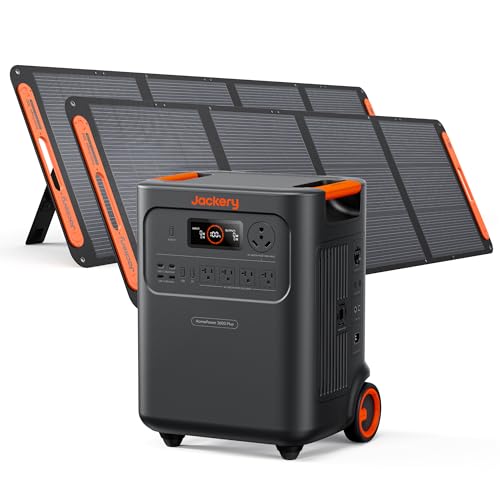
The HomePower 3600 Plus is a practical middle ground between a compact battery and a large home-energy system. Its 3,584Wh capacity and 3,600W output are substantial enough for many household essentials, while the luggage-style body, wheels, and telescoping handle make movement between a garage and kitchen less awkward than the raw numbers might suggest.
This package includes two 200W solar panels, although the listing says the station and panels may arrive separately. The unit supports four charging methods, with stated charging claims for hybrid AC and DC, AC, solar, and a gas generator. Its dual-voltage capability is listed for parallel operation, so buyers should read the connection and installation requirements carefully rather than assume every 240V appliance can be connected directly.
Pros
- 3,584Wh battery capacity for substantial essential-load backup.
- 3,600W AC output with 7,200W parallel output listed.
- Expandable to 21kWh per unit according to the supplied specifications.
- Wheels and a telescoping handle improve repositioning.
- Includes two 200W solar panels in the listed kit.
Cons
- The station and panels may ship in separate packages.
- 120V and 240V use in parallel should be checked against the exact setup and connected load.
This kit suits households that want a large battery without moving immediately to the 5,000Wh class. It offers more capacity and output than the smaller Jackery and EcoFlow options, while remaining more approachable than a full high-capacity system. Buyers seeking a simple plug-in unit for a few electronics may find it larger than necessary.
To buy this product, click here.
3. Jackery HomePower 3000 with 2x200W Solar Panels – Best for Essential Appliances

The HomePower 3000 targets the familiar outage essentials: a refrigerator, Wi-Fi router, lights, fans, and small appliances. Its 3,072Wh capacity and 3,600W output give it a strong specification profile for that job, while the built-in TT-30 RV port adds flexibility for buyers who split time between home backup and recreational use.
The published specifications also identify a UPS with switching of up to 20ms. That is useful information for electronics and selected essential equipment, but a transfer-time claim should not be treated as proof that every computer, medical device, or refrigerator will operate without interruption. The kit includes two 200W panels, and the listing states that the station and panels may ship separately, so confirm the complete delivery before relying on the solar-recharge setup.
Pros
- 3,072Wh capacity for a broad essential-load setup.
- 3,600W AC output and 7,200W surge claim.
- Published UPS switching specification of up to 20ms.
- Includes a TT-30 RV port.
- Two 200W solar panels are listed with the kit.
Cons
- The stated 20ms switching time does not guarantee compatibility with every sensitive device.
- Solar panels and station may arrive separately.
This is a strong fit for a buyer who wants a sizable station with a useful mix of home and RV connections. Its capacity is substantial, though the unit is still subject to inverter losses and the actual draw of each appliance. Buyers who need 240V operation or much more expansion should look higher in the range.
To buy this product, click here.
4. ABOK Ark3600 with 3x200W Solar Panels – Best Solar-Rechargeable Large Station

The ABOK Ark3600 kit brings a 3,840Wh battery, 3,600W rated output, and three 200W panels together in one listing. That makes it appealing for buyers who want a larger solar-generator package from the start rather than purchasing a station first and adding panels later. The 15-port layout includes AC outlets, USB-A, USB-C, DC5521, XT60, and a 12V cigarette-lighter port, giving it broad connection variety.
The listing also specifies up to 2,000W PV input and up to 3,500W combined AC and solar input, along with an expandable capacity of 11,520Wh. Those figures describe supported system capabilities, not guaranteed solar yield or delivered AC energy. The included panels are described as 200W monocrystalline units with MC4 output and an IP68 rating, but buyers still need to verify electrical limits before adding or rearranging panels.
Pros
- 3,840Wh base capacity.
- 3,600W rated output with 7,200W peak listed.
- Three 200W solar panels are included in the specified kit.
- 15 output ports cover AC, USB, DC, XT60, and 12V connections.
- Expandable capacity is listed up to 11,520Wh.
Cons
- Panel connector compatibility does not by itself prove electrical compatibility with every configuration.
- The large capacity and output make it less suited to buyers seeking a small, easily carried station.
This kit makes sense for a household that values solar input flexibility and many port types. Its higher base capacity is useful for longer backup planning, while the included panels make the package more complete than a station-only purchase. Before expanding the array, verify voltage, current, connector, and input limits from the relevant documentation.
To buy this product, click here.
5. Jackery Explorer 2000 v2 with 2x200W Solar Panels – Best Mid-Sized Kit

The Explorer 2000 v2 is a useful step up from 1,000Wh-class stations without reaching the size of the large 3,000Wh systems. Its 2,042Wh capacity and 2,200W AC output can support a wider range of household essentials, while the supplied kit includes two 200W solar panels for replenishment away from the grid.
Portability is a central part of the design. The listing gives a weight of 39.5 pounds and describes a smaller body than conventional 2kWh LiFePO4 stations. It also lists 80% AC charging in 66 minutes and an app-activated emergency mode for a full charge in 102 minutes. These are published charging claims, so actual results can vary with the selected mode and conditions. The 20ms switching feature adds backup functionality, but it should be matched against the requirements of sensitive equipment.
Pros
- 2,042Wh capacity fits many mid-sized backup needs.
- 2,200W AC output exceeds the 1,500W class.
- Two 200W solar panels are included in the listed package.
- 100W USB-C PD output is specified.
- 20ms seamless switching and UL1778 test certification are listed for the UPS feature.
Cons
- The solar-panel connection requires attention to the specified DC plug arrangement.
- Its 2,200W output is below the larger 3,600W and 7,200W options.
This is a sensible option for buyers who want a home backup station that can also travel to an RV or work area. It provides more reserve than compact models and remains smaller than the high-capacity choices. Households planning to run large heaters, pumps, or multiple high-draw appliances should review continuous-load requirements carefully.
To buy this product, click here.
6. Anker SOLIX S2000 – Best for Fridge and Home-Office Backup
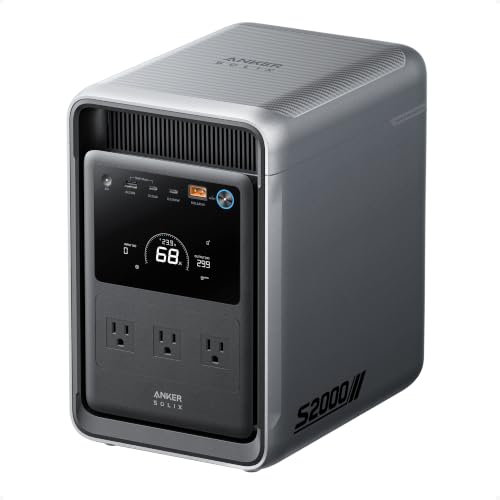
The Anker SOLIX S2000 focuses on a 2,010Wh capacity and 1,500W continuous output. That combination is less suited to high-wattage heating appliances than the larger stations, yet it is well matched to a refrigerator, router, lights, computers, and other moderate loads. The listing claims up to 35 hours of refrigerator backup, while also warning that runtime varies with the refrigerator, usage, and ambient temperature.
Its compact dimensions and listed 35.7-pound weight make it easier to place near a home office or essential appliance than a 3,000Wh-plus station. The unit supports up to 400W solar input and six recharge methods, including AC, solar, generator, alternator, and car outlet charging. It has eight outlets arranged at the front and rear, but the listing specifically says there is no 12V DC port, which matters for buyers with direct-current equipment.
Pros
- 2,010Wh capacity for moderate home backup.
- 1,500W continuous output with 3,000W peak listed.
- 35.7-pound weight and compact dimensions are supplied.
- Supports up to 400W solar input and six charging methods.
- Under-10ms UPS switching is listed for home-office use.
Cons
- No 12V DC port is listed.
- The 1,500W continuous output limits suitability for high-demand appliances.
This station is a good match for a buyer whose priority is keeping a refrigerator, network equipment, and work devices operating without stepping up to a larger system. The advertised fridge duration is not a universal runtime promise, so measure the actual appliance load and account for cycling behavior. Buyers needing direct 12V connections or higher output should choose a different design.
To buy this product, click here.
7. EF ECOFLOW DELTA 3 Classic with 220W Solar Panel – Best Compact UPS Option

The DELTA 3 Classic is aimed at buyers who need a portable station capable of handling more than small electronics. Its 1,024Wh battery and 1,800W output place it above the 1,000Wh Jackery in listed AC power, while the 3,600W surge specification and X-Boost claim add flexibility for selected loads. The supplied kit includes a 220W bifacial solar panel with N-Type cells.
Charging speed and UPS behavior are its headline features. EcoFlow lists 0 to 80 percent AC charging in 45 minutes, solar replenishment in 5.8 hours with the included panel, and under-10ms UPS switching. Those figures are manufacturer claims under specified conditions, not guaranteed results for every load or weather pattern. The station is expandable to a stated 2,600W with X-Boost, although buyers should verify appliance requirements before relying on that mode.
Pros
- 1,024Wh capacity in a compact home-backup class.
- 1,800W continuous output and 3,600W surge listed.
- Includes a 220W solar panel.
- Under-10ms UPS switching is specified.
- LiFePO4 battery and 10-plus years of daily-use rating are listed.
Cons
- Its 1,024Wh capacity is much lower than the 2,000Wh and 3,000Wh options.
- Actual solar charging depends on conditions and the panel’s electrical setup.
This model suits apartments, home offices, and households that need a manageable station for electronics, lights, a router, and selected appliances. It is easier to fit into a smaller space than the large home systems, but it cannot provide their reserve. Match the 1,800W output to the appliance’s continuous and startup demands before purchase.
To buy this product, click here.
8. Jackery Solar Generator 1000 v2 with 200W Solar Panel – Best Portable 1,000Wh Option

The Solar Generator 1000 v2 is a strong portable choice for buyers who want meaningful backup without moving a 2,000Wh or 3,000Wh box around the house. It lists 1,070Wh capacity, 1,500W AC output, and a 3,000W surge peak, along with three AC ports, two USB-C ports, one USB-A port, and a DC car port.
The 23.8-pound listed weight and foldable handle make it easier to move between rooms or load into a vehicle. The included 200W panel is listed as reaching 80 percent in six hours, while the station can use an app-selected emergency charging mode for a claimed one-hour full charge. The default 1.7-hour mode is intended to optimize battery health, so the fastest setting requires deliberate activation rather than happening automatically.
Pros
- 1,070Wh capacity with 1,500W AC output.
- 23.8-pound listed weight supports easier repositioning.
- Includes a 200W solar panel.
- 100W USB-C PD charging is specified.
- LFP battery with 4,000 cycles to 70 percent capacity is listed.
Cons
- Capacity is limited for extended refrigerator or multi-appliance backup.
- The one-hour charging mode must be enabled through the app.
This is the right scale for a buyer who values portability and wants to cover essentials such as networking equipment, lights, laptops, and selected small appliances. It is less suitable as the sole backup source for a large household. The blend of weight, output, and included panel makes it more versatile than a tiny electronics-only station.
To buy this product, click here.
9. Jackery Solar Generator 300 with 40W Solar Panel – Best for Small Electronics

The Solar Generator 300 is the smallest option in this roundup, and its role is specific. Its 292Wh capacity and 300W rated output are suited to laptops, cameras, lights, small chargers, and similar electronics. The kit includes a 40W Air Solar Panel, AC adapter, and car-charging cable, creating a compact package for emergency electronics rather than whole-home appliance backup.
At 7.5 pounds, the station is easy to move from a desk to a vehicle or a room where a few devices need power. It includes two AC outlets, a 100W USB-C PD port, two USB-A ports, and a 120W car port. The listing describes a 600W peak and LiFePO4 chemistry with more than 4,000 cycles before reaching 70 percent capacity, but the small battery still limits how many large devices can run and for how long.
Pros
- 7.5-pound listed weight is highly portable.
- 292Wh capacity fits small electronics backup.
- 300W rated output and 600W peak are listed.
- Includes a 40W solar panel in this package.
- 100W USB-C PD, AC, USB-A, and car-port connections are provided.
Cons
- 292Wh is too small for extended household appliance backup.
- The included 40W panel is a slow replenishment source compared with the larger kits.
This kit is worth considering as a secondary emergency battery for communication devices, laptops, lights, and small electronics. It should not be mistaken for a refrigerator or whole-home backup system. Its appeal is the light, simple package, especially for a buyer who needs modest power in several locations rather than a single large station.
To buy this product, click here.
Buying Guide
Start With The Loads You Actually Need
List each appliance, its rated wattage, and whether it has a motor or compressor. A refrigerator, pump, heater, and microwave place very different demands on a battery station. Add the continuous loads you expect to run at the same time, then compare that total with the station’s continuous AC output. A peak or surge figure can help describe startup capability, but it is not a replacement for the continuous rating.
Understand Wh Versus Delivered Energy
Battery capacity in Wh describes stored energy under the stated rating. It is not the same as usable AC energy at the wall outlets. Conversion losses, idle draw, cutoff settings, temperature, and changing appliance demand all affect runtime. A simple calculation of nominal Wh divided by appliance watts is an idealized reference, not a tested result. Refrigerator runtime is especially difficult to predict because compressors cycle and startup demand can differ from running demand.
Check Solar Input Before Connecting Panels
Panel wattage alone does not prove compatibility. Confirm the station’s permitted solar voltage, current, maximum input power, connector type, and the panel’s electrical specifications. A connector that fits can still be electrically unsuitable. The included panels in these kits may be intended for the included station, but adding more panels or changing the arrangement requires model-specific limits. Actual solar output also changes with sunlight, orientation, shade, temperature, and conversion losses.
Separate UPS Claims From Pass-Through Charging
A listed transfer time can be useful for computers, networking equipment, and selected electronics, but it does not guarantee uninterrupted operation for every device. UPS, EPS, and pass-through functions are different. Check the required transfer behavior for sensitive or medical equipment, and verify the full setup rather than relying on a general product label.
Decide Whether Expansion Is Really Included
Expandable capacity usually describes what the station can support after additional batteries or system components are purchased. It does not mean the maximum figure is present in the box. The HomePower and ABOK options list large expansion figures, while the products reviewed here provide a stated base capacity. Compare the included station and panels with the future expansion path before treating a large advertised number as your current reserve.
Plan Placement And Home Connections Carefully
A portable station can power selected devices through its outlets, but that is different from supplying a home’s wiring. Never connect a station to a wall outlet to energize household circuits. Transfer switches and circuit-level equipment require the correct compatible components and suitable installation guidance. Also leave room for cables, ventilation requirements, panel placement, and safe charging practices.
Best Solar Generator for Home Backup FAQ
What Size Solar Generator Is Suitable For Home Backup?
That depends on the appliances and the length of the outage. A 292Wh model can cover small electronics, while 1,000Wh to 2,000Wh stations offer more useful reserve for routers, lights, laptops, and selected appliances. Larger 3,000Wh-plus systems are better suited to households that need more energy and higher continuous output. Calculate the loads instead of choosing by capacity alone.
Can These Stations Run A Refrigerator?
Several listings describe refrigerator backup as a use case, including the Anker SOLIX S2000 and Jackery HomePower 3000. Actual operation depends on the refrigerator’s running draw, startup demand, compressor cycling, ambient conditions, and the station’s AC output limits. A published runtime claim should be treated as a product-specific estimate, not a guarantee for every refrigerator.
Does A Solar Generator Work During A Power Outage?
Yes, a charged portable power station can provide electricity through its available outlets during an outage. Solar panels can replenish the battery when conditions and electrical compatibility permit. The station will not automatically power every circuit in a home unless the required transfer equipment and installation are provided. Keep selected appliances connected directly unless a compatible, properly installed system is in place.
Are The Included Solar Panels Always Shipped With The Station?
Not necessarily. Several listings state that the station and panels may ship in separate packages. Check the exact product listing and delivery details before relying on the complete kit. Also verify that the included panel configuration matches the station’s solar-input limits.
Is A Higher Peak Watt Rating Better For Home Backup?
Peak watts describe a temporary surge under stated conditions. Continuous AC output is more useful for judging whether a station can sustain a load. A high peak rating does not prove compatibility with a compressor, pump, heater, or tool because startup behavior varies by device. Compare both ratings and the appliance requirements.
Can I Connect A Portable Power Station To My Home Electrical Panel?
Do not backfeed a home through a wall outlet. Panel connection requires compatible transfer equipment and proper installation. The Jackery Solar Generator 5000 Plus listing identifies a compatible Smart Transfer Switch for selected circuits, but buyers should follow the manufacturer’s instructions and qualified electrical guidance for the complete arrangement.
Are Larger Power Stations Better Than Smaller Ones?
Larger stations provide more capacity and often higher output, but they also require more storage space and are harder to reposition. A small station may be a better fit for a router, laptop, lights, and communication devices. A large system becomes more useful when the household needs higher-wattage appliances, longer reserve, or future expansion.
Final Verdict
The Jackery Solar Generator 5000 Plus is the strongest overall choice for home backup in this group because its supplied specifications combine a 5,040Wh base capacity, 7,200W rated output, 120V and 240V support, and expansion up to 60kWh. Its Smart Transfer Switch compatibility also gives it a clearer path toward selected circuit backup than a small plug-in station. The HomePower 3600 Plus is a more moderate alternative with 3,584Wh, 3,600W output, wheels, and included panels.
For a smaller home setup, the Jackery HomePower 3000, Explorer 2000 v2, Anker SOLIX S2000, and EcoFlow DELTA 3 Classic cover useful middle ground. The Jackery 1000 v2 is easier to move, while the Explorer 300 kit is best treated as an electronics battery rather than a whole-home solution. Match the station to continuous load, desired reserve, solar-input limits, and the exact way you plan to connect appliances before making the final choice.
