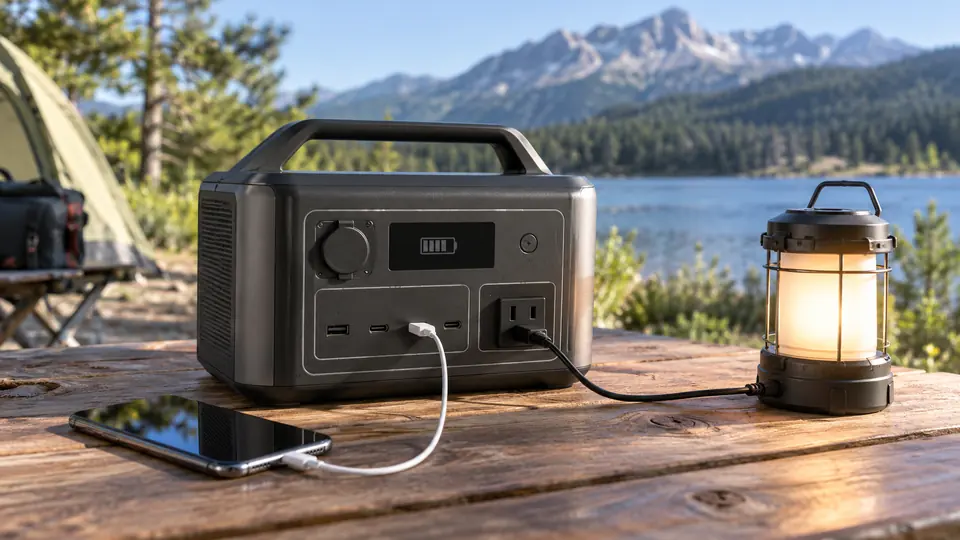
Half a kilowatt-hour is a useful middle ground for a portable battery: more reserve than a pocket-size charging station, without committing to a large home-backup unit. Here, 500Wh class means approximately 450–600Wh of nominal storage. A 500W inverter alone does not qualify a product for this comparison.
Explorer 500 v2 is the balanced starting point for ordinary AC and USB use. EB55 adds continuous AC headroom, Anker 535 offers four receptacles, and RIVER 3 Max uses a removable extra battery to reach this energy class. Their capacities are close, but their ports and carrying arrangements differ.
An idealized 100W load uses 500Wh in five hours. Inverter losses and the station's own consumption shorten actual AC operation, so use that arithmetic to set a budget rather than promise runtime. Waveform and device compatibility matter independently of battery size.
Quick Answer
- Best Overall: Jackery Explorer 500 v2 — 512Wh storage; 500W normal AC output.
- Best for Solar Input Headroom: EcoFlow RIVER 2 Max — 512Wh storage; 500W normal AC output.
- Best for Multiple AC Connections: Anker 535 PowerHouse — 512Wh storage; 500W normal AC output.
- Best for Mixed Small-Device Connections: GRECELL T-500 Portable Power Station — 519.48Wh storage; 500W normal AC output.
Best Portable Power Station 500Wh Comparison Table
| Product | Best For | Capacity | Continuous AC Output | Weight | Solar / Recharge Details |
|---|---|---|---|---|---|
| Jackery Explorer 500 v2 | Best Overall | 512Wh | 500W | 14 lb | Panel sold separately |
| EcoFlow RIVER 2 Max | Best for Solar Input Headroom | 512Wh | 500W | 13.3 lb | Panel sold separately |
| Anker 535 PowerHouse | Best for Multiple AC Connections | 512Wh | 500W | Verify current specification | Panel sold separately |
| BLUETTI EB55 | Best for Higher AC Output in This Class | 537Wh | 700W | 16.5 lb | Panel sold separately |
| ALLWEI PPS600-1 | Best for USB-C Port Choice | 512Wh | 500W | 13 lb | Panel sold separately |
| ROCKPALS Rockpower 500 | Best for Regulated 12V Connections | 505Wh | 500W | Verify current specification | Panel sold separately |
| EcoFlow RIVER 3 Max (RIVER 3 Plus + EB300) | Best Expandable 500Wh-Class Configuration | 572Wh | 600W continuous | Full bundle weight not confirmed | 220W maximum |
| ANTPO 500W Portable Power Station | Best for a 512Wh Multi-Port Layout | 512Wh | 500W | 13.2 lb | AC, solar, car |
| GRECELL T-500 Portable Power Station | Best for Mixed Small-Device Connections | 519.48Wh | 500W | Verify current specification | Verify current specification |
The reviews below compare the nine configurations within the defined capacity band, with continuous output kept separate from stored energy.
1. Jackery Explorer 500 v2 — Best Overall

The Explorer 500 v2 stays close to the half-kilowatt-hour target without turning the comparison into a larger-station shopping guide. Its 512Wh battery and 500W continuous AC output suit a modest electronics-and-appliance kit. The current Amazon identity is the v2, so the older Explorer 500’s 518Wh chemistry and charging specifications should not be transferred to this purchase.
Two pure sine wave AC outlets allow separate adapters to connect without an immediate power strip, although their combined draw must remain inside the station rating. At 14 pounds, this is a vehicle-camping or short-carry battery rather than an ultralight pack item. Jackery advertises a 10ms transfer function; that is a device-dependent backup feature, not proof of uninterrupted operation for every computer or medical appliance.
Pros
- 512Wh base capacity fits the 500Wh class.
- 500W continuous AC rating is identified separately from 1,000W surge.
- Two pure sine wave AC outlets are specified.
- LiFePO4 battery chemistry is identified for the v2.
- The package includes an AC charging cable.
Cons
- 14-pound weight is substantial for long-distance carrying.
- The solar panel is a separate purchase.
This is a balanced 500Wh-class choice for buyers who need AC outlets and a recognizable current model. Select a larger energy class when the load budget exceeds half a kilowatt-hour; the surge rating does not extend battery reserve.
To buy this product, click here.
2. EcoFlow RIVER 2 Max — Best for Solar Input Headroom

RIVER 2 Max pairs a 512Wh battery with a compact 500W continuous-output design. EcoFlow’s larger X-Boost marketing number is an operating-mode claim, not a reason to size an electronic load above the ordinary inverter rating. That distinction keeps it comparable with the other half-kilowatt-hour stations rather than making it look like a much larger power source.
The 220W solar-input ceiling provides useful room for a portable panel when the panel’s voltage, current, and cable match the station. EcoFlow also advertises a one-hour AC refill under its charging conditions. Its 13.3-pound weight is manageable for a vehicle kit, but a trail load should include the panel and charging accessories as well. Neither input rating guarantees the same refill time outdoors.
Pros
- 512Wh battery stays within the defined capacity band.
- 500W normal AC output is the load-sizing reference.
- 220W maximum solar input is specified.
- The LFP cycle claim is 3,000 cycles to 80% remaining capacity.
- AC and car charging cables are identified in the package.
Cons
- X-Boost is not an extra continuous rating for every connected load.
- A solar panel is not included in the station-only package.
RIVER 2 Max is worth comparing for a small solar-supported camp or a portable electronics reserve. Keep the continuous load under the normal output rating and choose the panel as a separate electrical match.
To buy this product, click here.
3. Anker 535 PowerHouse — Best for Multiple AC Connections

Anker 535 keeps 512Wh of nominal storage while providing four AC outlets, making the physical connection layout its main distinction in this group. Several adapters can plug in directly, but the station’s 500W system rating still applies to their combined load. Four receptacles do not supply four independent 500W circuits.
The 60W USB-C PD output can suit a laptop or another compatible device without using its AC charger. Three USB-A ports and a car outlet provide other connection routes. The supplied package includes a 120W adapter and car-charging cable, so buyers can plan those refill methods without treating an optional solar panel as part of the purchase.
Pros
- 512Wh LFP battery is identified.
- 500W AC system rating is specified.
- Four AC outlets accommodate separate device adapters.
- 60W USB-C PD output provides a supported USB charging route.
- A 120W adapter and car-charging cable are included.
Cons
- All AC devices share the 500W system limit.
- The 60W USB-C ceiling may be below a demanding laptop’s requirements.
The 535 is a useful layout for several modest devices sharing one station. It is less appropriate when one AC appliance consumes most of the output rating or a laptop needs a higher-power USB-C profile.
To buy this product, click here.
4. BLUETTI EB55 — Best for Higher AC Output in This Class

EB55 adds AC headroom without leaving the approximately 500Wh energy class. Its 537Wh battery and 700W continuous inverter differ from the 500W designs, while the 1,400W surge specification remains a separate limit. That extra output can be useful for a compatible appliance, but its stored energy is still closer to half a kilowatt-hour than a large home-backup battery.
The US Amazon product identifies four AC outlets, a 100W USB-C output, and a regulated 12V car port. BLUETTI also describes supported combined recharge arrangements; an extra AC adapter should not be assumed included just because dual-AC charging is supported. At 16.5 pounds, EB55 is a heavier carry than several other stations in this capacity group.
Pros
- 537Wh nominal capacity fits the comparison band.
- 700W continuous AC output exceeds the 500W designs here.
- The US package identifies four AC outlets.
- 100W USB-C output is specified.
- A regulated 12V car output supports an appropriate DC connection.
Cons
- 16.5-pound weight is higher than several compact alternatives.
- The solar panel and any extra adapter for a dual-AC setup require a package check.
EB55 fits a buyer who needs more AC headroom but does not want to move into a 1kWh battery. The higher wattage helps define eligible loads; it is not a promise of a longer operating time.
To buy this product, click here.
5. ALLWEI PPS600-1 — Best for USB-C Port Choice

ALLWEI’s PPS600-1 provides a 512Wh LFP battery and 500W AC output, with a 100W USB-C port alongside a separate 36W USB-C connection. That layout can be more useful than another AC socket when the planned devices support those PD profiles. The 1,000W surge figure should stay separate from the steady output limit.
The station-only package identifies an AC power cord and car cable, with a solar panel sold separately. Its published 13-pound weight makes it a short-carry or vehicle-kit option. ALLWEI describes Q, N, and S charging modes and a UPS function; these features need their stated conditions, and the transfer claim is not universal protection for every sensitive load.
Pros
- 512Wh capacity directly fits the target class.
- 500W continuous output and 1,000W surge are distinguished.
- 100W and 36W USB-C ports offer two specified PD ceilings.
- LiFePO4 chemistry is identified.
- The package includes AC and car-charging connections.
Cons
- The station-only ASIN does not include a solar panel.
- Connected AC devices must share the 500W continuous limit.
The two USB-C options make this worth considering for a laptop-centered travel kit. Compare the exact device profiles and the full charging package instead of assuming every USB-C laptop will use 100W.
To buy this product, click here.
6. ROCKPALS Rockpower 500 — Best for Regulated 12V Connections
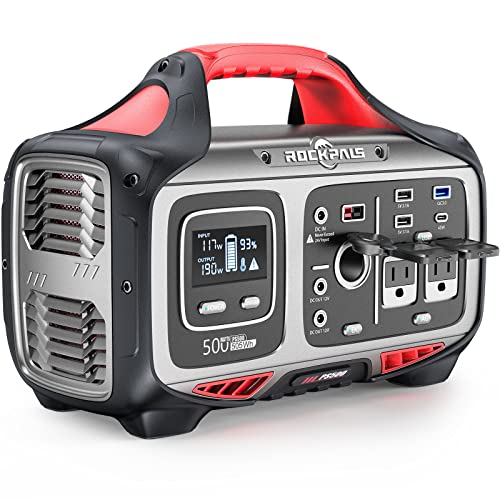
Rockpower 500 is another genuine half-kilowatt-hour design, with 505Wh nominal storage and 500W continuous AC output. Its regulated 12V connections are the relevant distinction for a kit using compatible DC devices. Regulation is useful information, but voltage, current, polarity, and connector matching still have to be completed for the actual equipment.
The product identifies two pure sine wave AC outlets, a 12V/10A car port, DC outlets, and 45W USB-C PD. Those connections make it a mixed AC/DC battery rather than a USB-only power bank. Its 750W maximum figure should not be confused with continuous output, and the seller’s device-runtime examples are not used here as independently measured results.
Pros
- 505Wh nominal capacity is in the comparison band.
- 500W rated AC output is specified.
- Two pure sine wave AC outlets are identified.
- A regulated 12V/10A car port is provided.
- 45W USB-C PD supports an appropriate lower-power USB route.
Cons
- 45W USB-C is below the 60W and 100W options in this group.
- The 750W maximum figure is not its continuous AC limit.
This is a mixed-load alternative when regulated 12V supply and modest AC power matter. A higher-power laptop or appliance may be a better match for another station, even if the nominal Wh figures are close.
To buy this product, click here.
7. EcoFlow RIVER 3 Max (RIVER 3 Plus + EB300) — Best Expandable 500Wh-Class Configuration

RIVER 3 Max pairs a RIVER 3 Plus base with an EB300 battery for 572Wh of nominal storage. The ordinary inverter remains rated at 600W. The additional battery changes the reserve and complete carrying weight, while the under-10ms transfer claim needs checking with the connected equipment.
The extra battery adds another item to carry and charge. Compare the complete configuration with a one-piece 512Wh station, and do not use the base station’s weight as the bundle weight. Its under-10ms transfer claim also needs checking with the connected equipment.
Pros
- 572Wh listed configuration gives a larger energy reserve than compact 200Wh-class stations.
- 600W steady output supports a broad range of office electronics.
- Under-10ms UPS claim is tailored to computers and network equipment.
- App and software controls provide remote monitoring and charging settings.
- Expandable design can suit an office that may need more stored energy later.
Cons
- The product listing uses River 3 Max in the title while describing River 3 Plus features, so buyers should verify the exact package and model before ordering.
- The included configuration and any optional expansion hardware should be confirmed carefully.
Choose this configuration when the removable reserve is more useful than a single compact case.
To buy this product, click here.
8. ANTPO 500W Portable Power Station — Best for a 512Wh Multi-Port Layout

The ANTPO listing describes a 512Wh LFP battery, 500W continuous output, and pure sine wave AC. Its 60W USB-C, QC3.0, and 12V car connections give a half-kilowatt-hour kit several power routes, provided the devices match those ratings.
At a listed 13.2 pounds, it is a short-carry or vehicle option. Confirm the exact current package and charging instructions before ordering; the advertised 200W solar charging arrangement is a separate electrical pairing, and the panel is not included.
Pros
- 512Wh listed LiFePO4 battery fits the requested capacity class closely.
- 500W continuous and 1,000W surge output are clearly identified.
- Pure sine wave AC output is stated in the published specifications.
- Includes 60W USB-C PD, QC3.0, AC, and 12V car outputs.
- Supports AC, solar, and car charging, with a listed 24-month warranty.
Cons
- The 13.2-pound weight is less convenient for long walks than smaller stations.
- The product listing says the solar panel is separate rather than included.
Consider it only after the exact listing, included cables, and device requirements are confirmed.
To buy this product, click here.
9. GRECELL T-500 Portable Power Station — Best for Mixed Small-Device Connections

GRECELL T-500 has 519.48Wh of nominal storage and a 500W continuous pure sine wave AC rating. Its capacity belongs in this comparison, independently of the larger 1,000W peak figure advertised for short demand.
The 60W USB-C PD output is relevant to supported computers and charging devices, with other connections available for a mixed kit. Add every device to the system budget: the listed ability to connect several items does not increase the battery reserve or continuous AC ceiling.
Pros
- 519.48Wh capacity is suitable for a larger electronics load than the compact models.
- 500W continuous AC output is clearly stated.
- Pure sine wave AC outlets are identified in the listing.
- 60W USB-C PD supports compatible higher-demand USB-C devices.
- Offers AC, USB, DC, car, and wireless charging outputs.
Cons
- Weight is not clearly specified in the supplied product information.
- Solar panel is not included, and panel electrical compatibility still requires verification.
Compare it for a modest AC-and-USB kit with appropriate device profiles.
To buy this product, click here.
Buying Guide
Define the Capacity Band
The nine choices range from approximately 500Wh to 572Wh. Wh describes nominal stored energy; W describes the instantaneous output limit. A 288Wh station with a 600W inverter belongs in a different energy comparison.
Budget Energy at the Devices
Add each device's average draw multiplied by its operating time. Conversion losses, idle consumption, and temperature reduce the energy delivered from the nominal battery rating. Leave reserve rather than planning to consume every listed watt-hour.
Choose the Normal AC Rating
Most options here provide 500W continuous AC output; EB55 provides 700W and the RIVER 3 Plus inverter provides 600W. Surge ratings and special boost modes have separate conditions and are not additional continuous power for electronics.
Compare the Connection Layout
Anker 535 provides four AC outlets, while several alternatives emphasize higher-power USB-C. Check the laptop's PD profile and the rating of each DC connection. All connected devices share the station's system limits.
Check the Required AC Waveform
Use the equipment manufacturer's requirements when choosing an AC source. Several reviewed stations explicitly identify pure sine wave output, but that should not be inferred from an outlet or battery size alone. A suitable waveform does not establish every motor's startup compatibility.
Plan the Complete Charging Kit
Check the AC charger, car cable, and any optional panel before buying. Solar requires the correct voltage, current, polarity, and connector; a panel with a suitable wattage alone is insufficient. The listed station-only packages should not be treated as solar kits.
Count Every Piece You Carry
RIVER 3 Max combines a base station with an extra battery. Its complete carrying weight differs from the base-only specification. For a one-piece station, add the charger and any panel to the transport plan as well.
Best Portable Power Station 500Wh FAQ
What counts as a 500Wh-class station here?
Approximately 450–600Wh of nominal battery storage. The listed choices stay in that band; an inverter rated 500W does not determine battery capacity.
Will 500Wh last five hours at 100W?
Five hours is the idealized result before station losses. Real AC runtime will be shorter and depends on the equipment, station settings, temperature, and battery condition.
Which option has more continuous AC headroom?
EB55 lists 700W continuous output. RIVER 3 Plus, the base of RIVER 3 Max, supplies 600W. Most of the other choices list 500W; compare the actual device against the appropriate rating.
Does RIVER 3 Max contain one 572Wh base battery?
The reviewed configuration pairs RIVER 3 Plus with EB300 to reach 572Wh. The additional battery changes capacity and carrying arrangements, not the base inverter's ordinary 600W rating.
Are four AC outlets four separate 500W supplies?
No. Anker 535's four receptacles share the station's 500W AC system limit. Add the input requirements of the devices rather than multiplying the rating by the outlet count.
Can one of these stations power a CPAP?
Only after the exact machine, approved power pathway, heated accessories, and required reserve are checked. No overnight medical-device runtime is established by the nominal Wh figure.
Do these choices include solar panels?
The station-only selections identify panels separately. Verify the precise Amazon package and the input limits before adding a panel; support for solar charging does not establish included hardware.
Is every option LiFePO4?
Several models explicitly identify LFP, but chemistry should be checked for the exact model rather than inferred from the capacity class. Cycle ratings also need their stated remaining-capacity threshold.
Final Verdict
Start with Explorer 500 v2 when a one-piece 512Wh station and 500W AC output cover the kit. EB55 is the higher-output alternative at 700W, while Anker 535 deserves a look when several modest AC adapters need their own sockets.
RIVER 3 Max reaches 572Wh through a two-piece configuration; compare the complete bundle when packing. For every option, check the actual device requirements and included charging equipment. A surge rating or an extra outlet does not increase stored energy.
