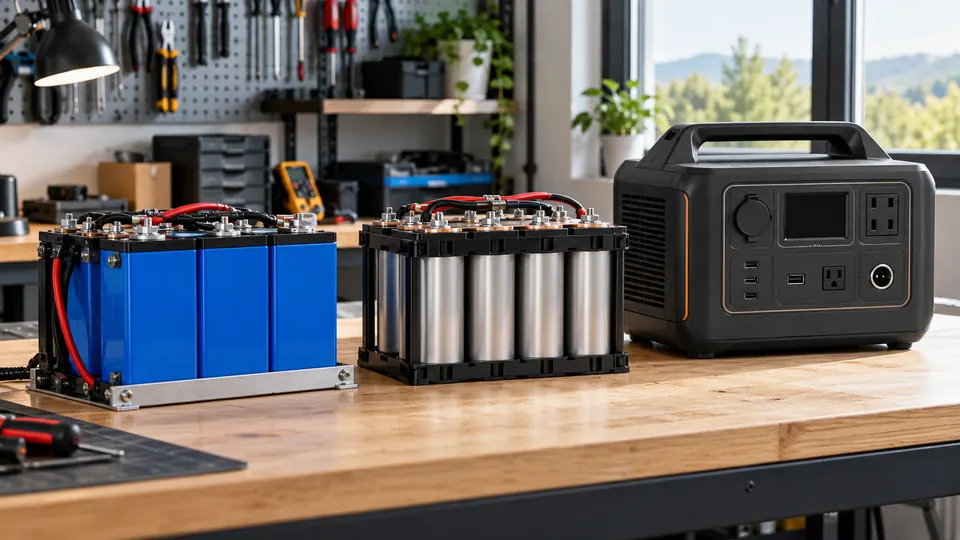
LiFePO4 and other lithium-ion power stations can both provide quiet, portable electricity, but the battery chemistry affects weight, usable capacity, cycle life, temperature behavior, and cost. LiFePO4, also called LFP, is itself a lithium-ion chemistry. In portable power stations, it is commonly compared with nickel manganese cobalt (NMC) lithium-ion cells. LFP often suits frequent cycling, long-term backup, and users who value thermal stability. NMC can offer more energy in a lighter, smaller battery, which may matter for compact camping or mobile setups. The battery label is only one part of the decision. Inverter output, charging limits, warranty terms, operating temperature, and the station’s complete design matter too.
LiFePO4 Is a Type of Lithium-Ion Battery
The phrase “lithium-ion” describes a broad family of rechargeable battery chemistries. LiFePO4 uses lithium iron phosphate as its cathode material. NMC batteries use nickel, manganese, and cobalt in their cathode chemistry.
That distinction matters because chemistry influences several design characteristics:
- Energy density: How much energy the battery stores for its weight and physical size.
- Cycle life: How many charge and discharge cycles the battery can complete before its capacity falls to a specified level.
- Thermal behavior: How the cells respond to heat, heavy loads, charging, and abnormal conditions.
- Operating limits: The temperatures and charge rates supported by the cells and battery management system.
- System cost: The price of the cells, enclosure, battery management system, inverter, charger, and related components.
A power station is a complete electrical system rather than a loose battery pack. Cell chemistry does not determine the station’s AC output, USB capabilities, solar input, transfer behavior, or safety protections by itself.
LiFePO4 vs NMC at a Glance
| Factor | LiFePO4 (LFP) | NMC Lithium-Ion |
|---|---|---|
| Energy density | Usually lower, so the battery may be heavier or larger for the same nominal Wh | Usually higher, which can support a lighter or smaller design |
| Cycle life | Often favorable for frequent cycling, but the exact claim depends on the product and test conditions | Varies by cell, design, depth of discharge, temperature, and charging conditions |
| Thermal characteristics | Generally regarded as more thermally stable than many other lithium-ion chemistries | Requires carefully designed cell controls, sensors, and protection systems |
| Weight and portability | May weigh more at a similar Wh rating | May provide more stored energy for a given weight |
| Cold-weather charging | Still may have strict low-temperature charging limits | Also has temperature-dependent charging limits |
| Best fit | Frequent use, stationary backup, and long service goals | Weight-sensitive applications and compact designs |
This table describes general tendencies, not a guarantee for every station. Cell format, battery size, cooling, firmware, charging strategy, and the manufacturer’s specifications can change the practical result.
Cycle Life and Long-Term Use
Cycle life is one of the strongest reasons many power station buyers choose LFP. Manufacturers often publish a cycle figure tied to a capacity-retention threshold, such as retaining a stated percentage of original capacity after a specified number of cycles. That figure is measured under particular conditions. It does not mean the battery stops functioning immediately after the listed cycle count.
Actual aging involves both cycle aging and calendar aging. Cycle aging results from charging and discharging. Calendar aging occurs with time, including periods when the station is stored and lightly used. High temperatures, deep discharges, high charge rates, and long periods at a very high state of charge can affect battery aging.
LFP is often a strong match for equipment that may be charged and discharged regularly, such as a station used for van travel, work equipment, recurring outages, or solar energy storage. NMC can still provide a long service life when operated within its specifications. A published cycle-life number should be read alongside the retention percentage, test conditions, warranty language, and storage instructions.
Weight, Size, and Stored Energy
For the same nominal capacity in watt-hours, an NMC battery may achieve a lighter or more compact design than an LFP battery. That can help with short trips, small vehicles, or situations where every pound matters.
LFP stations may be physically larger or heavier for a comparable Wh rating. The tradeoff can be worthwhile for users who expect frequent cycling or plan to keep the station as emergency equipment for many years.
Nominal capacity still does not equal delivered energy. A station labeled 1,000Wh does not promise that 1,000Wh will reach an AC appliance. Inverter losses, DC conversion, internal consumption, reserve capacity, temperature, battery age, and load level affect usable energy. Compare both the battery Wh rating and the station’s output specifications.
Thermal Behavior and Safety
LFP chemistry is generally considered more thermally stable than many other lithium-ion chemistries. That characteristic can provide a useful design margin, but it does not make an LFP power station immune to overheating, electrical faults, damage, or misuse.
Safety depends on the full system, including cell construction, wiring, enclosure, fuses, temperature sensors, charger, inverter, and battery management system (BMS). A BMS may monitor conditions and limit charging or output when its programmed thresholds are reached. It does not make bypassing protection safe, and it cannot correct every form of physical damage or misuse.
Use either chemistry according to the manufacturer’s instructions. Keep the station away from moisture, direct heat, blocked vents, and severe temperatures. Stop using a unit that is swollen, leaking, smoking, unusually hot, sparking, or producing a burning smell. Do not open a sealed battery pack or attempt internal repairs.
Cold Weather Requires Special Attention
LFP batteries are sometimes described as suitable for cold weather, but that description can be misleading if it implies unrestricted charging below freezing. Lithium-based batteries can have different temperature limits for charging and discharging. Charging at a temperature below the manufacturer’s permitted range can damage cells.
Some power stations include low-temperature charging protection or a battery heater. Others may require the unit to warm naturally before charging. These features are model-specific. Check the exact station’s manual for:
- Permitted charging temperature
- Permitted discharge temperature
- Low-temperature cutoff behavior
- Whether a battery heater is included
- Whether the temperature rating applies to the battery, solar input, AC charger, or entire station
Do not use an improvised heater or bypass a temperature warning. Cold weather can also reduce available power and charging performance for either chemistry.
Power Output Matters as Much as Chemistry
Battery chemistry affects stored energy, but it does not tell you whether a station can run a particular appliance. Check the station’s continuous AC output, temporary surge rating, outlet voltage, waveform, and protection behavior.
W (watts) measures power. Wh (watt-hours) measures energy. A station with a large Wh rating may still shut down under a high-wattage load if its inverter cannot provide the required continuous or startup power.
For example, an electric heater rated at 1,500W requires roughly 1,500Wh for one hour of operation before system losses, assuming it runs continuously. A 1,000Wh station cannot be expected to provide that full hour simply because its battery capacity is close to 1,000Wh. A refrigerator presents a different challenge because its compressor cycles and may draw a brief startup surge. Running wattage, startup behavior, duty cycle, ambient temperature, and actual daily energy use all matter.
For a roughly steady load, an ideal upper-bound estimate is:
Runtime in hours ≈ nominal battery capacity in Wh ÷ average load in W
If a hypothetical 500Wh station powers a device averaging 50W, the ideal estimate is 10 hours before losses. Actual runtime will be shorter in many setups because the AC inverter or DC conversion system consumes energy. An assumed usable-energy fraction can produce a more realistic estimate, but that fraction must be treated as an assumption rather than a universal efficiency.
Charging, Solar Input, and BMS Features
Neither LFP nor NMC automatically determines how quickly a station charges. Recharge performance depends on the AC charger, solar controller, input limits, temperature, battery state of charge, and charging curve.
Solar compatibility must be checked from the exact specifications. Confirm the station’s supported solar voltage range, maximum open-circuit voltage (Voc), current limit, maximum input wattage, connector, and polarity. A panel connector that fits physically is not proof of electrical compatibility.
The same caution applies to vehicle charging and USB-C. A 12V vehicle socket, USB-C port, or solar input may have specific current, voltage, and protocol limits. Do not assume an LFP station accepts more solar power or charges faster than an NMC station without documentation.
The BMS also differs from one model to another. It may control overcharge, over-discharge, temperature, short-circuit, and current protection, but the available functions and cutoff behavior are product-specific.
Which Chemistry Fits Different Uses?
Frequent Cycling and Home Backup
LFP often fits users who expect regular charge and discharge cycles, such as daily solar use or repeated outage preparation. Its cycle-life potential can reduce the importance of replacing the battery quickly, provided the station is operated and stored within its specifications.
Lightweight Camping and Mobile Work
NMC may be attractive when weight and package size have priority. A compact station can be easier to carry between a vehicle, campsite, work area, or temporary workspace. Check the actual station weight rather than assuming all NMC units are lighter than all LFP units.
Emergency Storage
For a station that may sit for long periods and operate only during occasional outages, chemistry is one factor among several. Storage temperature, state-of-charge guidance, periodic inspection, warranty coverage, and self-discharge behavior deserve equal attention. Follow the exact storage instructions instead of applying a universal charging schedule.
High-Draw Loads
Neither chemistry guarantees that a station can run a heater, microwave, kettle, induction cooker, air conditioner, pump, or power tool. Match the appliance’s continuous and startup requirements to the station’s documented output. A larger inverter and appropriate output design may matter more than the cell chemistry.
What to Check Before Choosing a Power Station
Use the following checklist to compare complete systems rather than battery labels alone:
- Nominal capacity: Compare Wh, not Ah alone. Ah requires a voltage reference to express energy meaningfully.
- Continuous AC output: Confirm that the inverter can support the intended loads.
- Surge capability: Check whether motor-driven devices have startup requirements the station can handle.
- Output type: Verify AC voltage, frequency, waveform, DC voltage, USB-C power delivery, and connector limits.
- Charging inputs: Review AC, solar, vehicle, and USB-C input limits separately.
- Temperature limits: Check charging and discharging ranges, especially for winter use.
- Cycle-life statement: Look for the retention percentage and stated test conditions.
- Warranty terms: Confirm what the warranty covers and whether capacity retention is addressed.
- Storage guidance: Follow the manufacturer’s instructions for temperature, charge level, and inspection.
- Service options: Check whether battery service is available through the manufacturer or an authorized provider.
Frequently Asked Questions
Is LiFePO4 safer than NMC in a power station?
LFP generally has favorable thermal stability characteristics compared with many NMC designs. That does not make every LFP station inherently safe or every NMC station unsafe. Cell quality, BMS functions, charging controls, enclosure design, and proper use are all significant.
Does LiFePO4 always last longer?
No. LFP often has strong cycle-life potential, but the exact result depends on the cells, depth of discharge, temperature, charge rate, storage conditions, and the manufacturer’s test method. NMC service life also varies across products.
Can an LFP power station charge below freezing?
Only when the exact model permits it. Many lithium batteries restrict charging at low temperatures, and some LFP stations include heating or protective cutoff features. Check the manual before charging outdoors in freezing conditions.
Does LFP provide more usable power than NMC?
Cell chemistry alone does not answer that question. Usable output depends on nominal Wh, reserve settings, conversion losses, inverter behavior, temperature, battery age, and load. Compare the complete station specifications.
Should an occasional emergency-use station use LFP?
LFP may be a sensible fit for long-term storage and repeated maintenance cycles, but an occasional-use buyer should also examine storage instructions, warranty coverage, temperature limits, self-consumption, and the station’s output capabilities. Chemistry should support the intended use rather than replace a full system comparison.
For most users, LFP is attractive for repeated cycling, long-term ownership, and favorable thermal characteristics. NMC can make sense where lower weight and a compact design matter more. The practical choice is the complete power station that matches the required Wh, continuous W, surge behavior, charging inputs, temperature limits, and storage needs.
