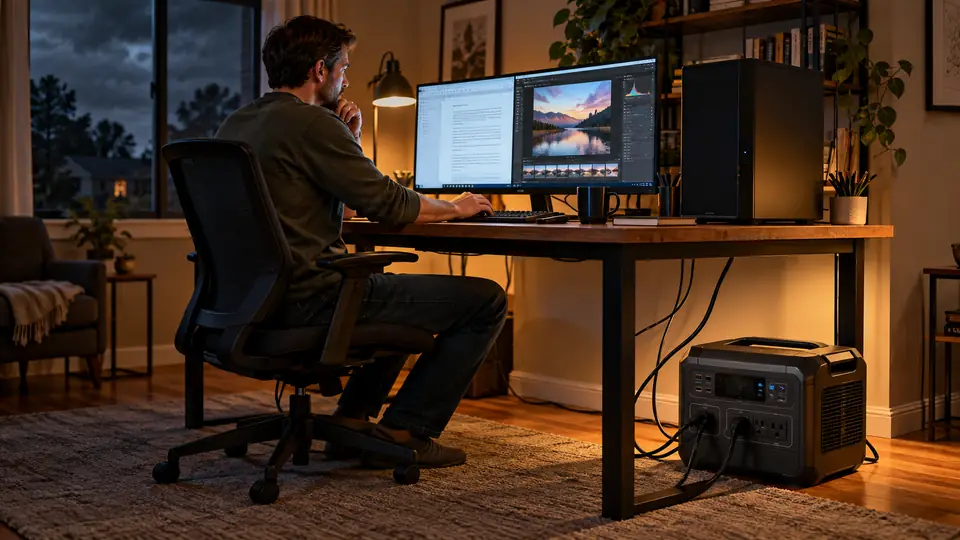
A power station used as a UPS has a more specific job than a battery box for camping. It must keep a router, computer, NAS, security system, or other connected equipment running through a utility interruption, while still offering enough stored energy for the gap that follows. That makes transfer time, output type, capacity, and charging behavior more important than a flashy peak-watt number.
A common mistake is treating every portable power station with an “UPS” label as interchangeable. A 10ms transfer claim does not prove compatibility with every computer or medical device, and nominal watt-hours do not equal the energy available from an AC outlet after inverter losses and idle consumption. Buyers should also check continuous output, port requirements, recharge options, battery chemistry, and whether the unit fits the intended desk, closet, vehicle, or home backup location.
Different buyers need different balances. A home-office user may prioritize fast transfer and app monitoring, while a camper may care more about weight, solar input, and DC ports. For most households seeking a capable UPS-capable portable station, the BLUETTI Elite 100 V2 offers the strongest combination of 1,024Wh capacity, 1,800W continuous output, 10ms UPS switching, rapid AC charging, and manageable 25-pound portability.
Quick Answer
- Best Overall: BLUETTI Elite 100 V2 Portable Power Station for its 1,024Wh capacity, 1,800W output, 10ms UPS, and compact 25-pound design.
- Best for Home Office Capacity: Anker SOLIX S2000 Portable Power Station for its 2,010Wh battery, 1,500W continuous output, and under-10ms switchover.
- Best Compact UPS: BLUETTI Elite 10 Mini Portable Power Station for laptops, routers, cameras, and other smaller electronics at 4 pounds.
- Best for USB-C Devices: UDPOWER S1200 Portable Power Station for its USB-C PD and PPS support with up to 100W combined output.
Best Portable Power Station for UPS Comparison Table
| Product | Best For | Capacity | Continuous AC Output | UPS Transfer | Weight |
|---|---|---|---|---|---|
| BLUETTI Elite 100 V2 | Best overall | 1,024Wh | 1,800W | 10ms | 25 lb |
| EF ECOFLOW DELTA 3 Classic | App-controlled home backup | 1,024Wh | 1,800W | Under 10ms | Not clearly specified |
| Anker SOLIX S2000 | Higher-capacity office backup | 2,010Wh | 1,500W | Under 10ms | 35.7 lb |
| UDPOWER S1200 | USB-C and multi-port setups | 1,191Wh | 1,200W | 10ms | Not clearly specified |
| LIBRIDS C600 | Multi-device UPS use | 640Wh | 600W | 10ms | 16.3 lb |
| BLUETTI Elite 30 V2 | Portable compact backup | 288Wh | 600W | 10ms | 9.4 lb |
| Jackery Explorer 300 | Lightweight electronics backup | 292Wh | 300W | Not clearly specified | 7.5 lb |
| LIBRIDS 640Wh Power Station | Compact UPS with four AC outlets | 640Wh | 600W | 10ms | Not clearly specified |
| BLUETTI Elite 10 Mini | Small desk and travel setups | 128Wh | 200W | 10ms | 3.97 lb |
The reviews below sort out the practical differences between transfer behavior, stored energy, output capacity, portability, and device connectivity.
1. BLUETTI Elite 100 V2 Portable Power Station — Best Overall

The BLUETTI Elite 100 V2 hits the sweet spot for a UPS-focused portable power station. Its 1,024Wh capacity gives a home-office setup substantially more breathing room than a compact 200Wh-class unit, while the 1,800W continuous AC output leaves room for several ordinary electronics and selected higher-draw devices. The published specifications also identify an 10ms UPS switchover, which is the central reason this model ranks first for the keyword.
At 25 pounds, this is still a liftable unit rather than a desk accessory, but the compact 17-liter design and hidden handle make moving it between a closet and office more realistic. The 1,200W TurboBoost AC input is advertised to reach 80% in roughly 45 minutes, and the station supports Wi-Fi and Bluetooth app control. A user protecting a router, monitor, desktop computer, and network storage can check power status from a phone instead of crouching behind a desk to read a screen.
Pros
- 1,024Wh capacity suits longer home-office backup needs.
- 1,800W rated AC output supports a broad range of compatible electronics.
- Published 10ms UPS switchover helps maintain power for compatible devices.
- 25-pound body and compact 17-liter design improve portability for its capacity.
- Wi-Fi and Bluetooth app control provide remote monitoring and power management.
Cons
- The published specifications do not clearly state a guaranteed runtime for any particular UPS load.
- The advertised 45-minute figure applies to reaching 80% charge, not a complete charge.
This is the strongest all-purpose choice for a home office, network corner, or portable emergency setup that needs meaningful capacity without moving into the 35-pound-plus class. Buyers should still verify that their computer, router, NAS, or medical equipment accepts the station’s UPS behavior before relying on it. Those seeking the largest battery should look at the Anker SOLIX S2000, while lighter electronics-only setups can save space with a smaller BLUETTI model.
To buy this product, click here.
2. EF ECOFLOW DELTA 3 Classic Portable Power Station — Best for App-Controlled Backup
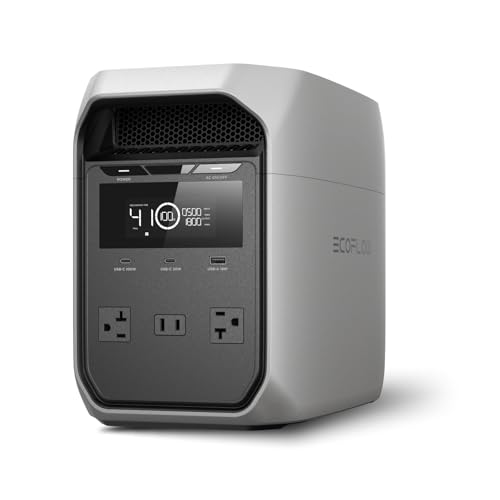
The DELTA 3 Classic brings the same broad 1,024Wh capacity class and 1,800W continuous output as the BLUETTI Elite 100 V2, but its appeal leans toward connected control and flexible household use. The listing specifies an under-10ms UPS function for PCs, servers, and other sensitive electronics, plus an app that can monitor usage, set charging schedules, and activate modes such as Storm Alert and Self-Powered Mode.
For a workstation that stays plugged in day after day, those controls can feel more useful than a bare battery percentage. The unit reaches 80% charge in a stated 45 minutes through X-Stream AC charging, and optional solar input is listed at up to 500W with a claimed 2.5-hour recharge under the supplied conditions. Its 3,600W surge rating and X-Boost feature may help with certain heavier loads, but peak capability should not be confused with continuous output or treated as proof that every motor or appliance will start.
Pros
- 1,024Wh capacity provides substantial stored energy for compatible UPS loads.
- 1,800W continuous AC output supports many home and office devices.
- Under-10ms UPS behavior is specified for compatible sensitive electronics.
- App features include usage monitoring, charging schedules, and backup modes.
- Optional solar charging is listed at up to 500W.
Cons
- The product is incompatible with DELTA 2 Smart Extra Battery and DELTA 3 Series Smart Extra Battery.
- The published specifications do not clearly state the station’s weight.
This model suits buyers who want a substantial UPS station with software controls and a clearly stated solar pathway. It is a particularly sensible match for people who like scheduling and remote monitoring, although the optional-panel setup requires separate electrical compatibility checks. Buyers focused on a known portable weight may prefer the 25-pound BLUETTI Elite 100 V2.
To buy this product, click here.
3. Anker SOLIX S2000 Portable Power Station — Best for Higher-Capacity UPS Backup
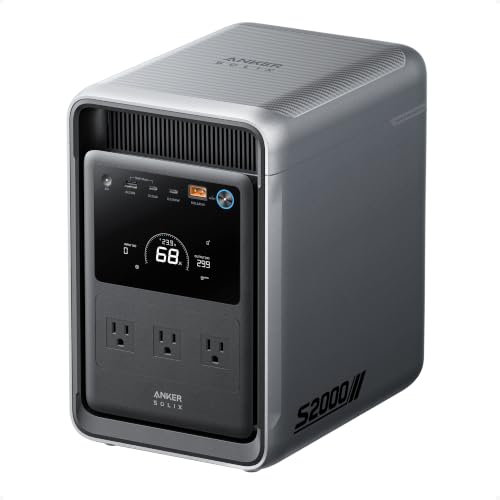
The Anker SOLIX S2000 is the capacity specialist in this group. Its 2,010Wh battery is almost twice the stored energy of the 1,024Wh models, giving a home-office or essential-appliance setup more reserve before a recharge becomes necessary. The listing also specifies 1,500W continuous output, 3,000W peak output, and an under-10ms UPS switchover, creating a strong combination for compatible equipment that needs more staying power.
Anker positions the S2000 for fridge backup and claims up to 35 hours under stated conditions, but actual runtime depends on the refrigerator, cycling pattern, temperature, and other connected loads. The 35.7-pound body is a meaningful trade-off. It is lighter than some large portable stations, yet it is better suited to a chosen office corner, utility area, or vehicle than frequent stairway trips. With up to 400W solar input and six charging methods listed, it can also serve as a larger reserve outside the UPS role.
Pros
- 2,010Wh capacity gives this model the largest energy reserve in the selection.
- 1,500W continuous AC output supports substantial compatible loads.
- Under-10ms UPS switchover is specified for home-office use.
- Up to 400W solar input supports a flexible recharge setup.
- Front and rear outlets can help organize always-on and occasional devices.
Cons
- At 35.7 pounds, it is less convenient to move than smaller UPS stations.
- The product has no 12V DC port, according to the supplied specifications.
The S2000 is a strong pick for buyers who value reserve capacity above easy carrying. It makes sense beside a workstation, refrigerator, or selected essential loads, provided the combined demand stays within its output limits. Those who need a station for a backpack, small desk, or frequent vehicle transfers will find its extra battery capacity harder to justify.
To buy this product, click here.
4. UDPOWER S1200 Portable Power Station — Best for USB-C and Multi-Port Setups

The UDPOWER S1200 takes a practical middle path. Its 1,191Wh capacity is larger than the 1,024Wh class, while the 1,200W pure sine wave AC output leaves a reasonable margin for computers, monitors, routers, and compatible appliances. The headline feature for a modern desk is its port selection: five AC outlets, four USB-A ports, two USB-C ports, two DC outputs, and a car outlet.
The USB-C ports support PD and PPS with up to 100W combined output, which can reduce adapter clutter for compatible laptops, phones, cameras, and accessories. The station also lists up to 800W AC input, up to 400W solar input, and 12V car charging. Its 10ms UPS mode is intended for compatible home-office equipment, though the listing itself advises checking device compatibility before relying on that function.
Pros
- 1,191Wh capacity offers substantial reserve for office and travel equipment.
- 1,200W continuous pure sine wave AC output is clearly specified.
- Two USB-C ports support PD and PPS with up to 100W combined output.
- Fourteen total outputs provide flexible connection options.
- 10ms UPS mode is specified for compatible routers, computers, and electronics.
Cons
- The published specifications do not clearly state the station’s weight.
- UPS suitability still requires checking the requirements of each connected device.
This is a compelling choice for a desk crowded with USB-C equipment, especially if a buyer wants one station to handle laptops, phones, cameras, and AC-powered gear. Its lower continuous output than the 1,800W models matters for high-draw appliances, and the missing weight specification makes portability harder to judge. For electronics-heavy backup, its port mix is unusually useful.
To buy this product, click here.
5. LIBRIDS C600 Portable Power Station — Best for Multiple AC Devices

The LIBRIDS C600 gives buyers a 640Wh station with four AC outlets, eight output ports overall, and a stated 10ms UPS function. That combination fits a modest desk or network shelf where several low-to-medium draw devices need connections at once. The listing identifies pure sine wave AC output and names routers, computers, NAS devices, security systems, and CPAP machines among its intended applications, although any medical-device setup still requires equipment-specific verification.
Its 600W continuous AC output is the boundary to watch. That is suitable for electronics, lights, fans, cameras, laptops, and similar loads within the limit, but it does not belong in the same output class as an 1,800W home-backup station. The 16.3-pound body, metal housing, LCD status display, and four recharge methods make it a practical car, closet, or small-office unit.
Pros
- 640Wh capacity offers more reserve than compact 128Wh and 288Wh stations.
- Four AC outlets and eight total ports support several connected devices.
- 10ms UPS switching is specified for compatible electronics.
- Pure sine wave AC output is identified in the published features.
- 16.3-pound weight and integrated handle support manageable relocation.
Cons
- 600W continuous output limits the range of appliances and high-draw equipment.
- Actual AC runtime will vary with inverter losses, idle draw, and connected load.
The C600 is a good fit for buyers who need more capacity and outlet access than a small travel station provides, without stepping up to a 1,000Wh-class unit. Its output ceiling makes it an electronics and light-duty backup product rather than a broad appliance solution. A buyer with a desktop workstation and several peripherals should calculate the combined load before plugging everything in.
To buy this product, click here.
6. BLUETTI Elite 30 V2 Portable Power Station — Best Lightweight 600W UPS Option

The BLUETTI Elite 30 V2 is a nimble alternative for buyers who need a real UPS function without carrying a 1,000Wh station. It stores 288Wh, delivers 600W continuously, and lists a 10ms UPS switch for compatible laptops, routers, CPAP machines, and similar equipment. At 9.4 pounds, it is easier to move from a home office to a vehicle or a weekend setup than the larger choices above.
The station also lists 1,500W surge capability and a Power Lifting Mode, though surge or lifting figures do not replace the 600W continuous rating. Its charging options include wall, solar, and car charging, with a published claim of 0 to 80% in 45 minutes and full charging in 70 minutes under the listed charging setup. The modest capacity makes it better for short interruptions and lower-power electronics than extended appliance backup.
Pros
- 288Wh capacity keeps the unit compact while offering more than a basic power bank.
- 600W continuous AC output supports a useful range of electronics.
- 10ms UPS switching is specified for compatible devices.
- 9.4-pound weight makes relocation straightforward.
- Wall, solar, and car charging provide several recharge pathways.
Cons
- 288Wh gives less reserve than the 640Wh and 1,000Wh-class stations.
- The published full-charge claim depends on the specified charging setup and should not be treated as a universal result.
This is the right shape of product for a router, laptop, monitor, camera kit, or small electronics station that needs short-duration protection and occasional outdoor use. Buyers protecting several high-draw devices for a long outage should move up to a larger battery. Its balance of 9.4-pound portability and 600W output is the main reason to choose it over a heavier model.
To buy this product, click here.
7. Jackery Explorer 300 Portable Power Station — Best for Lightweight Electronics Backup

The Jackery Explorer 300 is a compact 292Wh station aimed at laptops, cameras, drones, and other modest loads. Its 300W rated output and 600W peak figure place it below the BLUETTI Elite 30 V2 in continuous output, but its 7.5-pound weight makes it attractive for a portable electronics kit. Two AC outlets, a 100W USB-C PD port, two USB-A ports, and a 120W car port cover the basics without turning the unit into a bulky equipment case.
For solar users, the listing describes charging with Jackery panels and gives separate 100W and 40W panel examples with stated 80% charging times. The panel is not included, so the station-only package requires a separate purchase and a compatibility check. The supplied information identifies LiFePO4 chemistry and more than 4,000 cycles before reaching 70% capacity, but it does not clearly state a UPS transfer time.
Pros
- 292Wh capacity suits portable electronics and shorter backup periods.
- 7.5-pound weight is convenient for travel and vehicle storage.
- 100W USB-C PD supports compatible laptop and device charging.
- Two AC outlets, USB ports, and a 120W car port provide varied connections.
- LiFePO4 chemistry and a stated cycle-life claim support repeated use.
Cons
- The published specifications do not clearly state a UPS transfer time.
- The solar panel is not included with the station.
The Explorer 300 makes sense as a lightweight backup source for devices that can tolerate a less specifically documented UPS function, or for buyers who value USB-C PD and easy carrying above maximum output. It is a weaker fit for a desktop computer or network system that must remain continuously powered through an interruption because the transfer behavior is not clearly supplied. Verify the exact backup requirement before using it as a primary UPS.
To buy this product, click here.
8. LIBRIDS 640Wh Portable Power Station — Best Compact Four-Outlet UPS

This LIBRIDS model shares the 640Wh and 600W output class with the C600, while its supplied features emphasize UPS backup, a 10ms transfer, four AC outlets, and a pure sine wave inverter. That makes it a practical option for several routers, laptops, monitors, or small accessories that need an uncomplicated plug-in backup. The LCD displays battery percentage, input power, and output power, which helps a user see whether a connected load is consuming more energy than expected.
The listing identifies a LiFePO4 battery rated for 4,000-plus cycles and an AC full-charge claim of 1.5 hours. It also carries a specific usage boundary: the bottom label says indoor use only, and the supplied description warns against rain, humidity, and precipitation. A dry, well-ventilated location is therefore part of the setup, while the station’s 600W continuous ceiling limits it to modest loads.
Pros
- 640Wh capacity provides useful reserve for smaller UPS systems.
- 600W continuous output is suitable for compatible electronics within the limit.
- Four AC outlets and additional USB ports support multiple devices.
- 10ms UPS and pure sine wave output are specified.
- LCD monitoring shows battery, input, and output information.
Cons
- The supplied safety information says the unit is for indoor use only and must avoid moisture.
- The 600W continuous output is unsuitable for many higher-draw appliances.
This unit is best for a dry office, media shelf, or network area where four AC sockets are useful and the connected devices remain within the output limit. It should not be treated as a weatherproof camping power source, and buyers wanting broad appliance support should move to a higher-output station. Its clear indoor-use limitation is a detail worth planning around before purchase.
To buy this product, click here.
9. BLUETTI Elite 10 Mini Portable Power Station — Best for Small Desk and Travel Setups

The Elite 10 Mini is the smallest station in this roundup, with 128Wh of capacity, a 200W AC outlet, a 100W USB-C output, and multiple DC ports. Its built-in 10ms UPS is aimed at laptops, Wi-Fi routers, security cameras, and gaming setups, so it can serve as a tidy backup for a single small workstation or network device. At 3.97 pounds, it slips into a backpack or sits beside a monitor without the visual and physical bulk of a full-size station.
The unit supports AC, solar, and car charging, with a listed 150W AC input and 100W solar input. Bluetooth control provides power monitoring and lighting adjustments, while the built-in light offers warm, cool, and SOS modes. Its 128Wh capacity falls in the range that may be carried on some major airlines with prior approval, but airline rules and approval requirements must be confirmed before travel.
Pros
- 128Wh capacity is suitable for small electronics and short interruptions.
- 3.97-pound weight is the lightest in this selection.
- 10ms UPS is specified for laptops, routers, security cameras, and gaming setups.
- 100W USB-C output supports compatible fast-charging devices.
- AC, solar, and car charging provide three listed recharge methods.
Cons
- 200W continuous AC output rules out many larger appliances and desktop loads.
- Airline carriage requires prior approval and remains subject to the carrier’s rules.
The Elite 10 Mini is a smart pick for a single router, laptop, camera setup, or compact travel kit where every pound and inch matters. Its tiny battery cannot replace a 640Wh or 1,024Wh UPS for extended outages, and the 200W output requires careful load selection. Buyers who want a personal backup device rather than a household reserve will find its size especially appealing.
To buy this product, click here.
Buying Guide
Match Capacity to the Actual UPS Load
Start by listing the equipment that must remain powered, then add the wattage shown on each device or power adapter. A 1,024Wh station offers a much larger nominal energy reserve than a 128Wh model, but neither number represents guaranteed AC energy at the outlet. Inverter losses, idle consumption, load changes, and battery cutoffs affect what reaches the equipment.
A compact station can be perfectly sensible for one router or laptop. A desktop, monitor, NAS, and networking stack may need a larger reserve, particularly if the goal is to keep working through a lengthy outage rather than shut down neatly after a short interruption.
Separate Continuous Output from Surge Output
Continuous AC output is the number to use for the combined ongoing load. Surge or peak output describes a temporary allowance under stated conditions. A station with a 3,000W peak rating is not a 3,000W continuous power source, and a larger peak figure does not guarantee that every compressor, motor, or appliance will start successfully.
Keep the total connected load below the station’s continuous rating. Leave practical headroom for devices that change demand, particularly equipment with startup behavior or power adapters that draw more under heavy use.
Read the UPS Claim Carefully
A published 10ms or under-10ms transfer figure is useful evidence, but it is not a universal compatibility guarantee. Computers, servers, routers, storage devices, and medical equipment can respond differently to a transfer between utility power and battery power. The complete device and power-adapter requirements should be checked before relying on any station for critical operation.
UPS mode also differs from ordinary pass-through charging and from a basic emergency power supply claim. Look for a stated transfer function and time. Do not assume that a station will provide zero interruption for every connected load.
Check Charging Paths, Not Just Charging Claims
AC charging input, solar input, and car charging are separate specifications. A station may accept a high AC input while allowing a different maximum through its solar connector. A claim such as “80% in 45 minutes” describes a particular charging point and setup, not necessarily a full charge or a universal result.
For solar charging, verify the panel’s voltage, current, wattage, connector, and the station’s permitted input range. A connector that physically fits does not prove electrical compatibility, and a panel’s rated wattage does not guarantee that much power in actual sunlight.
Choose Ports by Device Type
AC outlets are useful for standard power adapters, while DC and USB ports can reduce conversion steps for compatible equipment. A USB-C connector alone does not prove a particular Power Delivery profile. The UDPOWER S1200 specifically lists USB-C PD and PPS with up to 100W combined output, while other models provide USB-C without the same supplied protocol detail.
Likewise, a 12V car-style outlet is not universal proof that every 12V device will work. Check voltage, current, polarity, cable type, and the device manufacturer’s requirements before using a DC connection.
Balance Portability Against Reserve
Weight changes the way a station gets used. The 3.97-pound BLUETTI Elite 10 Mini can stay near a desk or travel in a bag, while the 35.7-pound Anker SOLIX S2000 is better assigned to a fixed location or moved less often. The middle options offer different compromises, from the 9.4-pound Elite 30 V2 to the 25-pound Elite 100 V2.
Think about stairs, storage shelves, vehicle loading, and cable reach. A larger station that remains accessible may be more useful than a higher-capacity model that is awkward to relocate.
Plan for Safe Placement
Follow the supplied usage instructions and keep the station in a dry, ventilated location appropriate to its documentation. The LIBRIDS 640Wh model specifically carries an indoor-use warning and should be protected from rain, humidity, and precipitation. A portable battery station should never be connected to a home wall outlet to energize household wiring, and these products should not be treated as replacements for a professionally installed transfer-switch system.
Best Portable Power Station for UPS FAQ
What makes a portable power station suitable for UPS use?
Look for a clearly stated UPS or transfer function, a quoted transfer time, adequate continuous AC output, and enough capacity for the connected equipment. A station with a UPS label still needs device-specific verification, particularly for computers, servers, network storage, and medical equipment.
Is a 10ms UPS transfer time fast enough for every computer?
No universal guarantee applies. A 10ms specification indicates the stated transfer behavior of the station, but computer power supplies and other electronics can respond differently. Test the complete setup if the equipment is important, and maintain a normal shutdown plan for longer outages.
How much capacity is needed for a home office?
That depends on the combined load and the desired backup period. A router and laptop may fit a compact 128Wh or 288Wh station, while a desktop, monitor, NAS, and networking equipment may justify a 640Wh, 1,024Wh, or larger model. Nominal Wh should be treated as a battery rating rather than guaranteed AC runtime.
Can a UPS power a CPAP machine?
Several listings mention CPAP use, including the BLUETTI Elite 30 V2 and the LIBRIDS models, but that does not establish guaranteed medical-device compatibility or overnight runtime. Check the CPAP’s voltage, adapter, humidifier, heated hose, and uninterrupted-power requirements against the station documentation before relying on it.
Is pure sine wave output necessary for a portable UPS?
Pure sine wave output can be relevant for sensitive electronics, but the supplied information should explicitly identify it. The LIBRIDS C600, LIBRIDS 640Wh model, and UDPOWER S1200 list pure sine wave output. Do not infer waveform quality from the brand, price, battery chemistry, or UPS label alone.
Can a portable power station run a refrigerator during an outage?
It depends on the refrigerator’s running demand, startup demand, cycling pattern, and the station’s continuous and peak limits. The Anker SOLIX S2000 listing discusses refrigerator backup, but its stated runtime depends on the refrigerator model, usage, and ambient temperature. A peak-watt number by itself does not prove compressor compatibility.
Can I connect a portable power station to my home wiring?
Do not connect a station to a wall outlet to backfeed household wiring. Portable stations are intended for compatible devices plugged directly into their outlets or ports unless a properly designed, approved installation says otherwise. Whole-home integration requires suitable equipment and qualified electrical guidance.
Does a solar input make a station a complete solar-generator kit?
No. A solar-chargeable station may require a separately purchased panel, cable, or adapter. The Jackery Explorer 300 listing specifically says its solar panel is not included, while the other supplied station records describe solar input without establishing that a panel comes in the package. Verify every included component and electrical rating before buying.
Final Verdict
The BLUETTI Elite 100 V2 is the strongest overall choice for a portable power station used as a UPS. Its 1,024Wh capacity, 1,800W continuous output, stated 10ms switchover, 25-pound weight, fast AC input, and app connectivity create a well-balanced package for home-office and general electronics backup. It has enough output for a wider range of equipment than the compact stations without taking on the 35.7-pound burden of the Anker SOLIX S2000.
Choose the Anker SOLIX S2000 if longer reserve matters most, the EF ECOFLOW DELTA 3 Classic if app-based control and solar flexibility are priorities, or the UDPOWER S1200 if USB-C PD and PPS ports simplify your setup. The BLUETTI Elite 30 V2, Jackery Explorer 300, and BLUETTI Elite 10 Mini suit progressively lighter electronics loads, while the two LIBRIDS options offer useful four-outlet UPS configurations. Before purchase, total the actual device load, verify UPS compatibility, inspect solar-input requirements, and select a capacity that fits the way the station will be stored and moved.
