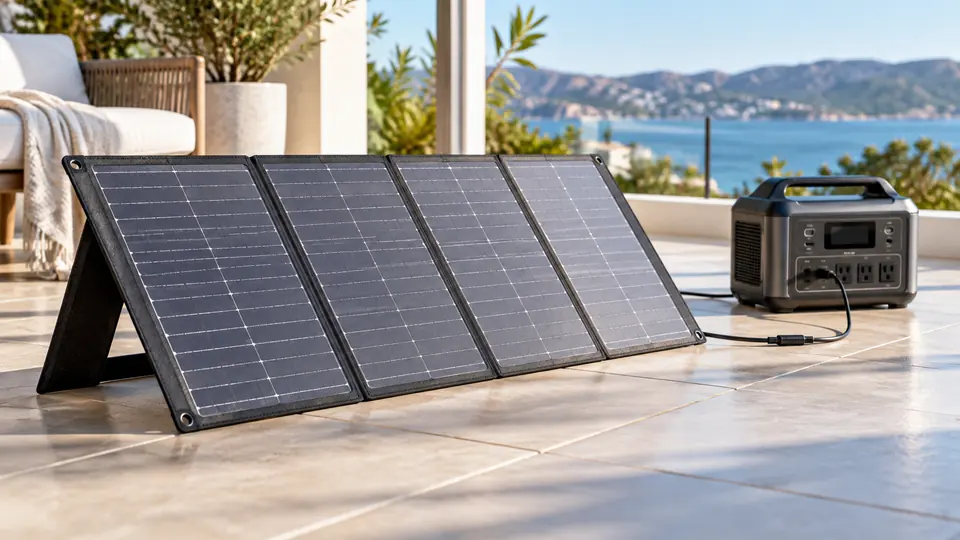
A portable solar panel can turn a power station from a one-time battery into a recharge system you can carry to a campsite, RV, van, boat, or emergency kit. The challenge is matching panel output to the station’s solar input. A 400W panel may sound like the obvious choice, yet its voltage can exceed what a small power station accepts. A compact 100W panel may be easier to position and transport, while a complete station-and-panel kit may suit someone starting from scratch.
Common mistakes include treating connector shape as proof of compatibility, assuming a panel will produce its rated wattage in every condition, and overlooking the cable included in the package. Weight, folded dimensions, kickstand design, weather rating, rated voltage, output connectors, and the receiving station’s maximum solar input all matter. Different buyers will prioritize different details. An RV owner may need higher wattage, while a hiker may prefer a smaller foldable panel with direct USB charging.
The ZOUPW 100W panel is the strongest all-around choice in this group because it combines a foldable format, a five-connector cable, direct USB charging, IP67 protection, and a useful 100W rating. Buyers who need more solar capacity should look at the 200W and 400W options, but they must verify voltage and current limits before connecting anything.
Quick Answer
- Best Overall: ZOUPW 100W Portable Solar Panel for its connector coverage, direct charging ports, foldable design, and IP67 rating.
- Best for Higher Solar Capacity: Renogy 200W Portable Solar Panel with 200W rated output, USB-C PD, and adjustable positioning.
- Best for Large Power Stations: CTOLITY 400W Portable Solar Panel for its 400W rating and 36V design.
- Best Complete Kit: ZeroKor 300W Power Station With 60W Panel for buyers who need a station and panel together.
Best Portable Solar Panel for Power Station Comparison Table
| Product | Best For | Rated Power | Key Connection Details | Weight or Size |
|---|---|---|---|---|
| ZOUPW 100W Portable Solar Panel | Broad station compatibility | 100W | Five-in-one cable, USB-C and USB-A | 9.48 lb; folds to 24.13 × 21.06 × 1.77 in |
| Renogy 200W Portable Solar Panel | Higher-output portable setups | 200W | MC4 output; adapter sold separately | 13.89 lb; folds to 23.72 × 22.99 × 1.97 in |
| CTOLITY 400W Portable Solar Panel | Large compatible power stations | 400W | MC4, DC, XT60, and Anderson cables | Not clearly specified |
| TWELSEAVAN 400W Portable Solar Panel | High-output setups needing adapters | 400W | MC4 converter, three DC adapters | 22.7 lb; folds to 26 × 35.5 in |
| MHPOWOS 110W Portable Solar Panel | Compact 100W-class charging | 110W | Anderson, XT60, DC7909, and DC5521 | 4.5 kg; folds to 23.46 × 21.25 × 1.57 in |
| CTOLITY 100W Portable Solar Panel | Simple foldable charging | 100W | XT60 output; 19.8V listed | Not clearly specified |
| ZeroKor 300W Power Station With 60W Panel | Complete starter kit | 60W panel | DC5521 solar input; USB outputs on panel | Not clearly specified |
| MARBERO 111Wh Solar Generator Kit | Small electronics kits | 30W panel | Included panel and station | Station 2.3 lb; panel 1.8 lb |
| Jackery Explorer 300 | Station buyers adding a panel | Panel not included | Pairs with Jackery panels according to listing | 7.5 lb station |
The detailed reviews below separate panel-only options from complete kits and explain the electrical checks that matter before purchase.
1. ZOUPW 100W Portable Solar Panel for Power Station — Best Overall

The ZOUPW 100W panel is the easiest option here to recommend for buyers who own a power station but are unsure which cable they need. Its supplied five-in-one cable includes DC8020, XT60, Anderson, DC7909 or 8mm, and DC5521 connectors. The listing names compatibility with selected Jackery, EcoFlow, Anker, and Bluetti models, although the receiving station’s electrical limits still need to be checked. That cable spread can save a frustrating adapter hunt beside the car or tent.
The foldable panel uses monocrystalline cells, two adjustable kickstands, and an IP67-rated ETFE-coated panel. It also has a USB-C port and two USB-A ports for direct device charging, so a phone, GPS, or camera can be powered without routing everything through the station. The 100W rating will not guarantee 100W in changing sunlight, and a station limited to 60W will still draw only up to its own limit, but the package is unusually flexible for this category.
Pros
- 100W rated portable solar panel.
- Five-in-one cable covers several common connector types.
- USB-C and USB-A ports support direct device charging.
- IP67 ETFE panel construction is specified.
- Folds to 24.13 × 21.06 × 1.77 inches and weighs 9.48 pounds.
Cons
- Exact electrical compatibility must still be checked for each power station.
- The station’s input limit may prevent it from using the full 100W rating.
This is the best fit for campers, RV owners, and emergency-kit buyers who value connector flexibility over the highest possible panel output. A buyer with a large station that accepts 200W or more should look at the Renogy or 400W alternatives instead. For ordinary 100W-class charging, the cable selection and direct USB ports make this a particularly practical package.
To buy this product, click here.
2. Renogy 200W Portable Solar Panel for Power Stations — Best for Higher Solar Capacity

For a power station built to accept more solar input, the Renogy 200W panel brings a substantial step up from the 100W choices. The listing specifies 16BB N-Type cells and a claimed 25% efficiency, along with a foldable body weighing 13.89 pounds. Four kickstands offer 40, 50, and 60-degree positions, which gives buyers more control than a panel that simply lies flat on the ground.
This model also includes USB-C PD rated at 45W and two USB-A ports, useful when a phone or tablet needs a direct top-up. Its main output is MC4 only, and the listing says the four-in-one adapter is sold separately. That detail changes the buying decision. The panel may be a strong fit for supported stations such as the listed Jackery Explorer 1000 v2, EcoFlow DELTA 3, DELTA 3 Max, RIVER 3 Max, and Anker SOLIX S2000, but connector and electrical specifications should be confirmed for the exact model.
Pros
- 200W rated solar output.
- 25% efficiency is claimed for its N-Type cells.
- USB-C PD output is rated at 45W.
- Four kickstands provide three listed angle positions.
- Magnetic closure and a 13.89-pound weight support portable storage.
Cons
- MC4 is the listed panel output and the four-in-one adapter is separate.
- Its larger output is useful only with a station that accepts the relevant input.
The Renogy suits RV, vehicle-camping, and blackout-backup setups where 100W feels restrictive and the station has a suitable solar input. It is less convenient for someone who wants a cable-rich kit straight from the box. Verify voltage, current, connector, and maximum solar wattage before ordering.
To buy this product, click here.
3. CTOLITY 400W Portable Solar Panel for Power Station — Best for Large Power Stations

The CTOLITY 400W panel is aimed at a different kind of setup from a small weekend charging kit. Its listed 400W rating and 36V design make it relevant to larger portable power stations that accept higher solar input. The panel uses monocrystalline cells with a claimed 23.4% conversion efficiency, while ETFE lamination is listed as part of the construction. Buyers should treat those as published specifications rather than guaranteed output in real sunlight.
Connection flexibility is a strong point. The package is described with MC4 connectors plus DC, XT60, and Anderson cables, and it includes QC3.0 USB outputs. Adjustable kickstands make ground positioning easier, especially beside an RV or vehicle where a smaller panel might require several units. The missing weight and detailed voltage-window information are meaningful gaps, so this panel deserves a careful electrical match before purchase.
Pros
- 400W rated solar output.
- 36V design is aimed at compatible higher-input stations.
- MC4, DC, XT60, and Anderson connection options are listed.
- QC3.0 USB outputs are included.
- Foldable ETFE construction and adjustable kickstands support portable use.
Cons
- Weight is not clearly specified in the supplied information.
- Small power stations may not accept its listed voltage or full wattage.
This panel makes sense for an RV or basecamp setup with a power station explicitly rated for its electrical output. It is too much panel for a small station unless the manufacturer confirms compatibility. Buyers who want a similar rating with a stated weight and adapter package should compare the TWELSEAVAN model.
To buy this product, click here.
4. TWELSEAVAN 400W Portable Solar Panel for Power Station — Best for Adapter Coverage

TWELSEAVAN gives high-input power station owners another 400W option, with a more clearly documented portable package. The panel weighs 22.7 pounds and folds to 26 by 35.5 inches. Four adjustable kickstands and a magnetic handle make the setup process more manageable, though this remains a substantial panel for one person to move compared with 100W models.
The included five-in-one MC4 cable converts to Anderson, XT60, 8020, 7909, and 5521 connections, and three DC adapters are also listed. That is helpful for mixed equipment, but the supplied open-circuit voltage of 46.9V is the detail that deserves the most attention. The listing specifically warns that the panel is unsuitable for small power stations unless their maximum supported voltage is higher than 46.9V.
Pros
- 400W rated output with a claimed 24% conversion efficiency.
- 22.7-pound weight is specified.
- Five-in-one MC4 cable and three DC adapters are included.
- Four adjustable kickstands and a magnetic handle support setup.
- IP65 rating and ETFE lamination are listed.
Cons
- The listed 46.9V open-circuit voltage rules out some small stations.
- At 22.7 pounds, it is less convenient for backpack-style carrying.
This is a strong candidate for larger stations, RVs, and vehicle-based systems where high solar input matters more than minimal carry weight. It should be skipped by buyers who have not checked maximum PV voltage. A connector adapter cannot solve an electrical limit, so the station manual needs to come first.
To buy this product, click here.
5. MHPOWOS 110W Portable Solar Panel — Best 100W-Class Alternative

The MHPOWOS panel occupies a useful middle spot for shoppers who want a little more rated output than a basic 100W model without moving to a 200W or 400W panel. Its monocrystalline construction is listed at 23.5% efficiency, with a 20V panel specification. The foldable body weighs 4.5 kilograms and includes two kickstands, making it practical for a vehicle trunk, RV storage compartment, or organized camping kit.
The supplied cable supports Anderson, XT60, DC7909, and DC5521 connections, which covers several common station inputs. The listing also provides an important warning: a power station with a lower maximum input limit will not use the panel’s full 110W rating. IP67 protection is listed for the panel, but the receiving station and cable connections still need their own weather precautions.
Pros
- 110W rated output provides a modest step above 100W panels.
- 23.5% monocrystalline efficiency is claimed.
- Anderson, XT60, DC7909, and DC5521 connections are included.
- IP67 protection is listed for the panel.
- Folded dimensions are 23.46 × 21.25 × 1.57 inches.
Cons
- The 4.5-kilogram weight is higher than some compact 100W panels.
- Power station input limits may reduce the usable charging rate.
This panel fits buyers who want simple positioning and broad connector coverage at a modest size. It is a sensible choice for small and mid-size stations that accept roughly 100W, provided the 20V specification matches the station’s solar input window. Buyers wanting direct USB-C charging should look at the ZOUPW instead.
To buy this product, click here.
6. CTOLITY 100W Portable Solar Panel — Best for Simple XT60 Setups

The CTOLITY 100W panel keeps the design familiar and straightforward. It lists 19.8V and 100W output, an XT60 connection, adjustable kickstands, and a bifold format that can be carried like a small briefcase. Reinforced loops add another placement option for tents or RVs, although the correct attachment method and the receiving station’s cable arrangement still need to be confirmed.
The panel uses monocrystalline cells with a claimed 23.7% efficiency and ETFE lamination. The listing also describes a built-in smart IC for reverse-charge, overcharge, and overload protection. Buyers with a compatible station can connect two panels in series or parallel according to the listing, but the station’s voltage and current limits must be checked before attempting any array arrangement.
Pros
- 100W rated output at a listed 19.8V.
- XT60 output suits compatible power stations.
- Foldable bifold design includes adjustable kickstands.
- ETFE lamination and IP65 protection are listed.
- Series and parallel expansion is described by the listing.
Cons
- XT60 is less connector-flexible than the ZOUPW’s five-in-one package.
- Panel weight and folded dimensions are not clearly specified.
This panel is best for buyers who already know their station uses XT60 and want a focused 100W charging option. It is less attractive for a first-time buyer who needs adapters or direct device charging. The compact design is appealing, but electrical matching matters more than the nominal wattage.
To buy this product, click here.
7. ZeroKor 300W Portable Power Station With 60W Solar Panel — Best Complete Starter Kit

This ZeroKor listing is a complete solar-generator kit rather than a panel-only purchase. It includes a 300W portable power station, a 60W foldable monocrystalline panel, an AC adapter, a car-charging cable, and a cigarette-lighter adapter. That makes it relevant for someone starting with no station at all, although the 60W panel is a smaller charging source than the dedicated 100W, 200W, and 400W choices above.
The station provides two AC outlets rated at 300W maximum, a DC port, three standard USB ports, a quick-charge USB port, and a flashlight with reading and SOS modes. The panel includes USB-A, USB-C, and an 18V DC interface listed at 60W maximum. The panel junction box is not waterproof, so outdoor use requires careful placement and dry protection rather than treating the complete kit as weatherproof.
Pros
- Includes a 300W portable power station and 60W solar panel.
- Multiple AC, DC, USB, and quick-charge outputs are listed.
- Solar, AC, and 12V car charging pathways are included.
- The panel offers USB-A, USB-C, and DC outputs.
- Built-in protection features and an automatic cooling fan are described.
Cons
- The panel junction box is specifically identified as not waterproof.
- Loads above 300W can damage or disable the station.
This kit suits casual camping and small-electronics use where a panel and station are needed together. It is a poor match for buyers who already own a station and simply need a higher-output panel. The package is convenient, but its 60W solar input source and 300W output ceiling keep it in the starter category.
To buy this product, click here.
8. MARBERO 111Wh Solar Generator With 30W Panel — Best Lightweight Kit

The MARBERO package is built around portability rather than high solar throughput. It includes a 111Wh power station and a 30W foldable panel. The station weighs 2.3 pounds and the panel weighs 1.8 pounds, so the combined kit is easier to carry than the larger panel-only choices. The listed folded panel dimensions are 8.3 by 12 by 1.18 inches, giving it a small storage footprint for day trips and compact emergency kits.
Despite its small size, the station offers four USB-A ports, one USB-C port, two AC ports rated at 80W with a 120W peak, and a DC port rated up to 120W. The package also includes a power adapter and cigarette-lighter output. The panel’s claimed conversion range is 21.5% to 23.5%, but its 30W rating means it is aimed at phones, lights, cameras, and other modest loads rather than fast replenishment of a larger power station.
Pros
- Includes a 111Wh station and 30W foldable panel.
- Station weight is listed at 2.3 pounds.
- Panel weight is listed at 1.8 pounds.
- Four USB-A, one USB-C, two AC, and one DC output are included.
- Compact folded panel dimensions suit small storage spaces.
Cons
- The 30W panel is limited for larger power stations or heavier charging needs.
- AC output is rated at 80W continuous with a 120W peak, limiting appliance choices.
This is a good fit for a lightweight electronics kit where low carrying weight matters more than rapid solar charging. It should not be confused with a 100W-class panel for RV or large-station use. Buyers who need a complete kit but expect laptops, lights, and phones rather than high-draw appliances will find the scale more appropriate.
To buy this product, click here.
9. Jackery Explorer 300 Portable Power Station — Best Station to Pair With a Panel

The Jackery Explorer 300 is included as a station-only alternative for buyers who need the receiving unit as well as a portable solar panel. Its listed 292Wh capacity, 300W rated output, and 600W peak output place it above the smallest kits in this group. The station weighs 7.5 pounds and includes an integrated handle, two AC outlets, a 100W USB-C PD port, two USB-A ports, and a 120W car port.
The package does not include a solar panel, so the buyer must add one separately and confirm that the selected panel matches the station’s input requirements. The listing says it pairs with Jackery panels and describes reaching 80% capacity in approximately 2.8 hours with a 100W panel, but that is a manufacturer-stated charging claim, not a guarantee for every panel or condition. The listing also identifies LiFePO4 chemistry and more than 4,000 cycles before reaching 70% capacity.
Pros
- 292Wh capacity is listed.
- 300W rated AC output and 600W peak output are specified.
- 100W USB-C PD port is included.
- Two AC outlets, two USB-A ports, and a 120W car port are provided.
- 7.5-pound weight and integrated handle support portable use.
Cons
- A solar panel is not included in the package.
- Panel compatibility and charging performance require separate verification.
This station suits a buyer who wants a known capacity and output platform before selecting a separate panel. It is not the right choice for someone searching for a panel-only purchase. Pairing decisions should be based on the Explorer 300’s published solar input requirements, not simply a connector that happens to fit.
To buy this product, click here.
Buying Guide
Match Panel Voltage and Current Before Wattage
Rated watts are only one part of a solar-panel match. The panel’s voltage and current must stay within the power station’s solar input window. A connector such as XT60, MC4, Anderson, or DC5521 confirms physical shape only. It does not prove that the station can safely accept the panel. The TWELSEAVAN listing gives a useful warning by identifying a 46.9V open-circuit voltage and excluding small stations that cannot support it.
Understand Rated Solar Output
A 100W, 200W, or 400W label describes the panel’s rated output under specified conditions. It does not promise that much power in every position, season, or cloud condition. A station with a 60W maximum solar input will also limit what it draws from a 100W panel. That is why a 110W panel may still be useful with a station that accepts more than 100W, while a 400W panel may be excessive for a small unit.
Choose the Right Physical Format
Weight and folded dimensions become obvious after a few trips to the car. The ZOUPW weighs 9.48 pounds, the Renogy weighs 13.89 pounds, and the TWELSEAVAN weighs 22.7 pounds. Those differences matter for RV storage and vehicle camping, while the MARBERO kit’s 1.8-pound panel is better suited to lightweight electronics. Kickstands, handles, magnetic closures, and reinforced loops can also affect how quickly a panel goes from storage to charging position.
Check Cable and Adapter Inclusions
A panel with a broad adapter set may save a second purchase, but the adapter does not remove the need for electrical verification. The ZOUPW includes five connector types, the MHPOWOS package lists four, and the TWELSEAVAN includes a five-in-one MC4 cable plus three DC adapters. The Renogy uses MC4 output and lists its four-in-one adapter as separate, so the package contents should be compared with the station’s actual input port.
Separate Direct Device Charging From Station Charging
Some panels include their own USB ports, allowing phones, cameras, GPS units, or tablets to charge directly. The ZOUPW lists USB-C PD and USB-A outputs, while the Renogy lists 45W USB-C PD and dual USB-A ports. Direct charging can be convenient, but it does not make the panel a replacement for a power station. Check the individual port ratings and protect junction boxes and cable connections from conditions outside their stated rating.
Treat Weather Ratings Carefully
IP65 and IP67 ratings should be preserved as listed and should not be treated as proof that every cable, controller, pouch, or connected power station is waterproof. The ZOUPW, MHPOWOS, and TWELSEAVAN listings identify ratings for their panels, while the ZeroKor listing specifically says its panel junction box is not waterproof. Keep connections elevated or covered where the instructions require it, and disconnect the system before changing wiring.
Best Portable Solar Panel for Power Station FAQ
What size solar panel should I use with a portable power station?
Use a panel whose voltage, current, connector, and rated wattage fit the station’s published solar-input limits. A 100W panel is a common starting point for smaller stations, while 200W or 400W panels require a station built to accept that input. The largest panel is not automatically the best match.
Can I connect a 400W panel to any power station?
No. A 400W panel may exceed the station’s maximum solar wattage, voltage, or current. The TWELSEAVAN panel, for example, lists a 46.9V open-circuit voltage and warns against use with small stations that cannot support it. Check the station’s complete solar-input specifications first.
Does a 100W solar panel always produce 100W?
No. The 100W figure is a rated maximum under specified conditions. Sun angle, clouds, shading, temperature, cable losses, and the receiving station’s input limit can reduce actual charging power. A station capped at 60W cannot draw the full rated output of a 100W panel.
Are MC4, XT60, and Anderson connectors interchangeable?
They are different connector types and may require the correct cable or adapter. A physical connection still does not prove electrical compatibility. Verify voltage, current, polarity, and the station’s input limits before connecting a panel.
Is a foldable solar panel better than a rigid panel?
A foldable panel is generally easier to store and carry, which helps with camping, RV travel, and emergency kits. Rigid panels may suit permanent installations better, but the supplied products in this roundup are portable foldable models. Compare folded dimensions, weight, handles, kickstands, and cable storage.
Can I charge devices directly from a solar panel?
Some panels include USB outputs for direct charging. The ZOUPW lists USB-C and USB-A ports, and the Renogy lists a 45W USB-C PD port plus two USB-A ports. Check each port’s stated rating and use a power station for devices that require a regulated or continuous supply.
Should I buy a panel-only product or a solar-generator kit?
Buy a panel-only product if you already own a compatible power station. A complete kit such as the ZeroKor or MARBERO package is more convenient for a first purchase, but its included panel may have a lower rating than a dedicated 100W, 200W, or 400W panel. Compare the station output, battery capacity, included cables, and panel rating together.
Final Verdict
The ZOUPW 100W Portable Solar Panel is the strongest overall choice for this roundup because it balances a useful 100W rating with a five-in-one cable, direct USB charging, adjustable kickstands, a foldable format, and an IP67 panel rating. Those details make it easier to integrate into a range of camping, RV, and emergency charging setups. Compatibility still depends on the receiving station’s voltage, current, connector, and maximum solar-input specifications.
The Renogy 200W is the better direction for a station that accepts higher solar input, while the CTOLITY and TWELSEAVAN 400W panels suit larger systems that can handle their electrical demands. MHPOWOS is a practical 110W-class alternative, and CTOLITY’s 100W model fits a known XT60 setup. Buyers starting from zero can look at the ZeroKor or MARBERO kits, while the Jackery Explorer 300 provides a station platform without a panel. Match the panel to the station first, then compare weight, cable coverage, weather rating, and storage size.
