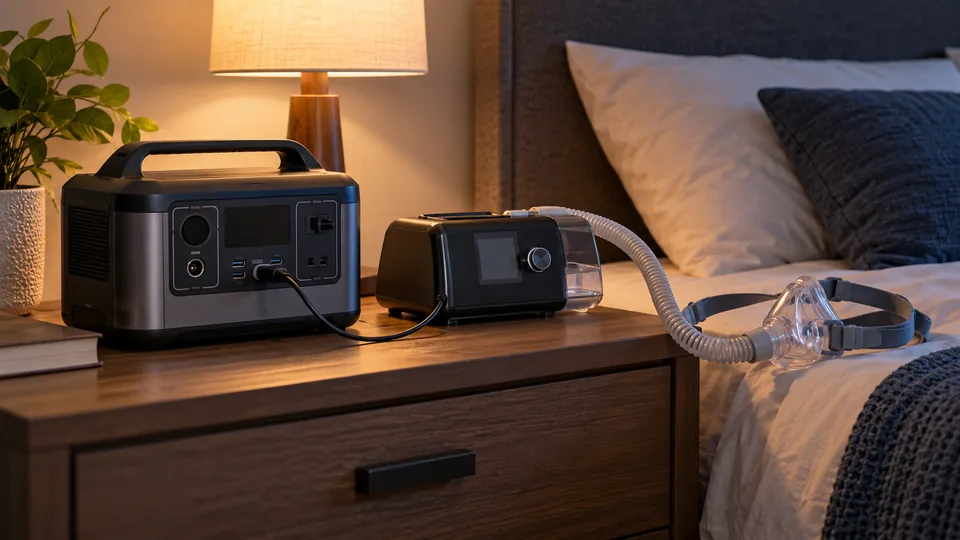
A CPAP power failure is a different kind of inconvenience from a dead phone or laptop. Your backup source needs enough stored energy for the night, a compatible output path, and controls you can understand before you are standing beside a packed travel bag. The biggest mistake is choosing by wattage alone. A station may advertise a high peak figure while offering modest continuous output, or list enough watt-hours on paper without clearly explaining how the CPAP will connect.
For this use, capacity, output type, weight, recharge options, and your machine’s actual power requirements matter together. Humidifiers and heated hoses can change the energy demand considerably, while a direct DC connection may differ from running the CPAP through an AC adapter. Different buyers will prioritize different features. A camper may want a light 296Wh unit, a home user may prefer a UPS function, and someone preparing for several nights may need the 1,070Wh Jackery Explorer 1000 v2. Among these options, the BLUETTI Elite 30 V2 is the strongest overall match because it combines a 288Wh capacity with 600W continuous output and a stated 10ms UPS switch.
Before choosing, confirm your CPAP manufacturer’s power requirements and decide whether you need one night of backup, repeated off-grid use, or a larger reserve for other essentials. The comparison below gives a quick way to sort the nine options by capacity, output, weight, and CPAP-relevant features.
Quick Answer
- Best Overall: BLUETTI Elite 30 V2 for its 600W continuous output and stated 10ms UPS switch.
- Best Higher-Capacity Option: Jackery Explorer 1000 v2 for its 1,070Wh battery and 1,500W continuous output.
- Best Lightweight Option: MARBERO Portable Power Station 296Wh at a listed 5.7 pounds.
- Best Compact Option: MARBERO 200W Portable Power Station for its 3.3-pound body and pass-through charging.
Best Portable Power Station for CPAP Comparison Table
| Product | Best For | Capacity | Continuous AC Output | Weight | CPAP-Relevant Feature |
|---|---|---|---|---|---|
| BLUETTI Elite 30 V2 | UPS-style backup | 288Wh | 600W | 9.4 lb | Stated 10ms UPS switch |
| Jackery Explorer 1000 v2 | Extended backup | 1,070Wh | 1,500W | 23.8 lb | Three AC outlets, 100W USB-C PD |
| Jackery Explorer 300 | Portable camping backup | 292Wh | 300W | 7.5 lb | Two AC outlets, 100W USB-C PD |
| EnginStar 300W 296Wh | Multiple output types | 296Wh | 300W | 6.5 lb | Two AC outlets and regulated DC outputs |
| Portable Power Station 500W | CPAP plus several devices | 519.48Wh | 500W | Not clearly specified | Pure sine wave AC and 60W USB-C PD |
| MARBERO Portable Power Station 296Wh | Lightweight emergency use | 296Wh | 300W | 5.7 lb | Two AC outlets and 12V to 16.6V DC ports |
| EnginStar Solar Generator 300W | Compact AC and DC charging | 296Wh | 300W | Not clearly specified | Two pure sine wave AC outlets |
| ENOFLO 300W | Compact multi-device backup | 228Wh | 300W | Not clearly specified | Two AC outlets and DC ports |
| MARBERO 200W | Very light travel backup | 146Wh | 200W | 3.3 lb | Pass-through charging and AC outlets |
The detailed reviews explain how each station’s capacity, output choices, charging methods, and limitations fit different CPAP backup situations.
1. BLUETTI Elite 30 V2 – Best Overall

The BLUETTI Elite 30 V2 is the most complete fit in this group for buyers who want a portable station with a clearly stated backup-power function. Its 288Wh capacity sits in the same general class as several lighter camping units, but the listed 600W continuous AC output gives it more headroom for a CPAP, charger, lamp, or other small load. The product information also identifies a 10ms UPS switch, a detail that separates it from stations that merely offer pass-through charging or an AC outlet.
Its 9.4-pound weight is reasonable for car camping, a bedside emergency kit, or moving between rooms, though it is heavier than the smallest options here. The listing states that it can recharge from a wall outlet, solar input, or a vehicle and claims 0 to 80 percent in 45 minutes and full charging in 70 minutes using its stated fast wall-charge mode. Those are manufacturer claims rather than independent test results. The CPAP still needs to be checked against the station’s output path and the device’s requirements, particularly if heated humidity is enabled.
Pros
- 288Wh capacity in a compact portable format.
- 600W continuous AC output with a stated 1,500W surge rating.
- Listed 10ms UPS switch for supported connected equipment.
- Supports wall, solar, and vehicle charging.
- Includes LFP battery chemistry according to the listing.
Cons
- At 9.4 pounds, it is heavier than several smaller stations.
- The supplied information does not identify a CPAP-specific DC cable or runtime.
This is the strongest choice for a buyer who values a stated UPS function and higher continuous output more than the absolute lightest carry weight. It may be more station than necessary for a simple short trip, while its 288Wh capacity still requires careful energy planning for a CPAP with heated accessories. Verify the complete CPAP setup before relying on it overnight. To buy this product, click here.
2. Jackery Explorer 1000 v2 – Best Higher-Capacity Option

For CPAP users who want a larger reserve for long outages, the Jackery Explorer 1000 v2 is in a different class from the compact stations. Its listed 1,070Wh capacity and 1,500W continuous AC output leave room for a CPAP alongside lights, phones, a router, or other modest appliances. Three pure sine wave AC ports make a conventional CPAP power-adapter setup straightforward in principle, although the exact medical device connection still needs confirmation.
The trade-off is physical size and weight. At 23.8 pounds, this is better suited to a home backup shelf, vehicle, or basecamp than a backpack. The LFP battery, stated 4,000-cycle specification, and app-controlled charging modes add useful management features. The listing says emergency charging can reach full charge in one hour through the app, while the default mode takes 1.7 hours to favor battery health. Solar charging is limited to Jackery solar panels according to the supplied information, and the panel is not included.
Pros
- Large 1,070Wh listed capacity for a longer reserve.
- 1,500W continuous AC output.
- Three pure sine wave AC outlets.
- Two USB-C ports, including 100W PD output.
- App-based charging modes and a stated LFP battery.
Cons
- At 23.8 pounds, it is not a lightweight travel choice.
- Solar charging is specified for Jackery panels, which are sold separately.
This model makes sense for home users who want extra capacity for CPAP equipment and other essentials during a longer interruption. Buyers who only need a compact camping battery may find the size excessive. The larger battery does not guarantee a particular CPAP runtime, so calculate from your equipment’s measured demand and remember that AC conversion consumes energy. To buy this product, click here.
3. Jackery Explorer 300 – Best Lightweight LFP Option

The Jackery Explorer 300 offers a useful middle ground for CPAP users who need meaningful battery capacity without carrying a bulky home-backup unit. The listing gives it a 292Wh capacity, 300W rated output, two AC outlets, and a 100W USB-C PD port. At 7.5 pounds, it is easier to place beside a bed, carry into a vehicle, or pack for a camping trip than the larger Jackery model.
This version is identified as using LiFePO4 chemistry and is listed with more than 4,000 charge cycles before reaching 70 percent capacity. The supplied package includes an AC adapter and car charger cable, while a solar panel is not included. Jackery states that an optional 100W panel can bring the station to 80 percent in about 2.8 hours, but that claim depends on the stated panel and charging conditions. CPAP buyers should pay attention to the difference between using the AC outlet and a compatible DC pathway, since this review cannot establish a universal runtime for every machine.
Pros
- 292Wh capacity with a listed 300W rated output.
- Light 7.5-pound design with an integrated handle.
- Two AC outlets for a conventional CPAP adapter.
- 100W USB-C PD port for compatible electronics.
- LiFePO4 chemistry and a stated 4,000-plus-cycle claim.
Cons
- The solar panel is not included.
- It has less capacity and continuous output than the larger Jackery Explorer 1000 v2.
Choose this station for portable CPAP backup, especially if weight matters and your other loads are limited. It is less compelling for multi-night home backup or a setup that includes a heated hose, humidifier, and several additional appliances. Confirm whether your CPAP can use the available output safely and whether your planned accessories fit within the battery reserve. To buy this product, click here.
4. EnginStar Portable Power Station 300W 296Wh – Best for Mixed AC and DC Loads

EnginStar’s 296Wh station is aimed at buyers who want several kinds of outputs in a small package. It lists two 110V pure sine wave AC outlets, two regulated DC outputs at 12V and 24V, USB-A, and an 18W USB-C port. That mix can be useful in a CPAP kit containing the machine, a phone, and a small DC accessory, provided each connection matches the equipment’s voltage and current requirements.
The unit measures 9 by 5.5 by 7.5 inches and weighs 6.5 pounds according to the listing. It can charge from a wall outlet, a car socket, or a compatible 12V to 25V solar panel, with the panel sold separately. EnginStar states that its maximum charging speed can bring the unit to 80 percent in two hours, but charging behavior depends on the selected input and the battery’s charge stage. The published information does not identify a CPAP-specific runtime or UPS function, so it is better viewed as a portable battery station than a confirmed uninterrupted medical backup.
Pros
- 296Wh capacity in a 6.5-pound body.
- Two pure sine wave 110V AC outlets.
- Regulated 12V and 24V DC outputs.
- Wall, car, and compatible solar charging options.
- Eight listed output ports for several small devices.
Cons
- The solar panel is sold separately.
- The supplied specifications do not state a UPS transfer function or CPAP runtime.
This is a sensible option for car campers who understand their CPAP’s input needs and want both AC and DC choices. It is less suitable for someone seeking a clearly documented UPS arrangement or a large overnight reserve. Check the CPAP manufacturer’s required voltage, connector, and power draw before selecting a direct DC cable. To buy this product, click here.
5. Portable Power Station 500W 519.48Wh – Best for Extra Capacity in a Mid-Size Station

This unnamed 519.48Wh station offers the largest listed capacity among the mid-size models in this roundup. Its 500W continuous AC output, two pure sine wave AC outlets, and 60W USB-C PD output give CPAP users several ways to organize a backup setup. The extra capacity may also leave room for a phone, lamp, router, or small fan, though no universal runtime should be assumed from the nominal battery figure.
The station lists three USB-A QC3.0 ports, two DC ports, a 12V car port, and a wireless charging pad. It supports wall, car, and compatible 100W or 200W solar-panel charging. The listing gives approximate full-charge claims for each method, including six to seven hours from a wall outlet, but these remain published specifications rather than independent measurements. Weight and battery chemistry are not clearly supplied, which makes it harder to judge carrying comfort and long-term cycle expectations.
Pros
- 519.48Wh listed capacity.
- 500W continuous AC output.
- Pure sine wave AC outlets for compatible equipment.
- 60W USB-C PD and multiple USB-A ports.
- Supports wall, vehicle, and compatible solar charging.
Cons
- Weight and battery chemistry are not clearly specified.
- The listing warns against loads above 500W and says AC output should be turned off when unused.
This station suits a CPAP user who wants more reserve than a 288Wh or 296Wh unit without moving to a 1,070Wh model. It may be a less attractive choice for frequent carrying because the supplied data does not establish its weight. Confirm the power draw of your CPAP and avoid treating the 519.48Wh rating as guaranteed AC-delivered energy. To buy this product, click here.
6. MARBERO Portable Power Station 296Wh – Best Lightweight Option
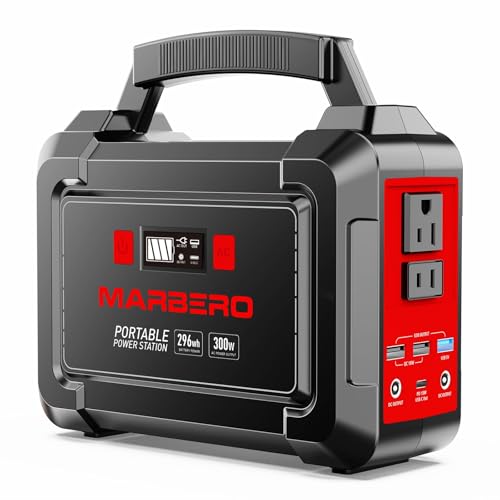
At a listed 5.7 pounds, this MARBERO is one of the easiest stations here to carry from a car to a tent or from a storage closet to a bedroom. Its 296Wh capacity is comparable to the compact Jackery and EnginStar units, while its two AC outlets are rated at 300W with a 350W peak. The station also offers two DC ports rated from 12V to 16.6V, plus USB-A, QC3.0, and USB-C outputs.
MARBERO’s listing gives approximate device-specific figures, including about nine hours for a CPAP, but it also says the time varies according to the machine’s power. That claim should be treated as a seller estimate, not a guaranteed result for your equipment. The unit can recharge from an AC wall outlet, car socket, or a solar panel within the stated DC input range. A built-in light with steady and SOS modes is convenient for packing or navigating a dark room, while the 12-month warranty is included in the supplied listing.
Pros
- 296Wh listed capacity.
- Lightweight 5.7-pound design.
- Two AC outlets with 300W rated output.
- Two DC ports and several USB charging options.
- Wall, car, and solar recharge methods.
Cons
- The published CPAP runtime is an estimate that varies by machine.
- The AC output is lower than the 600W available from the BLUETTI Elite 30 V2.
This is a practical pick for travelers who care more about low carry weight than UPS behavior or high output. It deserves extra scrutiny for a CPAP setup with heated accessories, since the listed estimate cannot cover every device configuration. Use the exact power requirements from your machine and confirm the DC connector before bypassing the CPAP’s AC adapter. To buy this product, click here.
7. EnginStar Solar Generator 300W – Best Compact Pure Sine Wave Alternative
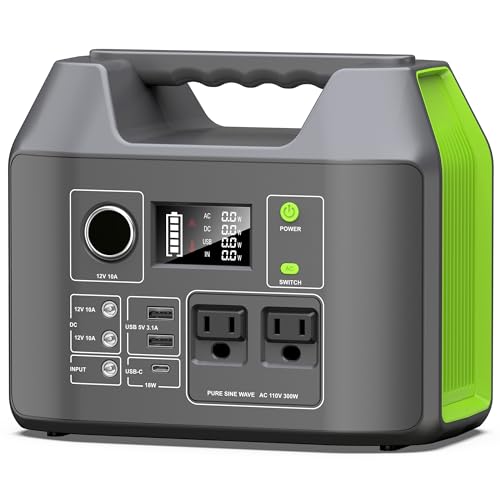
This EnginStar model shares the compact 296Wh class with several products here and provides two 110V pure sine wave AC outlets. It also lists USB outputs, an 18W USB-C port, a 12V car port, a 12V DC port, and a 24V barrel port. That collection gives a CPAP user flexibility, although the existence of a connector does not prove that a particular CPAP cable is electrically compatible.
The station measures 9 by 5.5 by 7.5 inches, while the listing does not clearly provide a weight. EnginStar says it can recharge through an AC adapter, a vehicle, or a 12V to 25V solar panel, with a full wall charge listed at about seven hours. The product includes a car charging cable and recommends periodic charging during storage. Its specifications also caution that it may not support larger appliances such as heaters, microwaves, or refrigerators, a useful reminder that 300W is a limit rather than a promise of broad appliance support.
Pros
- 296Wh listed capacity.
- Two 110V pure sine wave AC outlets.
- Multiple AC, USB, car, and DC output types.
- Wall, car, and solar charging pathways.
- Compact 9 by 5.5 by 7.5-inch dimensions.
Cons
- Weight is not clearly specified in the supplied information.
- No stated UPS transfer time or CPAP-specific runtime.
This model is a reasonable fit for a conventional AC CPAP setup in a vehicle or campsite, especially for buyers who want several port types. It is less compelling for a home user who needs a documented UPS function. The station’s 300W rating should be treated as a ceiling for continuous loads, and the CPAP’s actual requirements should be checked before use. To buy this product, click here.
8. ENOFLO 300W – Best Multi-Port Compact Option

The ENOFLO 300W trades some battery capacity for a broad selection of outputs. Its listed 228Wh capacity and 300W continuous output support a compact CPAP backup arrangement, while two 110V pure sine wave AC outlets provide the familiar route through the machine’s adapter. The station also includes two DC ports, a cigarette-lighter port, two USB-A ports, USB-C, and wireless phone charging.
ENOFLO identifies a built-in MPPT controller and supports its YT30 or YT60 solar panels, which are sold separately. The listing gives six to seven hours for wall charging and seven to eight hours from a car port, but actual charge time depends on input conditions and battery management. A large rear LED and LCD display add convenience during setup. The 228Wh capacity is materially lower than the 292Wh to 296Wh options above, so buyers should be more conservative about adding a humidifier, heated hose, or other loads.
Pros
- 300W continuous output with two pure sine wave AC outlets.
- Nine listed charging outputs or device connections.
- DC, car-port, USB, and wireless charging options.
- Built-in MPPT controller for the stated ENOFLO solar panels.
- LCD status display and rear LED light.
Cons
- 228Wh capacity is lower than most compact alternatives in this roundup.
- The solar panels are sold separately and the CPAP runtime is not specified.
ENOFLO works best for a compact, electronics-focused backup kit where the CPAP’s energy demand is modest and the extra ports are useful. Buyers planning to run heated accessories should look first at the larger-capacity options. The listing’s compatibility language does not replace a check of your CPAP’s voltage, connector, and operating draw. To buy this product, click here.
9. MARBERO 200W Portable Power Station – Best for Minimal Carry Weight

The smallest station in this roundup is the MARBERO 200W, a 3.3-pound unit with a listed 146Wh capacity and 200W continuous AC output. Its compact size makes sense for a travel bag, a bedside drawer, or a short trip where every pound matters. It has two AC outlets, two QC3.0 USB-A ports, standard USB-A ports, an 18W USB-C PD port, and a DC port.
The station supports pass-through charging according to the listing, but pass-through charging is different from a stated UPS function and does not establish zero-interruption operation for a CPAP. MARBERO also includes two LED lights with multiple brightness and SOS modes. Wall charging is listed at seven hours and car charging at nine hours, while solar charging requires a separately purchased panel within the stated voltage and current range. With less than half the capacity of the 296Wh models, this unit leaves less room for heated accessories or other overnight loads.
Pros
- Very light 3.3-pound design.
- 146Wh listed capacity with 200W continuous AC output.
- Two AC outlets and multiple USB ports.
- Pass-through charging is listed.
- Two integrated LED lights with several modes.
Cons
- Capacity is substantially lower than the other compact stations here.
- Pass-through charging is not a stated UPS function.
This is the niche choice for buyers who need the smallest possible battery station and have already confirmed that their CPAP’s energy demand fits the limited capacity. It is a poor match for a long outage, heated humidification, or a setup requiring documented UPS switching. Treat the 146Wh figure as nominal stored energy, not guaranteed AC energy delivered to the machine. To buy this product, click here.
Buying Guide
Start With the CPAP’s Actual Power Path
Look at the CPAP label, power adapter, and manufacturer’s instructions before selecting a station. A conventional AC adapter can plug into an AC outlet, while a direct DC solution may reduce conversion steps if the voltage, connector, polarity, and current are all correct. A USB-C connector alone does not prove that it can power a CPAP, and a 12V port is not automatically universal.
Separate Watt-Hours From Watts
Watt-hours describe stored energy. Watts describe the amount of power the station can deliver at a given time. A 296Wh station and a 300W station answer different questions, so check both figures. Nominal battery capacity will not equal the energy delivered through an AC outlet because inverter losses, idle consumption, battery cutoffs, and load behavior affect the result.
Plan for Heated Humidity
A CPAP using a humidifier or heated hose can require more energy than the machine alone. The supplied product listings do not provide a universal runtime for every CPAP configuration, so avoid treating a seller’s estimated number as a guarantee. Test your intended setup under controlled conditions before relying on it for travel or an outage.
Understand UPS, Pass-Through, and Ordinary AC Output
The BLUETTI listing states a 10ms UPS switch. The MARBERO 200W listing states pass-through charging. Those descriptions are not interchangeable. A station with an AC outlet may keep a CPAP running during a normal outage, but the listing must identify the transfer behavior before you assume uninterrupted operation. Medical-device backup arrangements should be checked against the CPAP manufacturer’s guidance.
Review Solar Input Before Buying a Panel
A station that accepts solar charging still needs a compatible panel. Check the station’s accepted voltage and current range, the panel’s electrical ratings, connector type, and any brand restrictions. The Jackery Explorer 1000 v2 listing specifies Jackery panels for solar charging, while several other products list general voltage ranges or brand-specific panels. A connector that fits physically does not prove that the electrical match is safe.
Choose Capacity Around Your Travel Style
The 146Wh MARBERO is easier to carry, while the 1,070Wh Jackery is better suited to extended backup and vehicle use. Compact 228Wh to 296Wh stations may be more practical for a single traveler, but the larger 519.48Wh model offers more reserve for other devices. More capacity generally means more mass or a larger footprint, so match the station to the way you will actually transport it.
Keep Safety Boundaries Clear
Do not connect a portable station to a household wall outlet to energize home wiring, and do not assume a portable unit replaces an installed transfer-switch system. Keep the station and cables within the supplied operating instructions, protect them from unsuitable moisture or heat, and verify all medical-device connections before use. A battery management system is a listed feature, not a guarantee against every electrical or battery failure.
Best Portable Power Station for CPAP FAQ
What is the best portable power station for CPAP use?
The BLUETTI Elite 30 V2 is the strongest overall option in this selection because its listing combines 288Wh, 600W continuous output, and a stated 10ms UPS switch. It still requires confirmation that your CPAP and accessories are compatible with the selected output path.
How many watt-hours does a CPAP need overnight?
There is no single answer for every CPAP. Machine settings, humidifier use, heated tubing, the chosen AC or DC power path, and conversion losses all affect consumption. Use the CPAP manufacturer’s specifications or a suitable power meter to establish the demand for your complete setup.
Can a portable power station run a CPAP without a humidifier?
Many of the listed stations advertise support for CPAP devices, but that does not establish a guaranteed runtime or universal compatibility. Turning off heated humidity may reduce energy demand, but the machine’s own requirements and the station’s output must still match.
Is a pure sine wave inverter important for a CPAP?
Several stations in this roundup list pure sine wave AC output, including the BLUETTI Elite 30 V2, EnginStar models, the 519.48Wh station, and ENOFLO. Follow the CPAP manufacturer’s power guidance rather than assuming that every AC outlet has the same waveform or compatibility.
Can pass-through charging replace a UPS for a CPAP?
No. Pass-through means the station can charge while supplying a load, while UPS behavior involves a stated transfer or backup function. The MARBERO 200W lists pass-through charging, whereas the BLUETTI Elite 30 V2 lists a 10ms UPS switch. Confirm the required continuity with the CPAP manufacturer.
Is a larger power station always better for CPAP backup?
A larger capacity can provide more reserve for the CPAP and other devices, but it also usually adds carrying weight and cost. The Jackery Explorer 1000 v2 offers 1,070Wh and 1,500W continuous output, while smaller units are easier to transport. Choose based on the intended backup period and complete load.
Can I use a solar panel with these stations?
Yes, the listed models support solar charging in different ways, but the panels are generally sold separately. Check voltage, current, connector, and brand restrictions before buying. The Jackery Explorer 1000 v2 listing specifically identifies Jackery solar panels, while other models provide different input ranges.
Final Verdict
The BLUETTI Elite 30 V2 is the best overall portable power station for CPAP use in this group because it balances a manageable 9.4-pound weight with 288Wh of listed capacity, 600W continuous output, and a stated 10ms UPS switch. That combination gives it a clearer backup role than stations that list only an AC outlet or pass-through charging. The Jackery Explorer 300 is a strong lighter LFP alternative, while the MARBERO 296Wh is appealing for buyers who want to keep carry weight low.
For longer backup periods or a CPAP plus several household electronics, the Jackery Explorer 1000 v2 offers the largest reserve and highest continuous output here. The 519.48Wh station sits between the compact and large options, while the MARBERO 200W is reserved for a carefully verified low-energy setup. Before purchase, confirm the CPAP’s voltage, adapter, humidifier settings, and expected demand, then allow for AC conversion losses rather than treating the printed watt-hour number as guaranteed overnight energy.
