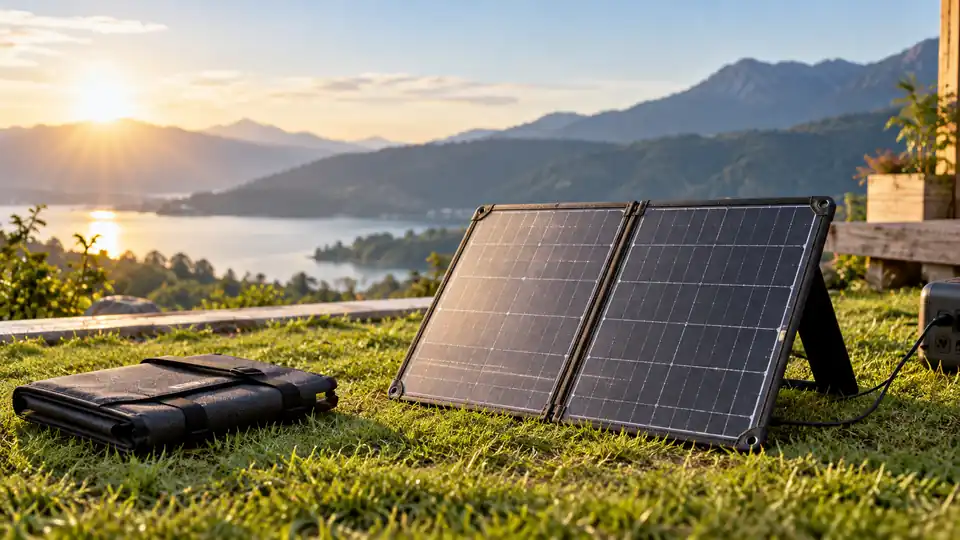
A portable 100W solar panel can turn a power station from a one-day battery into a more useful off-grid system, but the number printed on the front is only the starting point. Buyers usually want a panel that folds into a vehicle, aims easily at the sun, and connects to a familiar station without a bag full of adapters. The wrong choice can create a frustrating mismatch, such as a panel with the right wattage but an unsuitable cable, input range, or station limit.
Portability, connector selection, weather rating, direct USB charging, and panel construction deserve close attention. A 100W rating describes the panel’s maximum rated output under stated conditions, not a guaranteed harvest in every patch of shade or cloud. Some shoppers will value the lightest possible panel for hiking and car camping, while others will prefer a rugged framed kit for a 12V battery system. The ZOUPW N-Type 16BB panel is our strongest overall pick because it combines a 25% claimed efficiency rating, broad connector coverage, a manageable 7.98-pound weight, and adjustable positioning.
Read the station’s solar input limits before ordering, then match the panel’s connector and electrical requirements rather than relying on a familiar brand name. The comparison below gives a quick view of the nine strongest options selected for different portable solar setups.
Quick Answer
- Best Overall: ZOUPW 100W N-Type 16BB for its claimed 25% efficiency, 7.98-pound weight, five-connector cable, and adjustable kickstands.
- Best for Compact Setups: FlexSolar 100W Foldable Portable Solar Panel Charger because the listing specifies a 4.1-pound weight, 45W USB-C output, and IP67 protection.
- Best for Direct USB-C Charging: Twelseavan 100W Portable Solar Panel with a listed 60W USB-C PD port and several included adapters.
- Best for 12V Battery Systems: Renogy 100W Solar Panel Kit with 20A Controller for its included PWM controller, alligator-clip cables, and stated 12V battery compatibility.
Best Portable Solar Panel 100W Comparison Table
| Product | Best For | Rated Power | Weight | Key Connection Details |
|---|---|---|---|---|
| ZOUPW N-Type 16BB | Best overall | 100W, claimed 25% efficiency | 7.98 lb | Five-in-one cable, USB outputs |
| Renogy 100W Portable Solar Panel | Higher-efficiency panel | 100W, claimed 25% efficiency | 8.86 lb | MC4 cables, USB-C PD 45W |
| HQST 100W Portable Solar Panel | Lightweight rigid setup | 100W, claimed 25% efficiency | 5.91 lb | XT60, DC7909, DC5521 cable |
| FlexSolar 100W Foldable Panel | Lowest listed weight | 100W, claimed 23%+ efficiency | 4.1 lb | 100W DC, USB-C PD 45W, USB-A |
| 100W Portable Panel with USB-C/A | Lightweight multi-device charging | 100W, claimed 23.5% efficiency | 6 lb | 20V DC, XT60, USB-C PD 45W |
| Twelseavan 100W Portable Panel | USB-C device charging | 100W, claimed 24% efficiency | Not clearly specified | USB-C PD 60W, MC4 adapter set |
| ZOUPW 100W Portable Solar Panel | Broad connector coverage | 100W, claimed 23.5% efficiency | 9.48 lb | Five-in-one cable, USB-C PD |
| CTOLITY 100W Portable Solar Panel | Expandable panel setups | 100W, claimed 23.7% efficiency | Not clearly specified | 19.8V output, XT60 |
| Renogy 100W Solar Panel Kit | 12V battery charging | 100W, claimed 25% efficiency | 17.42 lb | 20A PWM controller, alligator clips |
The detailed reviews explain which panels suit portable power stations, direct device charging, RV use, and 12V battery projects.
1. ZOUPW 100W Portable Solar Panel N-Type 16BB — Best Overall

The ZOUPW N-Type 16BB is the most balanced option in this group for buyers who want a portable 100W panel without giving up useful connection flexibility. Its listing identifies N-Type, 16-busbar monocrystalline cells and claims up to 25% conversion efficiency. That figure is a manufacturer or seller claim rather than an independent measurement, but it gives the panel a strong specification profile for people working with limited setup space. At 7.98 pounds, it also avoids the heavy feel of many suitcase-style panels.
The five-in-one cable is the practical star here. It includes connectors identified for DC8020, XT60, Anderson, DC7909 or 8mm, and DC5521 connections, covering many Jackery, EcoFlow, Anker, BLUETTI, and generic battery arrangements listed by the seller. Two kickstands adjust from 35 to 60 degrees, while the IP67-rated ETFE-laminated panel is intended for rain, splashes, and dust exposure. The connection still needs electrical verification at the station input, but the supplied cable package makes campsite setup far less fussy.
Pros
- Rated at 100W with a claimed 25% N-Type conversion efficiency.
- At 7.98 pounds, it is easier to carry than the heavier framed alternatives in this group.
- Includes a five-in-one cable with DC8020, XT60, Anderson, DC7909 or 8mm, and DC5521 connectors.
- Two kickstands provide positioning from 35 to 60 degrees.
- IP67 ETFE construction and direct-device charging ports add outdoor flexibility.
Cons
- The listing does not provide the panel’s full Voc, Vmp, Isc, and Imp set for independent electrical matching.
- The claimed efficiency and possible output depend on sunlight, positioning, and the connected station’s input limits.
This is the strongest fit for campers, RV owners, and emergency-kit buyers who want one foldable panel for several station connector types. People who need a 12V battery controller included in the box should look at the Renogy kit instead. Before plugging in, verify the receiving station’s voltage, current, and wattage limits because a matching connector does not prove electrical compatibility.
To buy this product, click here.
2. Renogy 100W Portable Solar Panel for Power Stations — Best for Higher Claimed Efficiency

Renogy’s newer portable panel targets buyers who want a compact foldable format with a high stated cell-efficiency figure. The listing identifies N-Type technology and 16BB cells, with a claimed 25% conversion efficiency. It folds to 20.6 by 24.6 by 1.6 inches and weighs 8.86 pounds, a useful middle ground for an RV storage compartment or a vehicle-based camping kit.
Its direct charging section is unusually clear. The panel includes one USB-C PD port rated up to 45W and two USB-A ports rated at 18W and 15W, so phones, cameras, and some tablets can be connected without routing every device through a power station. The panel uses MC4 output cables, while the Renogy 4-in-1 adapter cable is listed separately. That is a meaningful distinction for a buyer expecting a ready-to-connect XT60 or 8mm cable in the box.
Pros
- Uses listed N-Type 16BB cells with a claimed 25% conversion efficiency.
- Folds to a relatively compact 20.6 by 24.6 by 1.6 inches.
- Includes USB-C PD up to 45W plus two USB-A outputs.
- IP67-rated construction and ETFE coating are specified for outdoor use.
- The listing gives several named compatible station models, subject to matching voltage and connector requirements.
Cons
- MC4 output cables are included, while the listed Renogy 4-in-1 adapter is sold separately.
- At 8.86 pounds, it is heavier than the HQST and FlexSolar options.
This Renogy is a sensible choice for buyers who already use MC4-compatible equipment or who want clearly identified direct USB outputs. It may frustrate someone expecting a complete multi-adapter cable kit. Verify the exact station input before purchase, since the supplied compatibility list still depends on voltage, current, and connector matching.
To buy this product, click here.
3. HQST 100W Portable Solar Panel — Best Lightweight Rigid Option

The HQST panel makes a strong case for buyers who want a 100W foldable panel that is easy to move from a trunk to a sunny patch of ground. The supplied listing gives a weight of 5.91 pounds and a folded thickness of 1.38 inches. That is a useful combination for day trips, beach setups, and small solar generators where every pound carried by hand matters.
Two adjustable kickstands are specified with a 40 to 70-degree range, giving the panel a broad aiming window. The included 3-in-1 cable supports XT60, DC7909 or 8mm, and DC5521 connections. HQST claims up to 25% efficiency from its N-Type cells, while the IP67 rating and laminated construction address rain, splashes, and surface wear. The listing names several compatible brands, but buyers still need to confirm their station’s electrical input requirements.
Pros
- Listed weight is 5.91 pounds, among the lightest in this roundup.
- Claimed 25% efficiency from N-Type solar cells.
- Includes XT60, DC7909 or 8mm, and DC5521 connectors.
- Kickstands adjust from 40 to 70 degrees.
- IP67 laminated construction is specified for outdoor conditions.
Cons
- The supplied data does not list USB-C or USB-A direct-charging outputs.
- The included cable has fewer connector types than the five-in-one options.
Choose the HQST when low carry weight and quick positioning matter more than direct USB charging. It fits many common station connections, but a buyer with a USB-C laptop or camera setup may prefer the Renogy or Twelseavan. Its missing full panel voltage and current details also mean the station manual should be checked before connection.
To buy this product, click here.
4. FlexSolar 100W Foldable Portable Solar Panel Charger — Best for Minimum Carry Weight

FlexSolar is the easiest panel here to justify for a lightweight travel kit. The listing specifies a 4.1-pound weight and a folded size of 12.99 by 10.43 by 2.17 inches, with a carry bag included. For someone moving gear between a car, picnic table, and tent, that difference is immediately practical. The unfolded panel measures 45.47 by 26.18 inches, so it still requires a reasonably clear surface once deployed.
The output arrangement is broad for such a light panel. It includes a 100W DC output, USB-C PD 3.0 up to 45W, and USB-A up to 18W, along with a 4-in-1 cable for DC5521, DC7909, Anderson, and XT60 connections. The listing claims 23% or greater conversion efficiency and gives the panel an IP67 rating. Those claims describe the product specification, not a guaranteed field result, but they make this a versatile travel-oriented choice.
Pros
- Listed at only 4.1 pounds.
- Folds to 12.99 by 10.43 by 2.17 inches and includes a carry bag.
- Provides 100W DC, USB-C PD up to 45W, and USB-A up to 18W.
- Includes DC5521, DC7909, Anderson, and XT60 adapters.
- IP67 protection and a claimed 23% or greater efficiency suit outdoor use.
Cons
- The large unfolded footprint may need careful placement despite the small folded size.
- The supplied information does not list Voc, Vmp, Isc, or Imp for detailed station matching.
This is the best fit for hikers, car campers, and anyone who expects to carry the panel farther than the power station. The lighter construction is attractive, while buyers building a permanent-feeling RV or 12V arrangement may prefer the Renogy framed kit. Check the receiving station’s solar input before relying on the included adapters.
To buy this product, click here.
5. 100W Portable Solar Panel with USB-C/A and 20V DC XT60 Port — Best for Flexible Device Charging

This unnamed 100W panel is built around practical cable coverage and direct device charging. Its listed weight is 6 pounds, and it folds to approximately 15.68 by 10.44 by 2.96 inches. Six adjustable kickstands can angle the panel toward the sun, while built-in grommets provide another way to hang it from a suitable tent or RV surface.
The connection package is generous. The listing specifies QC3.0 USB-A up to 24W, USB-C PD 3.0 up to 45W, and a 20V DC port, plus cables and adapters for XT60, Anderson, DC7909, DC5521, DC5525, and DC35135. A 3-meter DC5521 extension cable can keep the station or small electronics away from the panel’s direct sunlight. The seller also describes an auto-reboot function and protective circuitry, though actual charging depends on the connected equipment and sunlight.
Pros
- Weighs 6 pounds and folds into a compact package.
- Includes USB-C PD up to 45W and QC3.0 USB-A up to 24W.
- Provides a 20V DC port and a wide group of included adapters.
- Six kickstands support angled placement.
- A 3-meter extension cable gives more freedom to shade the connected station.
Cons
- The listing does not clearly identify a brand or provide full panel electrical specifications.
- Its waterproof construction is described, but the supplied information does not give a formal IP rating.
This panel makes sense for buyers who want one compact kit to feed a power station, phone, camera, or USB-C device. The broad connector set is useful, but it should not replace an electrical compatibility check. Buyers who prioritize a named brand, a formal IP rating, or a documented warranty may prefer one of the other nine selections.
To buy this product, click here.
6. Twelseavan 100W Portable Solar Panel — Best for USB-C Devices

Twelseavan’s strongest feature is its clearly listed direct-charging output. The panel includes a Type-C port rated up to 60W, a QC3.0 port rated up to 18W, and a USB port rated at 5V/3A. That arrangement suits a day outdoors with a phone, camera, tablet, or compatible USB-C device, although the device’s own charging requirements still apply.
The panel uses a two-fold design with kickstands and four metal mounting holes. Its claimed 24% conversion rate comes from A+ monocrystalline cells, while the ETFE-laminated case and polyester canvas backing are described as weather resistant. The included cable system uses MC4-to-Anderson, XT60i, 8020, 7909, and 5521 adapters, with a 9.8-foot cable. The listing gives an IP65 rating, so it should not be treated as equivalent to an IP67 or IP68 panel.
Pros
- Lists a USB-C PD output up to 60W.
- Includes QC3.0 up to 18W and a separate 5V/3A USB port.
- Provides a 9.8-foot cable with several adapter ends.
- Uses a foldable two-panel design with kickstands and mounting holes.
- ETFE lamination and an IP65 rating are specified for outdoor use.
Cons
- The panel’s weight is not clearly specified in the supplied information.
- IP65 provides a different level of protection from the IP67 and IP68 ratings found on some alternatives.
This is a good match for a portable electronics kit where USB-C charging is central. It is less attractive for buyers who need a very light panel with a clearly published carry weight. Check the USB-C voltage and protocol requirements of the device, and verify the station’s solar input before using the adapter bundle.
To buy this product, click here.
7. ZOUPW 100W Portable Solar Panel for Power Station — Best for Connector Coverage

The original ZOUPW 100W panel remains useful for buyers who want broad cable coverage and a built-in device charging hub. It weighs 9.48 pounds and folds to 24.13 by 21.06 by 1.77 inches. That is heavier than several newer lightweight panels, yet the magnetic handle and two kickstands keep the setup straightforward for an RV, vehicle, or emergency storage kit.
The listing identifies A+ monocrystalline cells with a claimed 23.5% efficiency and an IP67 ETFE coating. A 10-foot five-in-one cable covers DC8020, XT60, Anderson, DC7909 or 8mm, and DC5521 connections. Direct charging includes USB-C PD at 15V/3A and two USB-A ports, one of which is described as QC3.0. Buyers should pay attention to the station’s input limit, since the listing specifically warns that a station capped at 60W will draw no more than that.
Pros
- Includes a five-in-one cable covering several common station connectors.
- Provides a 10-foot cable for flexible panel placement.
- Lists USB-C PD and two USB-A direct-charging ports.
- Uses an IP67-rated ETFE-laminated panel.
- Includes two kickstands and a magnetic carry handle.
Cons
- At 9.48 pounds, it is relatively heavy for a portable 100W panel.
- The claimed 23.5% efficiency is lower than the 25% claims listed for several newer N-Type options.
This panel suits buyers who have several power stations with different connector styles or who want a longer cable for an RV or outdoor table. A lighter panel will be more comfortable for repeated hand carrying, and buyers focused on maximum stated efficiency may prefer the N-Type ZOUPW or Renogy. Connector fit remains only one part of a safe match.
To buy this product, click here.
8. CTOLITY 100W Portable Solar Panel — Best for Expandable Panel Arrangements

CTOLITY focuses on a straightforward 100W foldable panel with a listed 19.8V output and XT60 connection. The seller describes support for 12V batteries up to 12A maximum and says the panel can be used with many portable power stations. That gives it a clear role for people building a modest outdoor charging setup rather than shopping solely for the most elaborate adapter package.
The panel uses monocrystalline cells with a claimed 23.7% efficiency and includes adjustable kickstands for angled placement. Reinforced loops allow it to hang from a suitable tent or RV structure. The listing also says two panels can be paired in series or parallel, but the correct arrangement depends on the receiving equipment’s voltage, current, and solar-input limits. Its ETFE lamination and stated operating range of -10 to 70 degrees Celsius are seller-provided specifications.
Pros
- Lists 100W output and a 19.8V panel voltage.
- Includes an XT60 output for compatible power stations and systems.
- Claims 23.7% efficiency from monocrystalline cells.
- Supports angled placement with adjustable kickstands.
- Reinforced loops allow alternative hanging or mounting positions.
Cons
- The supplied data does not give the panel’s weight or folded dimensions.
- Series or parallel expansion requires careful checking of the connected system’s electrical limits.
CTOLITY is best for a buyer who values a stated panel voltage and the option to build a two-panel arrangement later. It is less suitable for someone who needs extensive included adapters or a clearly documented carry weight. Treat the expansion claim as a compatibility question to verify, not as permission to combine panels with any station.
To buy this product, click here.
9. Renogy 100W Portable Solar Panel Kit with 20A Charger Controller — Best for 12V Battery Systems
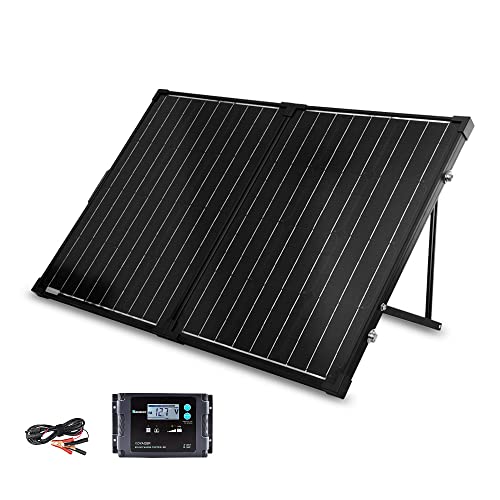
This Renogy listing is a different kind of portable solar panel choice. It is a heavier suitcase-style kit at 17.42 pounds, with tempered glass, an aluminum frame, an adjustable kickstand, and a pre-installed 20A PWM charge controller. The package includes alligator-clip cables and is described for 12V portable power stations and several 12V battery types. That built-in controller makes the kit more approachable for a battery project than a panel that arrives with only a raw output cable.
The panel uses N-Type cells with a claimed 25% efficiency and includes four-stage charging through the PWM controller. Its IP65-rated junction box, low-iron tempered glass, aluminum frame, and bypass diodes are all listed construction details. The panel is far less appealing for a backpack or short walk from a vehicle, but its rigid build and controller can suit an RV, van, or stationary emergency setup where the gear is moved occasionally rather than carried all day.
Pros
- Includes a pre-installed waterproof 20A PWM charge controller.
- Comes with alligator-clip cables for listed 12V battery applications.
- Uses N-Type cells with a claimed 25% efficiency.
- Tempered glass, an aluminum frame, and an adjustable kickstand are specified.
- Includes four-stage charging and bypass diodes in the listed design.
Cons
- At 17.42 pounds, it is the heaviest selected panel and kit.
- Its IP65-rated junction box should not be generalized to an IP67 or IP68 whole-panel rating.
This kit is the right kind of bulky for an RV or 12V battery project where a controller is more valuable than minimal carry weight. It is a poor match for backpack-style travel and should not be treated as a universal plug-in panel for every power station. Confirm the battery type, controller settings, and receiving equipment requirements before connecting the kit.
To buy this product, click here.
Buying Guide
Start with the Power Station’s Solar Input
A panel’s 100W label does not prove that every 100W power station can accept it. Check the station’s permitted solar voltage range, maximum current, maximum wattage, and connector requirements in the station documentation. A station with a 60W solar-input limit may draw no more than 60W from a higher-rated panel, while a connector that physically fits can still be electrically unsuitable.
Rated Wattage Is Not Guaranteed Harvest
The listed 100W rating describes a maximum under specified conditions. Sun angle, cloud cover, temperature, shading, cable losses, and the connected station’s charging limits affect the energy that reaches the battery. Claimed conversion figures such as 23.5%, 24%, or 25% are product specifications, not independent field measurements. Kickstands help aim a panel, but they cannot guarantee a particular output.
Choose the Cable Around Your Equipment
XT60, DC7909, DC5521, Anderson, DC8020, MC4, and USB-C are different connection systems. A matching plug is useful, but it does not establish voltage or current compatibility. The ZOUPW models include particularly broad connector sets, while the newer Renogy panel uses MC4 output cables and lists a separate adapter cable. Make a short list of the station’s exact input port and electrical limits before choosing the panel.
Decide Whether Direct USB Charging Matters
Some panels can charge small devices directly, which can be convenient when a power station is being saved for a larger load. The listed options range from the 45W USB-C outputs on the Renogy and FlexSolar panels to the Twelseavan’s claimed 60W USB-C output. USB-C shape alone does not establish a specific Power Delivery profile, so match the device’s input requirements with the panel’s published output.
Balance Weight Against Structure
The lightest options are easier to carry, but the right weight depends on how the panel will be used. FlexSolar lists 4.1 pounds, HQST lists 5.91 pounds, and the unnamed USB-C panel lists 6 pounds. The Renogy 12V kit lists 17.42 pounds because it includes a framed panel and controller. A vehicle-based setup may welcome that structure, while a hiker will likely value every pound saved.
Read Weather Ratings Precisely
IP65, IP67, and IP68 are different ratings and should remain separate in your decision. This roundup includes panels listed with IP65, IP67, and IP68 claims, but the rating may apply to a panel, junction box, or specified product construction rather than every cable and connection in the complete setup. Keep connectors protected as directed and avoid treating a weather rating as permission to immerse the equipment.
Check Battery-System Kits Carefully
A panel-only product and a panel kit do different jobs. The Renogy kit includes a 20A PWM controller and alligator-clip cables for listed 12V battery applications, while DOKIO, BLUETTI, and Anker alternatives were left out of this selection because the nine chosen products provided stronger fits for the requested balance of portability, direct charging, and connection flexibility. Never connect a raw solar panel directly to a battery unless the complete system calls for an appropriate charge controller.
Best Portable Solar Panel 100W FAQ
Can Any 100W Solar Panel Charge Any Power Station?
No. The station must accept the panel’s voltage and current, and its solar-input wattage limit must be respected. The connector must also match or use an electrically suitable adapter. Confirm the station’s solar-input specifications before connecting a panel.
Will a 100W Panel Produce 100W All Day?
No panel should be assumed to deliver its rated maximum continuously. The rating applies under stated conditions, while sun angle, clouds, heat, shade, cable losses, and station limits affect actual charging. A station with a lower input limit can also restrict the received power.
Is a Higher Efficiency Percentage Always Better?
A higher claimed efficiency can be useful where panel area is limited, but it does not guarantee higher real-world charging in every situation. The panel’s positioning, electrical match, cable setup, and weather also matter. Treat seller efficiency figures as specifications rather than independent test results.
What Is the Lightest 100W Portable Solar Panel Here?
FlexSolar lists the lowest weight at 4.1 pounds. HQST lists 5.91 pounds, and the unnamed USB-C/A panel lists 6 pounds. Folded dimensions, carry method, stand design, and the space required when unfolded should also be checked.
Do I Need a Charge Controller?
A charge controller is needed for many direct 12V battery charging arrangements. The Renogy kit includes a 20A PWM controller for its listed battery applications. A portable power station generally has its own charging circuitry, but the station’s instructions should determine whether an external controller is appropriate.
Can I Connect Two 100W Panels Together?
Some listings describe series or parallel expansion, such as CTOLITY’s product page, but the correct arrangement depends on the station’s maximum voltage, current, and solar-input wattage. Do not combine panels until those limits and the panel electrical specifications have been checked.
Is IP67 Better Than IP65 for Outdoor Charging?
They are different ingress-protection ratings, so one should not be casually substituted for the other. Several products here list IP67, while the Twelseavan and Renogy framed kit list IP65 for their supplied construction details. Protect cables and connectors according to the product instructions regardless of the rating.
Final Verdict
The ZOUPW N-Type 16BB is the strongest overall pick for a portable 100W panel because its listed combination is unusually balanced. It offers a claimed 25% efficiency, a 7.98-pound carry weight, two adjustable kickstands, IP67 ETFE construction, direct charging ports, and a five-in-one cable covering several common connector styles. Those features make it suitable for a broad range of station-based camping and RV setups, provided the buyer verifies the receiving station’s electrical limits.
FlexSolar is the better choice for minimum carry weight, HQST offers a very light panel with a simple rigid-style setup, and Twelseavan is appealing for buyers focused on listed USB-C output. The Renogy 100W kit serves a different priority with its included 20A PWM controller and 12V battery focus, while the original ZOUPW and CTOLITY options emphasize connection or expansion flexibility. Match the panel to the station input, cable requirements, carrying routine, and intended battery system before placing an order.
