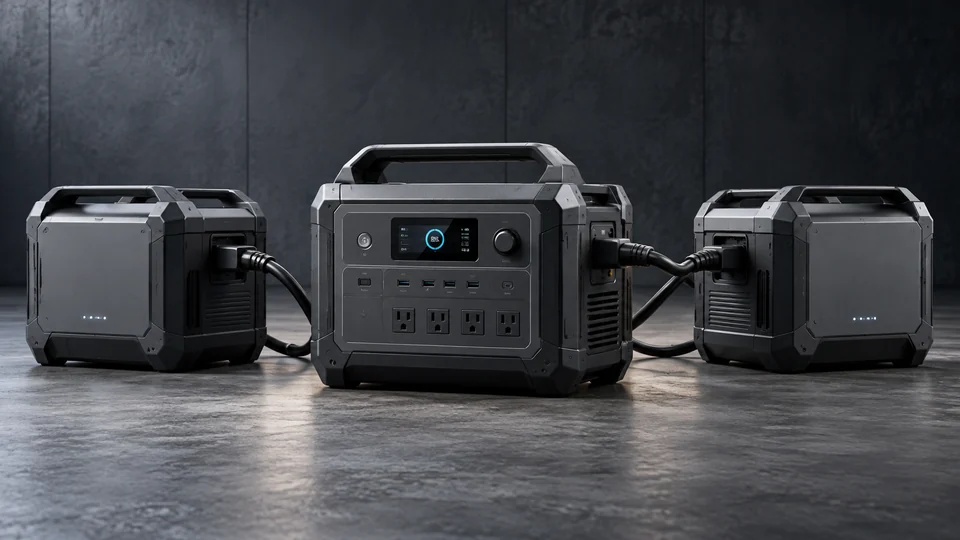
Expandable portable power stations appeal to buyers who want one battery today and a larger backup system later. A compact unit can handle laptops, lights, routers, and small appliances, while compatible expansion batteries can add meaningful reserve capacity for home backup, RV use, mobile work, or longer off-grid trips. The catch is that “expandable” can describe very different systems. Some listings include only the base station, some support several battery models, and some reach their advertised maximum capacity only after purchasing multiple accessories.
The most common mistake is choosing by watt-hours alone. Capacity tells you how much stored energy the battery is rated to hold, while continuous AC output determines which loads it can run at the same time. Solar input, expansion-battery compatibility, DC ports, charging methods, transfer behavior, weight, and package contents matter just as much. A buyer powering a refrigerator during an outage has a different priority from someone carrying a station to a campsite or running a mobile workstation.
For the broadest mix of expandable capacity, output, charging flexibility, and useful ports, the OUPES Mega 1 is the strongest overall fit in this group. Its 1,024Wh base capacity can grow to 5,120Wh with compatible B2 batteries, while its 2,000W continuous output and fast listed recharge make it practical for both everyday electronics and larger loads.
Quick Answer
- Best Overall: OUPES Mega 1 Portable Power Station for its 1,024Wh starting capacity, 2,000W output, and expansion to 5,120Wh.
- Best for Large-Scale Home Backup: Jackery HomePower 3600 Plus for its 3,584Wh base capacity, 3,600W output, and stated expansion options.
- Best for RV-Focused Expansion: BLUETTI AC200PL for its 48V RV port, 2,304Wh capacity, and support for several expansion-battery families.
- Best Compact Expandable Option: EcoFlow RIVER 3 Plus for its 286Wh base capacity, small footprint, and optional EB300 or EB600 battery support.
Best Expandable Portable Power Station Comparison Table
| Product | Best For | Base Capacity | Continuous AC Output | Expansion | Solar Input |
|---|---|---|---|---|---|
| OUPES Mega 1 | Balanced home, work, and outdoor use | 1,024Wh | 2,000W | Up to 5,120Wh with two B2 batteries | Combined AC and solar charging stated |
| Jackery HomePower 3600 Plus | High-capacity home backup | 3,584Wh | 3,600W | Up to 21kWh per unit | Solar charging supported |
| BLUETTI AC200PL | RV and flexible expansion | 2,304Wh | 2,400W | Up to 8,448Wh | Up to 1,200W |
| AFERIY 3840Wh | Large-capacity backup and workstations | 3,840Wh | 3,600W | Up to 11,520Wh | Supported, input details not fully specified |
| ABOK Ark3600 | Station-and-panel package | 3,840Wh | 3,600W | Up to 11,520Wh | Up to 2,000W PV input |
| EF ECOFLOW DELTA Pro | Heavy-duty expandable systems | 3,600Wh | 3,600W | Up to 25kWh with expansion options | Solar charging supported |
| Jackery HomePower 1000 Plus v2 | Compact expandable backup | 1,024Wh | 1,800W | Up to 11kWh with five battery packs | Not clearly specified |
| BLUETTI AC180 | Portable mid-size power | 1,152Wh | 1,800W | Not clearly specified | Up to 500W |
| EF ECOFLOW RIVER 3 Plus | Small electronics and compact setups | 286Wh | 600W | Up to 858Wh with EB300 or EB600 | Up to 220W |
The detailed reviews below focus on how each station handles expansion, output, charging, portability, and the practical trade-offs behind its advertised capacity.
1. OUPES Mega 1 Portable Power Station — Best Overall

The OUPES Mega 1 gets the central idea of an expandable power station right. Its 1,024Wh base battery is manageable for everyday backup and outdoor use, while support for up to two B2 Extra Batteries raises the advertised system capacity to 5,120Wh. That gives buyers room to start with a single unit and build toward a larger reserve instead of buying the biggest system immediately.
Its 2,000W continuous AC output is a strong match for demanding portable loads, and the listing specifies a 4,500W surge rating. Charging is another highlight, with a stated 0 to 80 percent AC recharge time of 36 minutes and a 26-minute claim using combined AC and solar input. The station also includes two 100W USB-C PD ports, four QC3.0 USB-A ports, 12V outputs, Bluetooth app control, and a stated under-20ms UPS transfer time.
Pros
- 1,024Wh base capacity expands to 5,120Wh with two B2 batteries.
- 2,000W continuous AC output and 4,500W stated surge output.
- Two 100W USB-C PD ports and four QC3.0 USB-A ports.
- Listed 0 to 80 percent AC charging time of 36 minutes.
- LiFePO4 battery and listed 3,500-plus cycle rating.
Cons
- Expansion batteries are required to reach the advertised 5,120Wh capacity.
- The listing does not provide complete solar voltage and current limits.
This is the most balanced choice for buyers who want meaningful expansion without starting with a very large base unit. It suits mobile offices, emergency essentials, tools, and mixed AC and DC loads. Buyers who need a high-capacity system immediately may prefer a 3,600Wh model instead.
To buy this product, click here.
2. Jackery HomePower 3600 Plus — Best for Large-Scale Home Backup
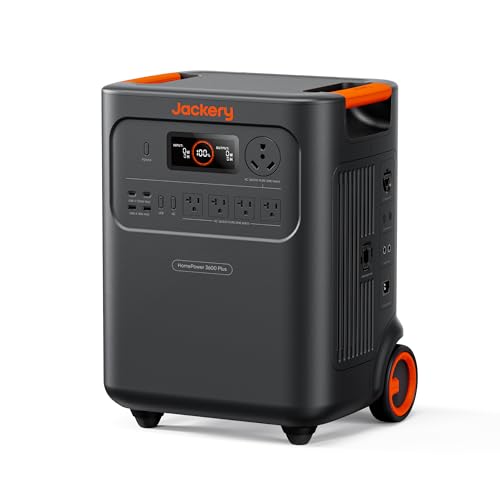
The Jackery HomePower 3600 Plus starts at a much larger 3,584Wh capacity, so it is aimed at buyers who already know they need substantial stored energy. Its 3,600W AC output is suited to the listing’s examples of pumps, heaters, and dryers, although actual appliance compatibility still depends on starting demand and total load. The advertised system can expand to 21kWh per unit, with multiple-unit expansion described separately.
This model also brings a luggage-style body with wheels and a telescoping handle, which matters when a 3.6kWh station must move between rooms or storage areas. The listing describes 120V and 240V operation in parallel, four charging methods, and hybrid AC plus DC charging. Its large base capacity makes it less nimble than a 1,000Wh station, but the wheels help shift the burden from carrying to rolling.
Pros
- Large 3,584Wh starting capacity.
- 3,600W AC output with stated 7,200W parallel capability.
- Advertised expansion up to 21kWh per unit.
- Wheels and telescoping handle support repositioning.
- Supports AC, solar, and other listed charging pathways.
Cons
- The high-capacity design is a poor fit for buyers who need easy hand carrying.
- 240V operation is described in parallel, so buyers must verify the exact setup required.
Choose this station for substantial home or basecamp backup where capacity matters more than backpack-style portability. It is excessive for phones, cameras, and occasional laptop charging, and the expansion figures should be read as system capabilities rather than included battery capacity.
To buy this product, click here.
3. BLUETTI AC200PL Portable Power Station — Best for RV-Focused Expansion

The AC200PL occupies a useful middle ground between compact stations and full-size home backup units. Its 2,304Wh LiFePO4 battery pairs with 2,400W of AC output, while the 48V RV port and 30A TT30 port give the product a particularly clear RV orientation. Buyers can also use its car port, USB outputs, and listed 48V/8A DC port for different types of equipment.
Expansion is unusually flexible on paper. The listing names B300, B210P, and B230 battery options and gives a maximum expanded capacity of 8,448Wh. Solar input is listed at up to 1,200W, and AC input can reach 2,400W, with a stated 0 to 80 percent AC recharge time of 60 minutes. The important detail is that the base unit and expansion batteries are separate considerations, so verify the desired package before planning a full system.
Pros
- 2,304Wh base capacity and 2,400W AC output.
- 48V RV port and 30A TT30 port.
- Supports several named expansion-battery families.
- Expansion potential reaches 8,448Wh according to the listing.
- Up to 1,200W solar input is specified.
Cons
- Expansion batteries are not identified as included in the base package.
- The larger capacity class is less convenient for lightweight travel.
This is a strong pick for RV owners, workshop users, and anyone who wants a clear path beyond 2kWh. Its ports are more specialized than those on small travel stations, while its capacity and expansion range make it less sensible for simple phone-and-laptop duty.
To buy this product, click here.
4. AFERIY 3840Wh Portable Power Station — Best for High-Capacity Mobile Workstations

AFERIY starts with one of the largest base batteries in this selection, rated at 3,840Wh, and pairs it with 3,600W of continuous output. That combination fits a home essentials setup, a mobile workstation, or a stationary off-grid application better than a lightweight day-trip kit. The published dimensions and 80.46-pound weight make the portability limits clear, although the pull handle helps with movement.
The system can expand to 11,520Wh with additional battery packs, and the listing describes four recharge methods, including AC, solar, car charging, and combined AC plus solar. Fifteen output ports include AC, USB-A, USB-C PD 3.0, DC5521, XT60, and a 12V car socket. A stated under-10ms UPS feature and app control add useful monitoring and backup functions, but connected-device requirements still need to be checked individually.
Pros
- 3,840Wh starting capacity.
- 3,600W continuous AC output.
- Expansion reaches 11,520Wh according to the listing.
- Fifteen output ports cover AC, USB, and several DC formats.
- Supports AC, solar, car, and combined charging methods.
Cons
- At 80.46 pounds, it is better rolled or positioned than carried far.
- Detailed solar voltage and current limits are not supplied here.
AFERIY makes sense for buyers who want a large expandable reserve from the outset and have a practical place to keep it. It is a weaker fit for frequent hand transport, and the expanded 11,520Wh figure requires separate battery hardware.
To buy this product, click here.
5. ABOK Ark3600 Portable Power Station — Best Station-and-Panel Package
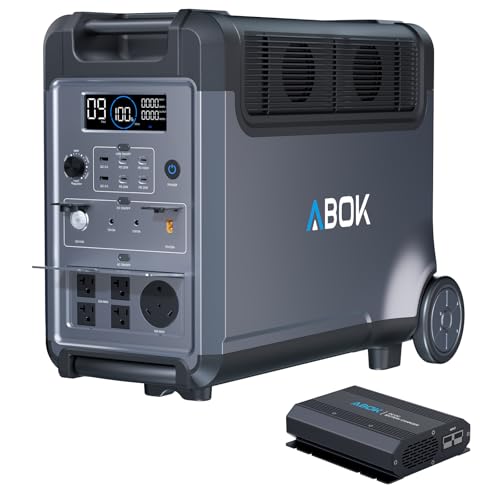
The ABOK Ark3600 combines a 3,840Wh battery with 3,600W of rated output and includes a 200W solar panel in the supplied product title. That package distinction matters for buyers assembling a solar-ready setup, although a 200W panel is separate from the station’s stated maximum 2,000W PV input. The unit also supports AC and car charging, with a listed 1,500W AC input.
Its expansion ceiling is listed at 11,520Wh, giving it a similar large-system role to the AFERIY. The 15-port layout includes a 30A AC port, four 20A AC ports, USB-A, USB-C, DC5521, XT60, and a cigarette-lighter output. Wheels and a telescoping handle reduce the hassle of moving this substantial unit, while Bluetooth control provides remote monitoring and adjustment.
Pros
- 3,840Wh base capacity and 3,600W rated output.
- 200W solar panel is identified in the product package.
- Expansion is listed up to 11,520Wh.
- Up to 2,000W PV input is specified.
- Fifteen output ports include AC, USB, and 12V formats.
Cons
- The included 200W panel does not represent the station’s full stated PV input.
- Exact panel electrical specifications are not supplied here, so compatibility details require verification.
This option suits buyers who prefer a station-and-panel listing rather than sourcing every part separately. It is a substantial basecamp or backup unit, not a casual carry-around battery, and the included panel should be viewed as a starting charging accessory rather than a guarantee of maximum solar input.
To buy this product, click here.
6. EF ECOFLOW DELTA Pro — Best for Heavy-Duty Expansion

The DELTA Pro is built around a 3,600Wh LFP battery and 3,600W AC output, giving it a serious base platform before any expansion is added. The listing describes expansion from 3.6kWh to 25kWh with DELTA Pro Extra Batteries or Smart Generators. It also states that two units can be paired for 7,200W, but that is a system configuration rather than the output of one station.
Charging flexibility is a major part of the appeal. The product supports wall, solar, car, EV station, and Smart Generator charging, with the listing providing separate charging claims for different input methods. Its 15 output methods include five AC outlets, USB-A, 100W USB-C, DC outputs, a car outlet, and an Anderson port. App control adds remote status and settings management, though the system’s size and accessory requirements make it a deliberate investment.
Pros
- 3,600Wh base capacity.
- 3,600W AC output with stated X-Boost expansion to 4,500W.
- System capacity can reach 25kWh with listed expansion options.
- Five charging pathways are identified.
- Fifteen output methods support varied equipment.
Cons
- The 25kWh figure requires additional equipment and is not included base capacity.
- Pairing two units for 7,200W involves a separate system arrangement.
DELTA Pro is a compelling fit for buyers planning a large, modular backup setup with several charging routes. It is excessive for light camping and small electronics, while buyers should map the complete expansion system before assuming the maximum capacity or output applies to a single base unit.
To buy this product, click here.
7. Jackery HomePower 1000 Plus v2 — Best Compact Expandable Backup

The HomePower 1000 Plus v2 is aimed at buyers who want a manageable 1,024Wh starting point with a clear growth path. Up to five battery packs can raise the advertised capacity to 11kWh, although the extra packs are sold separately. Its 1,800W rated output and 3,600W surge rating give the base unit useful headroom for appliances and tools within their electrical limits.
Jackery adds two independently controlled AC circuits, allowing users to prioritize selected equipment and shut down a secondary circuit at a chosen battery level. A stated under-10ms UPS function, app control, and 1.25-hour wall recharge claim add convenience for home-office and essential-device use. The station is also described as 18 percent smaller than the Explorer 1000v2, but the supplied material does not provide its actual weight.
Pros
- 1,024Wh base capacity can expand to 11kWh.
- 1,800W rated AC output.
- Two independently controlled AC circuits support load prioritization.
- Under-10ms UPS behavior is specified.
- Wi-Fi and Bluetooth app control are included.
Cons
- Expansion packs are sold separately.
- Solar input specifications are not clearly stated in the supplied material.
This is a sensible choice for a home office, refrigerator-and-router setup, or small workshop that may grow over time. It offers more control than many basic 1,000Wh stations, but buyers focused on solar recharging should verify the exact input details before building a panel plan.
To buy this product, click here.
8. BLUETTI AC180 — Best for Portable Mid-Size Power

The AC180 is the least clearly expandable option in this group, but it remains relevant for buyers who value portable power first and may prefer a straightforward station over a large modular system. Its 1,152Wh LiFePO4 battery provides a little more base capacity than the 1,024Wh models here, while its 1,800W AC output covers a wide range of everyday loads.
Solar input is specified at up to 500W, and the listing states that the station can fully charge in one hour using 1,440W AC input. It includes eight outlets, app-based output boosting to 2,700W, and a stated 20ms UPS function. The supplied data does not identify an expansion-battery system, so buyers should treat the AC180 as a fixed-capacity choice rather than assuming a larger battery can be attached later.
Pros
- 1,152Wh LiFePO4 base capacity.
- 1,800W AC output with 2,700W boosted output stated.
- Up to 500W solar input.
- Eight outlets provide flexible connections.
- 20ms UPS behavior is specified.
Cons
- An expansion-battery option is not clearly specified.
- Its 1,152Wh capacity is smaller than the large expandable systems in this roundup.
Pick the AC180 if portability, solar input, and a capable fixed base unit matter more than future capacity growth. It is a strong mid-size alternative, but shoppers specifically searching for a modular battery ecosystem should start with the OUPES, BLUETTI AC200PL, or larger systems above.
To buy this product, click here.
9. EF ECOFLOW RIVER 3 Plus — Best Compact Expandable Option

The RIVER 3 Plus proves that expandable does not have to mean huge. Its 286Wh base capacity can grow to 858Wh with the listed EB300 or EB600 batteries, creating a compact system for networking gear, laptops, lights, cameras, and other modest loads. Its 600W continuous output and 1,200W X-Boost figure keep the station in a smaller power class, so it should not be treated like a 1,000Wh or 3,600Wh home-backup unit.
Its compact design is paired with a stated 10.4-pound weight, dimensions of 9.2 by 9.1 by 5.8 inches, and a listed 30dB operating claim. Solar input reaches 220W, AC charging is stated at one hour from empty to full, and the unit includes a high-speed USB-C port, three UPS-supported AC outlets, and app control through Wi-Fi and Bluetooth. The optional battery connection uses the listed Pogo Pin design.
Pros
- 286Wh base capacity expands to 858Wh with named batteries.
- 600W continuous output and 1,200W X-Boost output.
- 220W solar input is specified.
- 10.4-pound weight and compact dimensions are listed.
- Three UPS-supported AC outlets and app control are included.
Cons
- Its 286Wh starting capacity is small for refrigerators, heaters, and other sustained high loads.
- Expansion still tops out below the capacity of the larger stations reviewed here.
This is the right kind of expandable station for a desk, small travel kit, or electronics-focused campsite. Buyers who want meaningful appliance backup should move up to a 1,000Wh or larger model, while compact-system shoppers will appreciate that the optional batteries preserve a relatively small footprint.
To buy this product, click here.
Buying Guide
Start With Base Capacity, Then Study Expansion
A station advertised at 1,024Wh begins with roughly 1,024 watt-hours of nominal battery energy. That figure is not the same as guaranteed AC energy delivered to your appliances because inverter losses, idle consumption, cutoffs, and load behavior affect results. Expansion figures also describe a possible system maximum, not what arrives in every base package. Check whether the extra batteries are included, which battery models are supported, and whether the expanded system changes output limits.
Match Continuous Output to Your Loads
Continuous AC output is the figure to use for sustained demand. Surge or peak output may help with brief startup demand, but a 4,500W surge rating does not turn a 2,000W station into a 4,500W continuous inverter. Refrigerators, pumps, compressors, heaters, and power tools deserve special caution because their startup behavior may exceed their ordinary running draw.
Read Solar Input as an Electrical Specification
A solar input rating in watts is only one part of the connection. Voltage range, current limit, connector, and panel specifications must also match. The ABOK listing identifies up to 2,000W PV input and includes a 200W panel, but that does not prove the included panel can provide the maximum input. Connector shape alone is not proof of electrical compatibility, so verify the station’s input limits before adding panels.
Separate Charging Claims From Real-World Runtime
A stated 0 to 80 percent charging time applies to the listed input method and conditions. It should not be rewritten as a full-charge time. Runtime is similarly load-dependent. A station running a 100W load cannot be assigned an exact runtime from nominal Wh alone without accounting for conversion losses, idle draw, and battery cutoffs.
Choose Ports for the Devices You Actually Use
USB-C is a connector type, while USB-C PD identifies a power-delivery standard and profile. A 12V socket also does not guarantee compatibility with every 12V appliance. Check the individual port ratings, cable requirements, and device input specifications. RV buyers may benefit from the BLUETTI AC200PL’s 48V and TT30 ports, while laptop users may prefer models with clearly stated 100W USB-C PD outputs.
Understand UPS, Expansion, and Home Connections
A stated transfer time describes a product feature, but it does not guarantee compatibility with every computer, network device, or medical device. Verify the requirements of critical equipment before relying on a portable station. Expansion batteries add stored capacity, not automatically higher AC output. These stations are portable plug-in systems, so do not connect one to household wiring through a wall outlet or attempt backfeeding.
Best Expandable Portable Power Station FAQ
What makes a portable power station expandable?
An expandable station has a supported connection for one or more external battery packs. The added battery increases stored energy, but it may not increase the station’s continuous AC output. Check the exact expansion-battery model and whether it is included with the package.
Is a higher expanded capacity always better?
Higher capacity can provide more reserve, but the extra batteries add cost, size, and weight. A 5,120Wh system may be unnecessary for laptops and lights, while a 286Wh station may be too small for sustained appliance loads. Match the base and expanded capacity to the equipment you expect to run.
Can I use any battery from the same brand?
No. Brand matching does not establish compatibility. The OUPES Mega 1, BLUETTI AC200PL, Jackery HomePower 1000 Plus v2, and RIVER 3 Plus each identify particular expansion systems. Use only the battery family specified for the exact model.
Does expandable mean the extra battery is included?
No. Product listings commonly describe maximum system capacity separately from the base package. Unless the supplied package specifically identifies an expansion battery, assume the advertised maximum requires a separate purchase and verify the included items.
Can an expandable station run a refrigerator?
Some reviewed models have enough stated continuous output for many refrigerator loads, but compatibility depends on the refrigerator’s running demand, startup demand, and cycling behavior. A surge number alone does not guarantee startup success. Check the appliance specifications and the station’s operating limits.
Are solar panels included with these power stations?
Most stations in this roundup are station-only listings. The ABOK Ark3600 product title identifies a 200W solar panel, while the other products list solar charging without establishing that a panel is included. Confirm the exact package and panel electrical specifications before buying.
Is a portable power station suitable for medical equipment?
Suitability depends on the exact device, its input requirements, runtime needs, and whether uninterrupted operation is necessary. A listed UPS feature or USB-C port is not a universal medical-device guarantee. Verify the complete arrangement with the equipment documentation and qualified guidance.
Final Verdict
The OUPES Mega 1 is the strongest overall expandable portable power station in this selection because it balances a manageable 1,024Wh starting capacity with 2,000W continuous output, multiple useful USB and DC ports, fast listed charging, and expansion to 5,120Wh. It gives buyers a credible upgrade path without forcing them to begin with a very large 3,600Wh-class unit.
For larger backup plans, the Jackery HomePower 3600 Plus, AFERIY 3840Wh, ABOK Ark3600, and EcoFlow DELTA Pro offer much larger starting reserves. The BLUETTI AC200PL is especially appealing for RV-oriented buyers, while the Jackery HomePower 1000 Plus v2 provides a smaller expandable foundation. For compact electronics, the RIVER 3 Plus is easier to manage. Compare base capacity, continuous output, solar limits, expansion-battery cost, and the exact included package before choosing your system.
