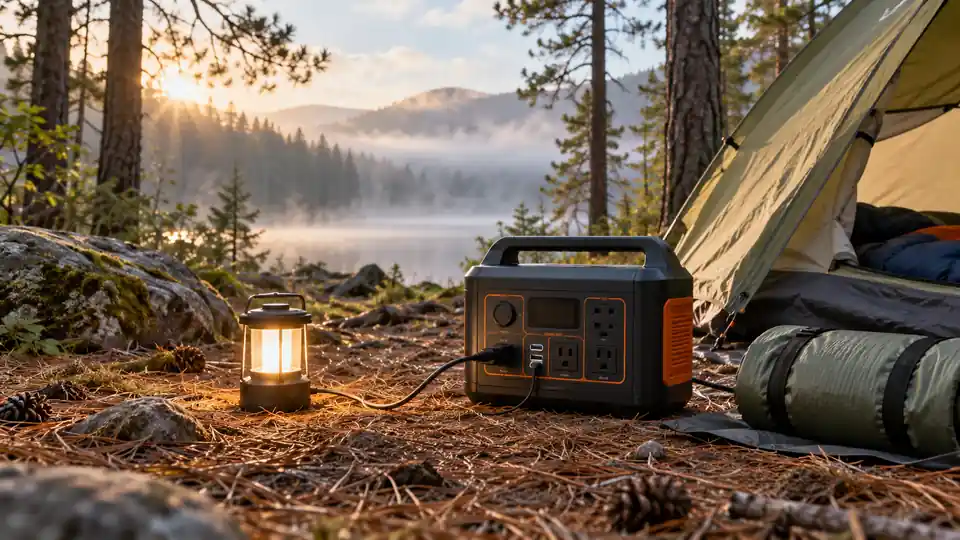
Camping can mean carrying a battery to a tent or unloading it beside a vehicle. Those two trips reward different choices. A 25-pound station can be reasonable for a drive-in site and burdensome on a trail, even when its extra energy looks attractive on a comparison sheet.
The Elite 100 V2 suits a vehicle-supported camp with refrigeration or several AC devices. Explorer 300 and ALLWEI are easier to carry for personal electronics. Choose the load and transport method before choosing the largest battery.
Elite 100 V2 accepts up to 1,000W solar input within 12–60V and 20A. That ceiling describes its input circuit, not the output of a single camping panel. Position the panel away from shade while keeping the battery dry and ventilated.
Quick Answer
- Best Overall: BLUETTI Elite 100 V2 for its 1,024Wh capacity, 1,800W continuous output, 11 ports, and 25-pound design.
- Best for Higher Capacity: BLUETTI AC180 for its 1,152Wh battery, 1,800W output, and stated 500W solar input.
- Best Compact Option: Jackery Explorer 300 for its 292Wh capacity, 300W output, and 7.5-pound weight.
- Best Lightweight Option: HOWEASY 88Wh Portable Power Station for its 2.3-pound size, built-in light, and broad selection of small-device outputs.
Best Portable Power Station for Camping Comparison Table
| Product | Best For | Capacity | Continuous AC Output | Weight | Solar / Recharge Details |
|---|---|---|---|---|---|
| BLUETTI Elite 100 V2 | Best Overall | 1,024Wh | 1,800W | 25 lb | 1,000W; 12–60V, 20A |
| BLUETTI AC180 | Best for Higher Capacity | 1,152Wh | 1,800W | About 35.3 lb | 500W; 12–60V, 10A |
| Jackery Explorer 1000 v2 | Best for App-Controlled Camping Power | 1,070Wh | 1,500W | 23.8 lb | 400W maximum; approved panel/cable |
| Jackery Explorer 300 | Best Compact Option | 292Wh | 300W | 7.5 lb | Jackery panels supported |
| EnginStar 300W Portable Power Station | Best for Small AC and DC Loads | 296Wh | 300W | 6.5 lb | Compatible 12–25V panel |
| ALLWEI 300W Portable Power Station | Best Lightweight LFP Option | 256Wh | 300W | 6.4 lb | 100W panel listed for charging |
| MARBERO M823 300W | Best for Compact Lighting and Device Charging | 237Wh | 300W | 4.6 lb | 16.4–24V, 2.7A maximum |
| HOWEASY 88Wh Portable Power Station | Best Lightweight Option | 88Wh | 120W | 2.3 lb | 15–24V panel |
| DARAN Portable Power Station 288Wh LiFePO4 | Best for a Small Multi-Device Camp | 288Wh | 350W | 8.2 lb | Supported, panel optional |
The detailed reviews below show where each station fits, from lightweight personal gear to higher-demand campsite equipment.
1. BLUETTI Elite 100 V2 — Best Overall

The BLUETTI Elite 100 V2 has the most balanced camping profile in this group. Its 1,024Wh battery gives a substantial energy reserve for a long weekend, while the 1,800W continuous AC rating leaves room for more demanding campsite equipment than the 300W class can handle. The listing also identifies 11 ports, so a group can charge phones, cameras, laptops, and other gear without constantly swapping cables.
At 25 pounds, this is best viewed as a vehicle-to-campsite station rather than a backpacking battery. The hidden handle and stated 17-liter design should make that short carry more manageable, and the listing claims a 30dB silent mode for overnight use. Its app adds Wi-Fi and Bluetooth monitoring, while the advertised 10ms UPS feature is useful for supported electronics, though that does not make the unit a guarantee for every device or medical setup.
Pros
- 1,024Wh capacity suits extended camping and basecamp use.
- 1,800W continuous AC output provides appliance headroom beyond the compact stations.
- Eleven ports support several devices at once.
- LiFePO4 battery chemistry and a stated 4,000-plus-cycle claim to 80% are supplied.
- App control, a hidden handle, and a listed 30dB silent mode add practical convenience.
Cons
- At 25 pounds, it is too substantial for most backpacking trips.
- Its solar input accepts up to 1,000W within 12–60V and 20A; panel choice and useful sunlight still govern actual replenishment.
This is the best match for car campers, family campsites, and off-grid basecamps that need meaningful AC power without stepping into a much larger unit. Backpackers and minimalist campers should look at the smaller Jackery, ALLWEI, MARBERO, or HOWEASY options instead.
To buy this product, click here.
2. BLUETTI AC180 — Best for Higher Capacity

AC180 combines 1,152Wh with 1,800W continuous AC output. Its 2,700W Power Lifting feature is intended for supported resistive loads; it is not a general motor-start allowance or a larger continuous rating. Match the actual equipment to the ordinary AC specification.
Solar charging is one of its clearest strengths on paper. The listing specifies a 500W solar input and describes a 2.8-to-3.3-hour solar charging claim, though actual results depend on panel conditions and the complete setup. The package includes AC, car, and solar charging cables, plus a stated five-year warranty. Its 20ms UPS claim applies to supported backup use and should not be read as proof of compatibility with every computer or essential device.
Pros
- 1,152Wh nominal capacity provides reserve for compatible loads.
- 1,800W continuous output supports substantial AC loads.
- 500W solar input is explicitly listed.
- AC, car, and solar charging cables are included.
- LiFePO4 battery chemistry and a five-year warranty are stated.
Cons
- At approximately 35.3 pounds, AC180 favors a vehicle-supported or stationary setup over frequent long carries.
- Power Lifting is a conditional resistive-load mode, not 2,700W continuous output.
At approximately 35.3 pounds, AC180 favors a vehicle-supported or stationary setup over frequent long carries.
To buy this product, click here.
3. Jackery Explorer 1000 v2 — Best for App-Controlled Camping Power

The Explorer 1000 v2 sits between the two BLUETTI choices in capacity at 1,070Wh, while its 1,500W continuous AC output remains substantial for campsite equipment. At 23.8 pounds, it is still a vehicle-camping product, but the foldable handle helps with moving it from a trunk to a tent or picnic table. Three AC ports, two USB-C ports, one USB-A port, and a car port give it a useful spread for mixed camping gear.
Its app is the distinctive feature. Campers can select an emergency charging mode, a 30dB quiet overnight charging mode, or an energy-efficiency mode. The listing says the one-hour full-charge setting must be activated in the app, while the default charging mode is 1.7 hours. Solar charging is restricted to Jackery panels according to the listing information, and the panel itself is not included, so the advertised station capacity should be planned as a battery reserve rather than an automatic solar kit.
Pros
- 1,070Wh capacity suits multi-day vehicle camping.
- 1,500W continuous AC output handles larger loads than compact stations.
- 100W USB-C PD support is listed.
- App modes include emergency, quiet, and energy-efficiency charging.
- LiFePO4 chemistry and a stated 4,000-cycle claim to over 70% capacity are supplied.
Cons
- Solar charging is stated to work only with Jackery solar panels.
- The solar panel is not included, and the unit weighs 23.8 pounds.
This model suits campers who appreciate app control and want a large battery without moving to the heaviest option here. It is less attractive for buyers seeking broad third-party solar flexibility or a station light enough for a long carry.
To buy this product, click here.
4. Jackery Explorer 300 — Best Compact Option

The Explorer 300 is a sensible middle ground for campers who need more than a phone-sized battery but do not want to haul a 20-plus-pound station. Its 292Wh capacity and 300W continuous AC output can serve laptops, cameras, drones, lights, and other moderate electronics. The 7.5-pound weight is easy to account for in a vehicle or carried a short distance to camp.
Port selection is generous for this size. Two AC outlets, a 100W USB-C PD port, two USB-A ports, and a 120W car port let several small devices charge together. The listing identifies LiFePO4 chemistry and a 4,000-cycle claim to 70% capacity. Jackery solar panels are supported, but the panel is sold separately, so buyers should check the exact charging arrangement before heading off-grid.
Pros
- 292Wh capacity gives more reserve than ultra-compact stations.
- 300W continuous and 600W peak output are clearly stated.
- 7.5-pound weight keeps transport manageable.
- 100W USB-C PD supports compatible laptops and other devices.
- LiFePO4 chemistry and Jackery solar-panel support are listed.
Cons
- The 300W continuous limit excludes many high-demand appliances.
- The solar panel is not included.
The Explorer 300 is a strong fit for weekend campers carrying electronics, lights, and camera equipment. It makes less sense for electric cooking, refrigeration loads, or a campsite where several large AC appliances will run together.
To buy this product, click here.
5. EnginStar 300W Portable Power Station — Best for Small AC and DC Loads

EnginStar offers nearly the same battery class as the Explorer 300, with 296Wh capacity and 300W continuous AC output, but it puts extra emphasis on separate DC outputs. Two AC outlets, regulated 12V and 24V DC outputs, USB-A, and 18W USB-C cover a broad collection of small camping electronics. At 6.5 pounds, it is easy to place in a vehicle, gear bin, or beside a compact tent setup.
The listing identifies pure sine wave AC outlets and three recharge routes: wall power, a 12V car socket, and a compatible 12-to-25V solar panel. It also states a maximum charging speed of 65W and an 80% charging claim in two hours. Those figures describe the seller’s published specifications, not a guaranteed field result. The supplied package includes home and car charging cables, while the solar panel is separate.
Pros
- 296Wh capacity and 300W continuous AC output fit everyday camping electronics.
- Two regulated 12V/24V DC outputs are useful for compatible DC equipment.
- Two AC outlets and eight total output ports support several devices.
- Compatible 12–25V solar charging is listed.
- At 6.5 pounds, it is lighter than many stations in its capacity class.
Cons
- The 18W USB-C output is modest for demanding USB-C laptops.
- The solar panel is not included.
EnginStar is a practical choice for campers who split their gear between AC and DC power and want a compact station with clearly listed charging methods. Buyers whose main priority is USB-C laptop charging should compare its 18W port with the 60W or 100W options elsewhere in this group.
To buy this product, click here.
6. ALLWEI 300W Portable Power Station — Best Lightweight LFP Option
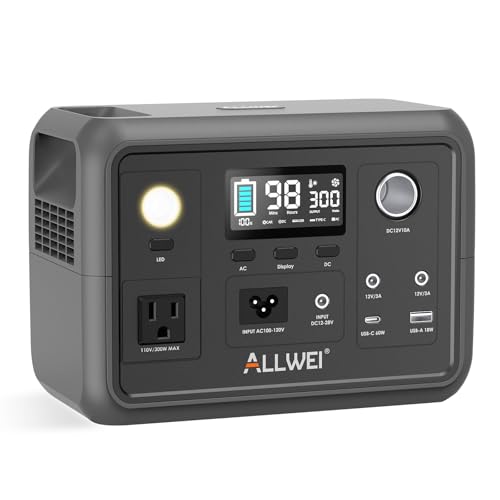
ALLWEI keeps the familiar compact-station format but pairs a 256Wh battery with a 300W continuous AC rating and a 6.4-pound body. Its one AC outlet, two DC5521 ports, car port, USB-A, and 60W USB-C PD port cover the essentials for a solo camper carrying a laptop, phone, camera, and small accessories. The 60W USB-C output is especially useful for compatible devices that outgrow basic phone-charging ports.
The listing states LiFePO4 chemistry, 3,000 charge-discharge cycles, pass-through charging, and four charging routes when dual charging is counted. It specifies 3.5-to-4-hour AC or car charging and lists 4-to-5-hour solar charging with a 100W panel. Those are published charging claims, and the panel is not included. The built-in three-level light with SOS mode adds a simple campsite function without requiring a separate lantern.
Pros
- 300W continuous output and 600W peak output are listed.
- 60W USB-C PD is stronger than the USB-C ports on several compact rivals.
- LiFePO4 battery chemistry and 3,000-cycle claim are supplied.
- 6.4-pound weight is manageable for short carries.
- 100W solar-panel charging and dual charging are described.
Cons
- Its 256Wh capacity is lower than the Jackery Explorer 300 and EnginStar.
- Only one AC outlet is listed.
ALLWEI is well suited to solo campers who rely heavily on USB-C devices and want a light station with a stated LFP battery. A larger group or a campsite using multiple AC devices will benefit from a station with more AC outlets and greater capacity.
To buy this product, click here.
7. MARBERO M823 300W — Best for Compact Lighting and Device Charging

The MARBERO M823 is unusually easy to carry for a 300W-class station. Its stated 4.6-pound weight and compact dimensions make it a natural companion for car camping, day trips, and compact gear kits. The 237Wh capacity is enough for small electronics, while two AC outlets, USB-A ports, an 18W USB-C port, and a DC output create plenty of connection points around a tent or picnic table.
Lighting is the M823’s most campsite-specific feature. It has a top flashlight plus a side light with steady, twinkling, and SOS modes, giving it more built-in illumination than many basic battery stations. The listing specifies 16.4-to-24V solar input with a 2.7A maximum, along with wall and 12V car charging. The solar panel is separate, and the 18W USB-C output is better suited to phones and smaller electronics than high-demand laptops.
Pros
- 4.6-pound weight makes it easy to move around camp.
- 300W continuous output and 375W peak output are listed.
- Two AC outlets and several USB ports support multiple small devices.
- Two built-in lights include SOS functionality.
- Solar, wall, and car charging methods are supplied in the specifications.
Cons
- Its 237Wh capacity is smaller than several other 300W options here.
- USB-C output is limited to 18W.
The M823 fits campers who value low carry weight, built-in illumination, and many small-device ports. It is a less convincing choice for USB-C laptops, large appliances, or trips where the extra capacity of a 256Wh or 296Wh station would be useful.
To buy this product, click here.
8. HOWEASY 88Wh Portable Power Station — Best Lightweight Option

At 2.3 pounds and 6.6 by 4 by 3 inches, the HOWEASY is the easiest station here to slip into a small camping bag. Its 88Wh battery and 120W continuous AC output are aimed at phones, cameras, lights, headphones, tablets, and other modest electronics. Two AC sockets, two QC 3.0 USB ports, a standard USB port, USB-C, and two DC ports give this small unit an unusually broad port mix.
The built-in LED provides steady, flashing, and SOS modes, which can replace a small emergency light in a minimalist kit. It supports wall, car, and 15-to-24V solar charging, with the panel sold separately. The published specifications also describe simultaneous charging and use, but that pass-through feature should not be confused with a UPS function or uninterrupted backup for sensitive equipment.
Pros
- 2.3-pound weight is excellent for lightweight camping.
- Eight output ports cover phones, lights, cameras, and other small devices.
- 120W continuous AC output is suitable for loads below that rating.
- Three recharge methods are listed.
- Built-in lighting includes steady, flash, and SOS modes.
Cons
- 88Wh capacity is much lower than every other station in this selection.
- Its 120W continuous output limits the connected equipment.
The HOWEASY is the right scale for a hiker who wants emergency charging and light without carrying a full-size power station. It should be skipped for multi-day basecamp use, large appliances, or any plan that depends on extended AC runtime.
To buy this product, click here.
9. DARAN Portable Power Station 288Wh LiFePO4 — Best for a Small Multi-Device Camp

DARAN NEO300L puts 288Wh and 350W output into an 8.2-pound station. It occupies the useful space between a tiny personal battery and a vehicle-only reserve, especially when a tent kit includes several chargers rather than a high-power cooker.
Solar charging is supported, but the panel is optional. Budget the devices for the stay before adding a panel: the station’s 350W ceiling describes eligible loads, while 288Wh describes the finite reserve.
Pros
- 288Wh LiFePO4 battery suits medium-sized imaging kits.
- Two AC outlets make simultaneous equipment connection easier.
- 60W USB-C port supports compatible laptop and camera charging needs.
- At 8.2 pounds, it remains manageable for vehicle-based field use.
- LCD and rear lighting provide useful status and visibility features.
Cons
- 350W continuous output is lower than the BLUETTI Elite 30 V2.
- Solar panels and car charging cables are not included in the listed package.
A modest tent or overnight electronics kit is the sensible assignment.
To buy this product, click here.
Buying Guide
Match Battery Capacity to the Trip
Capacity is expressed in watt-hours, or Wh, and represents stored energy rather than guaranteed AC energy delivered to your equipment. The 88Wh HOWEASY is aimed at short electronics-focused outings, while the 1,024Wh to 1,152Wh BLUETTI models are better suited to longer vehicle-based camping. AC conversion losses, idle consumption, load changes, and device charging behavior affect actual use, so treat the printed capacity as a comparison point rather than a promise of runtime.
Separate Continuous Output from Peak Output
Continuous wattage is the rating to compare with the normal operating demand of an appliance. Peak or surge wattage may help with a brief startup event, but it does not turn a 300W station into a 600W continuous source. The Explorer 300, EnginStar, ALLWEI, and MARBERO are compact 300W-class stations, while the Elite 100 V2 and AC180 provide 1,800W continuous output. Check the appliance rating and startup requirements before connecting equipment.
Choose Ports for the Gear You Actually Carry
Port variety can matter more than a long feature list at camp. The Explorer 1000 v2 supplies two USB-C ports and three AC ports, while ALLWEI lists a 60W USB-C PD port. The HOWEASY includes many small-device connections, but its 120W AC limit remains the controlling factor. A USB-C connector alone does not establish a particular charging protocol or wattage, so match the published port rating with your device and cable.
Read Solar Input Details Carefully
A solar-ready station still needs an electrically compatible panel. The MARBERO listing specifies a 16.4-to-24V input and 2.7A maximum, while EnginStar lists a compatible 12-to-25V panel range. The AC180 lists 500W solar input, and the Explorer 1000 v2 is described as compatible only with Jackery solar panels. Connector shape and panel wattage alone do not prove compatibility. Check voltage, current, connector, and the station’s instructions before buying a panel.
Think About Carrying and Placement
Weight changes the best choice dramatically. The HOWEASY at 2.3 pounds and MARBERO at 4.6 pounds are easier to carry from a trailhead, while the 23.8-pound Jackery and 25-pound BLUETTI Elite are better transported by vehicle. A larger station can offer more energy and output, but it also needs a sensible storage and carrying plan. For tent camping, keep the station protected from moisture and follow the manufacturer’s charging and operating guidance.
Understand Battery and Backup Claims
LiFePO4 or LFP chemistry appears in several listings, including the Jackery Explorer models, BLUETTI units, and ALLWEI. Cycle claims preserve the stated threshold and test conditions, so they should not be converted into a guaranteed service life. UPS, pass-through charging, and emergency power features are separate concepts. A pass-through function does not establish UPS behavior, and a stated transfer time does not guarantee compatibility with every computer or medical device.
Best Portable Power Station for Camping FAQ
What size power station is best for camping?
For phones, lights, cameras, and a few small electronics, an 88Wh to 300Wh station can be appropriate. Longer vehicle camping or higher-demand AC equipment calls for a model in the 1,000Wh class, such as the BLUETTI Elite 100 V2, BLUETTI AC180, or Jackery Explorer 1000 v2. Start with the wattage and expected use of each device rather than choosing by capacity alone.
Can a portable power station run a CPAP while camping?
Several listings mention CPAP use, but suitability depends on the exact CPAP model, power adapter, humidifier, heated hose, and required runtime. The station’s output must match the device’s electrical needs, and a published capacity does not guarantee an overnight result. Verify the complete setup with the CPAP manufacturer and test the intended configuration before relying on it away from home.
Are portable power stations safe to use inside a tent?
The reviewed products are battery power stations rather than fuel-burning generators, but the listings do not establish blanket safety for every enclosed space or charging condition. Keep the unit dry, maintain ventilation around cooling areas, follow the product instructions, and avoid exposing it to conditions outside its stated guidance. Do not treat a battery station as waterproof unless the complete product has an applicable rating.
Do these camping power stations include solar panels?
No. The product listings identify the solar panels as separate for the Jackery Explorer 300, Explorer 1000 v2, EnginStar, ALLWEI, MARBERO, and HOWEASY models. The BLUETTI listings provide solar charging information or cables, but the supplied package details do not identify an included solar panel. Confirm the exact package before purchase.
Can a 300W power station run a refrigerator?
A 300W continuous rating may be lower than a refrigerator’s normal or startup requirements, and the published specifications does not establish refrigerator compatibility for these compact models. Compressor startup demand and cycling behavior matter, so do not rely on the peak number alone. Check the refrigerator’s electrical specifications and the power station’s continuous and surge requirements together.
Which camping power station is easiest to carry?
The HOWEASY is the lightest listed model at 2.3 pounds. The MARBERO weighs 4.6 pounds, while ALLWEI and EnginStar weigh 6.4 and 6.5 pounds. The Jackery Explorer 300 weighs 7.5 pounds. The larger BLUETTI and Jackery units offer more capacity or output but are better suited to vehicle transport than long-distance carrying.
Can I charge a power station from a solar panel and use it at the same time?
Some listings describe simultaneous charging and device use, but that does not establish the same behavior for every model or every output. Solar input also varies with panel conditions and electrical limits. Review the exact station’s instructions, verify panel compatibility, and avoid assuming that a connected panel will fully offset the load.
Final Verdict
For a drive-in camp, the Elite 100 V2 offers considerably more appliance headroom than the compact options. For a tent reached on foot, Explorer 300 or ALLWEI keeps the carrying burden lower; HOWEASY is limited to a small personal charging kit.
Solar replenishment should be planned around daylight and the actual panel, not the station’s maximum input alone. A fast input circuit does not make a shaded campsite a fast charging site.
