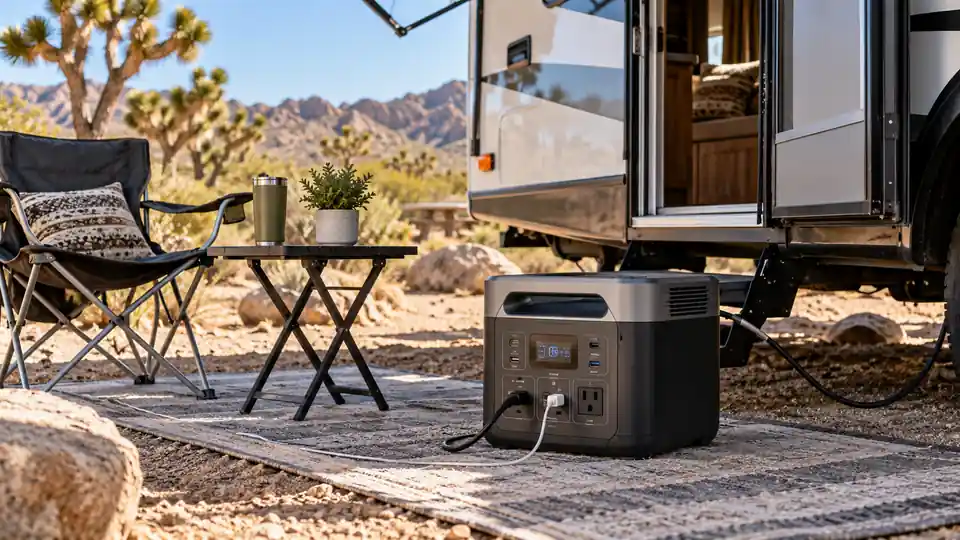
RV power needs can swing from a few phones and a laptop to a refrigerator, water pump, CPAP machine, or microwave. That makes the best portable power station for RV use a very different purchase from a small camping battery. A compact 300Wh unit may be easy to store under a seat, while a 2,000Wh or 3,000Wh model can better suit extended stays away from hookups, provided its output, charging options, and physical size fit the rig.
A common mistake is judging these stations by watt-hours alone. Capacity tells you how much energy the battery is rated to store, while continuous AC output tells you which appliances the inverter may support. RV buyers should also check for a TT-30 outlet, useful 12V output, solar and car charging, the exact package contents, and the difference between a stated surge rating and continuous power. Priorities vary widely. A couple who mainly charges electronics may prefer a light 300Wh station, while a boondocking setup may need the larger BLUETTI Elite 300 or EcoFlow DELTA 3 Max.
Among these options, the BLUETTI Elite 300 is the strongest overall match for RV use because it combines a 3,014.4Wh rating, 2,400W output, a TT-30 RV outlet, and 12V/30A DC output in one package. Smaller Jackery, BLUETTI, EnginStar, and ZeroKor models make more sense for lighter loads, while the EcoFlow offers a powerful alternative for buyers who place greater emphasis on high-demand appliances and rapid recharging.
Quick Answer
- Best Overall: BLUETTI Elite 300 Portable Power Station for its 3,014.4Wh capacity, 2,400W output, TT-30 outlet, and 12V/30A DC output.
- Best for Higher Loads: EF ECOFLOW DELTA 3 Max for its 2,048Wh LFP battery and stated 2,400W output.
- Best Mid-Size Option: Jackery Explorer 1000 v2 for its 1,070Wh capacity, 1,500W output, and 23.8-pound listed weight.
- Best Station-and-Panel Kit: ZeroKor 300W Portable Solar Generator because the listed package includes a 60W foldable solar panel.
Best Portable Power Station for RV Comparison Table
| Product | Best For | Capacity | Continuous AC Output | RV-Relevant Feature |
|---|---|---|---|---|
| BLUETTI Elite 300 | RV appliances and extended stays | 3,014.4Wh | 2,400W | TT-30 and 12V/30A DC |
| EF ECOFLOW DELTA 3 Max | Higher-demand appliances | 2,048Wh | 2,400W | Less-than-10ms transfer claim |
| Jackery Explorer 1000 v2 | Mid-size RV electronics | 1,070Wh | 1,500W | Three AC outlets and 100W USB-C PD |
| STARYLINE 1000W | RV electronics and small appliances | 1,024Wh | 1,000W | Up to 300W solar input stated |
| BLUETTI Elite 30 V2 | Compact RV setups | 288Wh | 600W | 10ms UPS claim and 9.4-pound weight |
| Jackery Explorer 300 | Light electronics | 292Wh | 300W | 7.5-pound weight and 120W car port |
| EnginStar 300W | Basic RV and road-trip loads | 296Wh | 300W | Two pure sine wave AC outlets |
| ZeroKor 300W Solar Generator | Off-grid electronics with panel included | Not clearly specified | 300W maximum stated | 60W foldable solar panel included |
| Jackery Explorer 1000 v2 Dune White | Same mid-size setup in a different finish | 1,070Wh | 1,500W | 100W USB-C PD and app control |
The detailed reviews below put each station’s capacity, output, charging setup, and RV usefulness into practical context.
1. BLUETTI Elite 300 Portable Power Station for RV and Home Backup — Best Overall
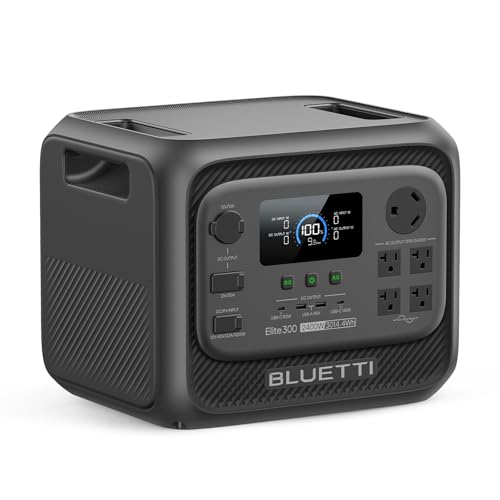
The BLUETTI Elite 300 is the clearest RV-focused choice in this group because its connection layout speaks directly to common camper electrical needs. The listing specifies a TT-30 RV outlet and a 12V/30A DC output, which are more relevant to many RV setups than a long row of general-purpose USB ports. Its 3,014.4Wh rated capacity also gives it a much larger energy reserve than the compact stations here, although delivered AC energy will depend on inverter losses, idle consumption, load behavior, and other operating conditions.
Its 2,400W continuous output gives the station a broad appliance range on paper, while the stated 4,800W surge rating may help with certain starting demands. That does not guarantee compatibility with every compressor, motor, heater, or microwave, so buyers should compare the actual appliance requirements before connecting them. The 10ms UPS claim and app control add useful flexibility for routers, computers, and monitoring, while AC, solar, and car charging suit a rig that moves between driveway backup and off-grid travel.
Pros
- Large 3,014.4Wh rated capacity for longer RV power needs.
- 2,400W continuous output is the highest stated continuous rating among the BLUETTI models here.
- Dedicated TT-30 RV outlet suits compatible RV connections.
- 12V/30A DC output is useful for listed RV loads such as 12V refrigerators and water pumps.
- AC, solar, and car charging options support several charging pathways.
Cons
- The listing does not provide a product weight in the supplied specifications.
- The rated battery capacity should not be treated as guaranteed usable AC energy.
This is the station for RV owners who want a substantial battery reserve and direct RV-oriented connections in one unit. It may be more capacity and equipment than needed for a weekend of phones and laptops, but its combination of TT-30, 12V/30A DC, and 2,400W output gives it a practical edge for larger rigs. Verify appliance startup requirements and the RV’s electrical arrangement before relying on it for a particular load.
To buy this product, click here.
2. EF ECOFLOW DELTA 3 Max Portable Power Station — Best for Higher Loads

The DELTA 3 Max takes a different route to RV usefulness. Rather than highlighting a TT-30 outlet, its listing centers on a 2,048Wh LFP battery, 2,400W output, and an X-Boost mode described as reaching up to 3,400W. That makes it appealing for an RV owner who expects to run larger plug-in appliances or tools, though X-Boost should not be confused with ordinary continuous AC output. Appliance requirements still need to be checked individually.
Charging is another strong point in the published description. EcoFlow states that the unit can reach 80 percent from empty in 1.13 hours through its X-Stream system. That is a partial-charge claim, not a promise of a full charge in the same time. The listing also identifies app controls, a less-than-10ms transfer claim, and a five-year service statement. Those details make the station attractive for mixed RV and home-backup use, especially for buyers who value rapid preparation between trips.
Pros
- 2,048Wh LFP battery provides a substantial rated energy reserve.
- 2,400W stated continuous output suits higher-demand plug-in loads.
- X-Boost is listed at up to 3,400W for supported applications.
- Published charging claim reaches 80 percent in 1.13 hours.
- App control and a less-than-10ms transfer claim add monitoring and backup flexibility.
Cons
- The supplied listing does not clearly specify a TT-30 RV outlet.
- The 3,400W X-Boost figure should not be treated as standard continuous output for every appliance.
Choose this model for a more appliance-oriented RV setup where high AC output matters more than a dedicated TT-30 connection. It is less directly tailored to 12V RV integration than the BLUETTI Elite 300, yet its output and charging claims make it a compelling alternative for buyers who frequently return to shore power and want to replenish the battery quickly.
To buy this product, click here.
3. Jackery Explorer 1000 v2 Portable Power Station — Best Mid-Size Option

The Explorer 1000 v2 lands in a useful middle class for RV owners who need more than a phone charger but do not want a 3,000Wh station. Its listed 1,070Wh capacity and 1,500W AC output can suit laptops, lights, entertainment devices, and selected small appliances. The 23.8-pound listed weight and foldable handle also make it easier to move between an RV compartment, a picnic table, and a home office than many larger units.
Jackery gives this model three pure sine wave AC ports, two USB-C ports, one USB-A port, and a DC car port. One USB-C port is identified as 100W PD, which is useful for compatible laptops and other higher-draw USB-C devices. The app includes an emergency charging mode described as one-hour full charging, while the default mode is listed as 1.7 hours. Since the solar panel is not included and solar charging is described as compatible only with Jackery panels, buyers should account for that separate equipment choice.
Pros
- 1,070Wh rated capacity fits many mid-size RV electronics setups.
- 1,500W continuous AC output is substantially higher than the compact 300W class.
- 23.8-pound listed weight and foldable handle support easier repositioning.
- 100W USB-C PD output suits compatible laptops and devices.
- LFP battery listing includes a 4,000-cycle claim to more than 70 percent capacity.
Cons
- The solar panel is not included in the listed package.
- The listing states that solar charging is compatible only with Jackery solar panels.
This is a strong fit for RVers building a flexible electronics station around laptops, cameras, lights, and selected AC appliances. It lacks the larger reserve and dedicated RV output of the Elite 300, yet its manageable weight and useful USB-C arrangement make it easier to live with in a smaller camper. Check each appliance’s running and startup requirements before connecting it.
To buy this product, click here.
4. STARYLINE 1000W Portable Power Station — Best for Solar-Ready Mid-Size Setups

STARYLINE offers a straightforward 1,024Wh and 1,000W combination for RV owners who want a mid-size battery without moving into the larger 2,000Wh class. The listing describes two 110V AC outlets, a 60W USB-C PD port, two USB-A ports, and compatibility with remote-work equipment. Its 27.73-pound listed weight is higher than the Jackery 1000 v2, but the integrated handle and stated ability to fit under car seats or RV cabinets may help with placement.
The solar input claim reaches a maximum of 300W, and the listing says an optional 200W panel can fully charge the station in 6 to 8 hours on sunny days. That statement depends on the specified equipment and conditions, so it should not be treated as a universal result for any panel. The station’s LFP battery is described as retaining 80 percent capacity after 3,000-plus cycles. It also includes a 1,000W continuous output, which is useful, though less generous than the Jackery 1,500W rating.
Pros
- 1,024Wh rated capacity suits medium-sized RV power plans.
- 1,000W continuous output supports more than the compact 300W stations.
- Up to 300W solar input is stated for off-grid charging.
- 60W USB-C PD output supports compatible USB-C devices.
- 27.73-pound listed weight and integrated handle aid relocation.
Cons
- The listing provides fewer AC outlets than the Jackery Explorer 1000 v2.
- The supplied information does not identify a dedicated TT-30 RV outlet.
STARYLINE fits RV buyers who value a 1,000Wh-class battery and solar input potential, especially for lights, routers, laptops, and small refrigerators described in the listing. It is less compelling for several simultaneous AC appliances or buyers who need a dedicated RV receptacle. Verify the panel’s voltage and current limits against the station before purchasing a solar setup.
To buy this product, click here.
5. BLUETTI Elite 30 V2 Portable Power Station — Best Compact Higher-Output Option

The Elite 30 V2 is small in capacity but unusually ambitious in output for its class. The listing identifies a 288Wh battery, 600W continuous output, and a 1,500W Power Lifting Mode. That combination may help with selected higher-wattage devices, but Power Lifting Mode should not be interpreted as a blanket guarantee for heaters, kettles, motors, or every appliance with a similar label. Its 9.4-pound listed weight makes it far easier to store in a compact RV than the larger stations.
For short trips, the station’s charging details are attractive. BLUETTI lists adjustable 380W or 200W wall charging and a 0 to 80 percent claim of 45 minutes, with a full-charge claim of 70 minutes. It also lists solar and car charging, an optional PV60L panel match, and a 10ms UPS switch. The battery reserve remains modest, so this is better for targeted loads such as lights, laptops, speakers, and selected DC equipment than for extended appliance use.
Pros
- 9.4-pound listed weight suits compact RV storage.
- 600W continuous output exceeds the 300W class.
- Power Lifting Mode is listed at 1,500W for supported uses.
- Solar, car, and adjustable wall charging provide several recharge routes.
- 10ms UPS and 100 percent charging claim of 70 minutes are stated by the listing.
Cons
- The 288Wh capacity is limited for refrigerators or extended RV appliance use.
- The supplied specifications do not identify a TT-30 outlet.
This model suits an RV owner who wants a light backup for electronics and occasional higher-wattage equipment. It is a poor match for a large daily energy budget, where the Elite 300 or a 1,000Wh-class model is more appropriate. The key trade-off is simple: easy storage and higher short-duration output in exchange for a smaller energy reserve.
To buy this product, click here.
6. Jackery Explorer 300 Portable Power Station — Best Lightweight Option

The Explorer 300 is the easiest station here to justify for a minimalist RV setup. Its listed 7.5-pound weight and integrated handle make it convenient to carry from the vehicle to a table or sleeping area, while the 292Wh capacity is enough for modest electronics planning. It has two AC outlets, a 100W USB-C PD port, two USB-A ports, and a 120W car port, giving small devices several ways to connect.
Its 300W rated output and 600W peak figure place a clear boundary around its role. Phones, cameras, laptops, lights, and similar equipment fit the published use case more comfortably than high-demand appliances. The listing identifies an LFP battery with a claim of more than 4,000 cycles before reaching 70 percent capacity. Solar charging is described with Jackery panels, but no panel is included, so the complete solar setup requires a separate purchase.
Pros
- 7.5-pound listed weight is the lowest among the stations reviewed here.
- 100W USB-C PD output suits compatible laptops and electronics.
- Two AC outlets support simultaneous small-device charging.
- 120W car port is useful for compatible DC equipment.
- LFP battery listing includes a more-than-4,000-cycle claim to 70 percent capacity.
Cons
- 300W rated output limits appliance selection.
- The solar panel is not included with the station.
Pick the Explorer 300 for electronics-first RV travel, especially where every pound and inch of storage matters. It should be skipped for a refrigerator, microwave, heater, or other demanding load unless the appliance’s requirements clearly fit the stated output. Compared with the Elite 30 V2, it offers less continuous output but weighs less and keeps the controls and port selection pleasantly simple.
To buy this product, click here.
7. EnginStar 300W Solar Generator — Best for Multiple Small Outputs
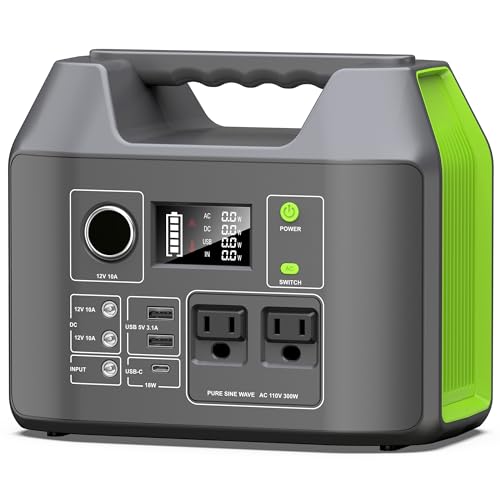
The EnginStar 300W focuses on compact storage and a broad selection of basic outputs. Its supplied dimensions are 9 by 5.5 by 7.5 inches, and the 296Wh battery sits in a small package suited to road trips, hunting, and simple RV use. Two 110V AC outlets, three USB outputs, a 12V car port, a 12V DC port, and a 24V barrel port let several small devices share the station, assuming their individual requirements fit the relevant port limits.
Recharge options include a wall adapter, a car charger, and a solar panel connection described as accepting a 12 to 25V panel. The solar panel is sold separately. The listing also states a full wall charge time of seven hours and recommends periodic recharging during storage. Its 300W output means buyers should treat this as a small-device station rather than a general RV appliance source. The listing specifically warns that large products such as electric grills, induction cookers, microwaves, refrigerators, and heaters may not work.
Pros
- Supplied 9 by 5.5 by 7.5-inch dimensions suit tight storage spaces.
- 296Wh capacity supports basic electronics and lighting needs.
- Two AC outlets provide more than one plug-in connection.
- Multiple USB, car, DC, and barrel outputs support varied small devices.
- Wall, car, and stated 12 to 25V solar charging options are available.
Cons
- 300W output is unsuitable for many larger RV appliances listed by the seller.
- The solar panel is sold separately.
EnginStar is a sensible choice for a small RV kit that needs several modest outlets in a compact box. It is less suitable for boondocking with a refrigerator or cooking equipment, and the supplied warning should be taken seriously. Buyers who want a panel included may prefer the ZeroKor, while buyers who need more output should move up to the BLUETTI Elite 30 V2 or a 1,000Wh-class station.
To buy this product, click here.
8. ZeroKor 300W Portable Solar Generator With 60W Solar Panel — Best Station-and-Panel Kit

ZeroKor is the most complete small off-grid package in this roundup because the listed box includes a 300W portable power station and a 60W foldable solar panel. That distinction matters for RV buyers who want to start with a panel rather than purchase the station first and solve solar charging later. The station includes two AC outlets, a DC port, three standard USB ports, a quick-charge USB port, and a flashlight with reading and SOS modes.
The supplied solar details are more useful than a generic “solar ready” label. The panel is identified as a 60W monocrystalline unit with an 18V/3.3A DC interface, USB-A and USB-C outputs, and a junction box that should be kept dry. The station’s solar input is described as accepting a 13 to 23V panel through its DC5521 connection. The listing does not state the battery’s watt-hour capacity, so buyers should not compare its energy reserve directly with the 288Wh, 292Wh, or 296Wh stations without that missing figure.
Pros
- 60W foldable solar panel is included in the listed package.
- 300W maximum station output suits small electronics and camping gear.
- AC, DC, USB-A, and USB-C charging ports support varied devices.
- Solar, AC, and 12V car charging pathways are listed.
- Panel includes USB outputs and a 60W maximum DC interface.
Cons
- The supplied product data does not clearly state the station’s battery capacity in Wh.
- The panel junction box is specifically described as not waterproof.
ZeroKor is the practical pick for an RV buyer who wants a small solar kit with the panel already included. It is less suitable for energy planning that depends on a clearly stated battery capacity, and its 300W limit rules out many high-demand appliances. Keep the panel’s junction box dry and verify all voltage, current, and connector requirements before connecting other panels.
To buy this product, click here.
9. Jackery Explorer 1000 v2 Portable Power Station, Dune White — Best for the Same Mid-Size Specification in a Different Finish

The Dune White Explorer 1000 v2 is a separate supplied ASIN with the same listed 1,070Wh capacity, 1,500W output, 23.8-pound weight, foldable handle, and port arrangement as the other Explorer 1000 v2 entry. Its distinction in this group is the finish and package identity, rather than a different electrical specification. That makes it relevant for buyers who prefer this color while shopping within the same mid-size RV power category.
The station includes three pure sine wave AC ports, two USB-C ports, one USB-A port, one DC car port, and a 100W USB-C PD output. Its app supports emergency charging, a 30dB quiet overnight charging mode, and energy-efficiency mode according to the listing. As with the other supplied Explorer 1000 v2 listing, a solar panel is not included and solar charging is stated to work only with Jackery panels. That limitation should be part of the equipment budget and installation plan.
Pros
- 1,070Wh rated capacity suits medium-sized RV electronics use.
- 1,500W continuous AC output offers a broad appliance range on paper.
- 23.8-pound listed weight and foldable handle help with storage and movement.
- 100W USB-C PD output supports compatible laptops and other devices.
- App includes emergency, quiet overnight, and energy-efficiency charging modes.
Cons
- The supplied package does not include a solar panel.
- The listing states that solar charging is compatible only with Jackery solar panels.
This version makes sense for the RV buyer who wants the Explorer 1000 v2 specification and prefers the Dune White finish. Its electrical trade-offs remain the same as the other listed color: good mid-size output and portability, but no dedicated TT-30 outlet and no included panel. Compare the two exact ASIN packages carefully before ordering so the selected finish and included cables match your plans.
To buy this product, click here.
Buying Guide
Match Capacity to the RV Load
Watt-hours describe rated stored energy, while watts describe the power an inverter or port can provide at a given time. A 3,014.4Wh station such as the BLUETTI Elite 300 has a much larger stated reserve than a 288Wh BLUETTI Elite 30 V2, but neither figure tells you exactly how much energy will reach an AC appliance. Inverter losses, idle draw, battery limits, temperature, and the load itself all affect results.
For a rough upper-bound calculation, divide the stated watt-hours by an assumed average load. For example, 1,000Wh divided by a constant 100W load equals 10 hours in an idealized calculation. That is not a measured runtime and does not account for conversion losses or cutoff limits. Intermittent loads such as refrigerators need extra care because compressor cycling and startup demand make simple division unreliable.
Check Continuous Output Before Surge Output
Continuous AC output is the more useful starting point for an RV buyer. The Explorer 1000 v2 lists 1,500W continuous and 3,000W surge, while the BLUETTI Elite 300 lists 2,400W continuous and 4,800W surge. A surge figure describes a temporary capability under stated conditions. It does not mean the station can run that wattage continuously.
Compare the station with the appliance label and manufacturer requirements. A high surge number does not prove that a refrigerator compressor, pump, microwave, heater, or power tool will start successfully. The EcoFlow’s stated X-Boost figure also should be treated separately from its ordinary 2,400W output.
Give RV Connections Priority
A dedicated TT-30 outlet can simplify connection for compatible RV equipment, and the BLUETTI Elite 300 is the only option here whose supplied description clearly identifies one. Its 12V/30A DC output is another meaningful RV-specific feature for listed 12V refrigerators, water pumps, and diesel heaters.
A standard AC socket is not automatically equivalent to a TT-30 outlet, and a 12V port is not universal for every DC device. Check voltage, current, connector type, and polarity before connecting RV equipment. Avoid improvised adapters and never connect a portable station to a household wall outlet to energize a home circuit.
Understand Solar Charging Claims
Solar compatibility requires more than matching panel wattage or finding a connector that fits. The station and panel must have compatible voltage, current, connector, and input limits. The ZeroKor listing provides a station solar range of 13 to 23V and includes a 60W panel, while the EnginStar listing describes a 12 to 25V solar connection. Those details still should be checked against the exact cables and input specifications before setup.
The Jackery Explorer 1000 v2 listings state that solar charging is compatible only with Jackery panels, and neither package includes a panel. The STARYLINE listing states up to 300W solar input, but its compatible panel’s full electrical specifications are not supplied here. Maximum solar input is a ceiling, not a promise of that charging rate in every weather or installation condition.
Choose the Right Charging Path
AC wall charging is useful before a trip, while car charging helps replenish a station during travel. Solar charging is valuable for longer off-grid stays, but charging speed depends on panel conditions, input limits, cable losses, and charge taper. The BLUETTI Elite 30 V2 lists a 0 to 80 percent wall-charge claim of 45 minutes and a full-charge claim of 70 minutes, while the EcoFlow listing gives a 0 to 80 percent claim of 1.13 hours.
Partial-charge claims should remain partial-charge claims. A stated 0 to 80 percent time does not prove a full-charge time, and advertised figures may depend on a particular charging mode. Read the included instructions and confirm which accessories are in the exact package.
Separate Battery Chemistry From Cycle Claims
Several stations identify LFP or LiFePO4 batteries, including the Jackery Explorer 1000 v2, Jackery Explorer 300, STARYLINE, BLUETTI Elite 30 V2, and EcoFlow DELTA 3 Max. The supplied listings also include cycle-life claims with different remaining-capacity thresholds. A claim of 4,000 cycles to 70 percent capacity is not directly equivalent to 3,000 cycles to 80 percent capacity.
Cycle figures are published claims rather than a guarantee of a specific ownership period. Storage conditions, charging habits, temperature, load, and the electronics around the battery can affect service. Follow the product instructions, especially for periodic charging during storage.
Plan Placement and Storage
Measure the compartment before ordering. The EnginStar listing supplies dimensions of 9 by 5.5 by 7.5 inches, the Jackery Explorer 300 lists a 7.5-pound weight, and the BLUETTI Elite 30 V2 lists 9.4 pounds. Larger units can offer far more stored energy, but the product data supplied here does not provide weights for every large model.
Keep the station and accessories in the environment specified by the manufacturer. The ZeroKor panel junction box is identified as not waterproof, and the EnginStar instructions advise dry storage away from direct sunlight and heat sources. A portable label does not establish waterproof operation or safe use in an enclosed compartment.
Best Portable Power Station for RV FAQ
What is the best portable power station for an RV in this roundup?
The BLUETTI Elite 300 is the strongest overall match because its listing combines 3,014.4Wh, 2,400W continuous output, a TT-30 RV outlet, and 12V/30A DC output. Those connections are especially relevant to RV owners who want more than general-purpose AC and USB charging. Confirm the station’s limitations against the specific RV electrical system and appliances.
Is a 300W power station enough for an RV?
A 300W station can work for phones, cameras, lights, laptops, and other small electronics if their requirements fit the available ports. The Jackery Explorer 300, EnginStar 300W, and ZeroKor 300W fall into this category. They are poor choices for many heaters, microwaves, induction cookers, refrigerators, and other higher-demand appliances identified in the supplied listings.
Does the BLUETTI Elite 300 plug directly into an RV?
The listing identifies a TT-30 RV outlet and a 12V/30A DC output, so it is the most directly RV-oriented option in this roundup. Compatibility still depends on the RV’s wiring, appliance requirements, and the exact connection method. Do not use improvised adapters or connect a station to household wiring through a wall outlet.
Can a portable power station run an RV refrigerator?
Some stations may have enough stated output for a compatible refrigerator, but the supplied information does not establish a universal refrigerator runtime or guarantee compressor startup. Compare the refrigerator’s running demand, startup demand, voltage, plug, and cycling behavior with the station’s specifications. The BLUETTI Elite 300 and EcoFlow DELTA 3 Max offer higher stated output than the compact 300W models, but that alone is not a compatibility guarantee.
Are solar panels included with these RV power stations?
The ZeroKor package explicitly includes a 60W foldable solar panel. The other listed stations either describe solar charging without including a panel or identify a separately sold panel. The Jackery Explorer 300 and both Explorer 1000 v2 listings state that the panel is not included, while the EnginStar listing says its solar panel is sold separately.
Can I use any solar panel with a portable power station?
No. Connector fit is not proof of electrical compatibility. Check the panel’s voltage, current, rated power, connector, and the station’s solar input limits. The supplied Jackery Explorer 1000 v2 listings state compatibility only with Jackery solar panels, while ZeroKor and EnginStar provide different voltage information. When critical specifications are missing, verify the match before connecting equipment.
What is the difference between a 1,000Wh and 3,000Wh station?
A 3,000Wh-class station has roughly three times the nominal stored energy of a 1,000Wh-class station, but actual AC delivery will be lower than the nameplate figure and depends on operating conditions. The BLUETTI Elite 300 is rated at 3,014.4Wh, while the Jackery Explorer 1000 v2 is rated at 1,070Wh. The larger station may suit longer or heavier RV use, while the smaller one is easier to move and store.
Final Verdict
The BLUETTI Elite 300 is the best overall portable power station for RV use in this selection because it addresses the RV format directly. Its 3,014.4Wh rated capacity, 2,400W continuous output, TT-30 outlet, and 12V/30A DC output give it a practical combination that the other models do not match. The capacity remains a nominal rating rather than guaranteed usable AC energy, so appliance planning should include inverter losses and actual load requirements.
For higher-demand AC equipment, the EcoFlow DELTA 3 Max offers 2,048Wh, 2,400W output, and a stated X-Boost mode. The Jackery Explorer 1000 v2 is a strong mid-size choice for buyers who prefer lower weight and 100W USB-C PD, while the BLUETTI Elite 30 V2 and Jackery Explorer 300 fit compact electronics setups. ZeroKor is the most convenient starting point for a small solar kit because its 60W panel is included. Match the station to the RV’s real loads, storage space, charging plan, and connection requirements before ordering.
