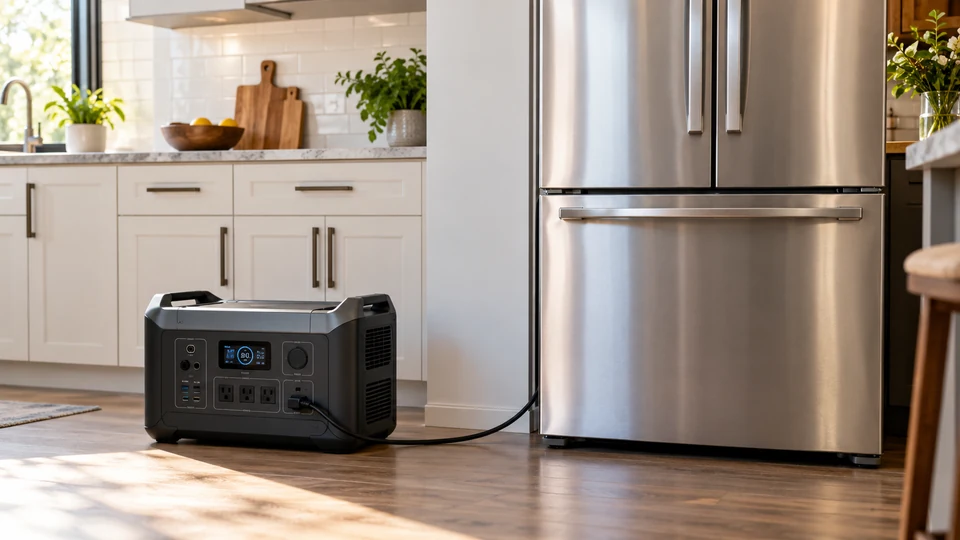
A refrigerator can quietly become the biggest concern during a power outage. Its compressor starts and stops, food safety depends on steady cooling, and a small battery that handles phones beautifully may struggle with the refrigerator’s startup demand. That is why shoppers looking for the Best Portable Power Station for Refrigerator need to look beyond a large-looking watt-hour number.
The main mistakes are choosing by peak wattage alone, treating nominal capacity as guaranteed AC runtime, or assuming that every solar generator will switch over quickly enough for an appliance. Capacity, continuous output, startup headroom, UPS behavior, charging options, and physical placement all matter. Different households also have different priorities. One buyer may need a slim refrigerator backup, while another wants a portable unit for camping, a freezer, or several essential loads.
Among the supplied options, the BLUETTI FridgePower is the strongest overall match because its purpose-built design, 2,016Wh capacity, 1,800W output, low standby claim, and stated 10ms UPS behavior align closely with refrigerator backup. Larger and smaller alternatives can make more sense for whole-home loads, frequent travel, or a tighter equipment budget.
Quick Answer
- Best Overall: BLUETTI FridgePower Portable Power Station for its refrigerator-focused design, 2,016Wh capacity, 1,800W output, and stated 10ms transfer behavior.
- Best 2kWh Alternative: Anker SOLIX S2000 for its 2,010Wh capacity, 1,500W continuous output, and 400W solar input.
- Best Compact Option: Jackery Explorer 1000 v2 for its 23.8-pound weight, 1,070Wh capacity, and 1,500W AC output.
- Best Higher-Capacity Choice: Jackery HomePower 3600 Plus for its 3,584Wh capacity and 3,600W AC output.
Best Portable Power Station for Refrigerator Comparison Table
| Product | Best For | Capacity | Continuous AC Output | Solar Input |
|---|---|---|---|---|
| BLUETTI FridgePower | Dedicated refrigerator backup | 2,016Wh | 1,800W | Not clearly specified |
| Anker SOLIX S2000 | 2kWh home backup | 2,010Wh | 1,500W | Up to 400W |
| Jackery Explorer 1000 v2 | Portable refrigerator backup | 1,070Wh | 1,500W | Not clearly specified |
| BLUETTI Elite 100 V2 | Compact home and camping use | 1,024Wh | 1,800W | Not clearly specified |
| BLUETTI AC180 | Fast recharge and larger loads | 1,152Wh | 1,800W | Up to 500W |
| EcoFlow DELTA 3 Classic | Refrigerator and mixed essential loads | 1,024Wh | 1,800W | 500W panel claim |
| Jackery HomePower 3600 Plus | Higher-capacity home backup | 3,584Wh | 3,600W | Solar recharge claim supplied |
| Portable Power Station 500W | Small refrigerator or mixed low-load backup | 519.48Wh | 500W | Compatible 100W or 200W panel |
| BROWEY S1600 | Built-in solar charging | 1,024Wh | 1,600W | Built-in panel and 40W solar claim |
The detailed reviews below show where each station fits, which refrigerator backup limits matter, and what to verify before connecting an appliance.
1. BLUETTI FridgePower Portable Power Station — Best Overall

The BLUETTI FridgePower is the most purpose-built refrigerator option in this group. Its 2,016Wh LFP battery and 1,800W output give it a substantial energy reserve and useful headroom for a refrigerator’s compressor startup, although actual runtime still depends on the appliance’s rated draw, startup demand, cycling pattern, and inverter losses. The listing also identifies an ultra-low 4W standby draw, which is relevant because an always-connected backup can spend many hours waiting for the next outage.
Its unusual advantage is physical rather than purely electrical. The 75mm slim body can fit behind a refrigerator, beside a cabinet, or on a wall with the included mounting hardware. The stated 10ms DualGuard UPS behavior is a closer fit for an appliance that should remain connected than a basic portable station, and the system can return to grid power automatically according to the listing. Expansion is supported up to 8,064Wh with BlueCell 200 expansion batteries, but those batteries are not identified as included here.
Pros
- 2,016Wh rated battery capacity.
- 1,800W AC output for refrigerator and household loads.
- Purpose-built 75mm slim form factor.
- Stated 10ms UPS transfer and automatic return to grid power.
- Supports expansion up to 8,064Wh with compatible expansion batteries.
Cons
- Solar input specifications are not clearly stated in the supplied information.
- Expansion batteries are separate hardware, not confirmed as part of the package.
This is the strongest choice for a refrigerator that will remain in one place and stay connected during outages. Buyers seeking a lightweight campsite unit may find the specialized slim design less useful, while anyone needing solar charging details should verify the input limits before planning an off-grid setup.
To buy this product, click here.
2. Anker SOLIX S2000 — Best 2kWh Alternative
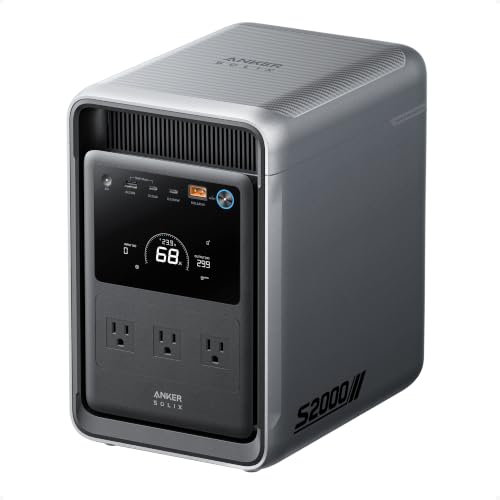
The Anker SOLIX S2000 brings nearly the same rated energy class as the FridgePower, with a 2,010Wh battery and a listing claim of up to 35 hours of refrigerator backup. That figure should be treated as a manufacturer claim rather than a universal result. Refrigerator models vary widely, and compressor cycling, room temperature, door openings, and station overhead all influence the outcome. Still, the 6W idle draw and stated efficiency focus are useful details for a station that may sit ready for an outage.
Its 1,500W continuous output and 3,000W peak output provide a sensible balance for a refrigerator plus smaller essentials. The station supports up to 400W solar input and six listed recharge methods, including wall, solar, vehicle, generator, and alternator pathways. A sub-10ms switchover is also listed for home-office use. The absence of a 12V DC port matters for buyers who want to run a refrigerator through a DC connection, since this model is more naturally suited to AC appliance backup.
Pros
- 2,010Wh rated capacity for extended refrigerator backup planning.
- 1,500W continuous and 3,000W peak output.
- Up to 400W solar input is specified.
- Stated sub-10ms UPS switchover.
- 35.7-pound listed weight and compact dimensions.
Cons
- No 12V DC port is listed.
- The 35-hour refrigerator figure is a seller claim, not a guaranteed runtime.
The S2000 suits households that want a compact 2kWh-class station with several recharge routes and a clean AC refrigerator setup. It is less compelling for a 12V refrigerator arrangement, and buyers should compare the appliance’s startup requirement with the station’s continuous and peak ratings rather than relying on capacity alone.
To buy this product, click here.
3. Jackery Explorer 1000 v2 — Best Compact Option

A refrigerator backup station does not always need to be a 2kWh heavyweight. The Jackery Explorer 1000 v2 offers 1,070Wh, 1,500W AC output, and a 3,000W surge claim in a listed 23.8-pound package. That combination makes it easier to move from storage to kitchen or campsite, though the smaller capacity gives less energy reserve than the first two choices. The refrigerator’s actual draw and compressor behavior should decide whether that reserve is sufficient.
The Explorer 1000 v2 is especially appealing for mixed use. It has three pure sine wave AC ports, two USB-C ports, one USB-A port, a DC car port, and LED lighting. The app can enable a one-hour emergency charging mode, while the normal full-charge setting is listed at 1.7 hours. Solar panels are not included, and the listing states that solar charging is compatible only with Jackery panels, so a buyer planning solar recovery should verify the exact panel and electrical pathway.
Pros
- 1,070Wh capacity in a listed 23.8-pound design.
- 1,500W AC output and 3,000W surge claim.
- Two USB-C ports, a USB-A port, and a DC car port.
- App-controlled emergency and quiet charging modes.
- LFP battery claim with over 4,000 cycles to 70% capacity.
Cons
- Smaller energy reserve than the 2kWh refrigerator-focused models.
- Solar panel is not included, and the listing limits solar charging to Jackery panels.
This is a good fit for someone who needs refrigerator backup that can also travel. It may be a poor match for long outages, multiple large AC loads, or buyers who want to build a solar array from a wider range of panels without checking Jackery compatibility first.
To buy this product, click here.
4. BLUETTI Elite 100 V2 — Best Compact High-Output Option

The Elite 100 V2 places unusual emphasis on output relative to its 1,024Wh capacity. Its stated 1,800W AC rating and 2,700W Power Lifting mode provide useful headroom for appliances, while 11 ports make it practical beside a refrigerator that shares power with smaller electronics. Capacity remains modest for a long outage, so think of this as a compact essential-load station rather than a refrigerator endurance specialist.
Portability is a major part of its appeal. The listing gives a 25-pound weight and a 17-liter compact design with a hidden handle. A stated 10ms UPS mode, 30dB silent-mode claim, Wi-Fi and Bluetooth app control, and roughly 45-minute charge to 80% add convenience around a kitchen or campsite. The published information does not clearly state the solar input rating, so solar recovery planning needs a closer specification check.
Pros
- 1,024Wh rated capacity.
- 1,800W AC output and 2,700W Power Lifting claim.
- Listed 25-pound weight and compact 17-liter design.
- Stated 10ms UPS switchover.
- 11 ports and app control through Wi-Fi and Bluetooth.
Cons
- Capacity is substantially below the 2kWh refrigerator-focused options.
- Solar input limits are not clearly specified in the supplied data.
Choose this model for a compact refrigerator backup that must also power several everyday devices. Skip it for multi-day food-storage backup unless your load calculation supports the smaller energy reserve and you have a dependable recharge plan.
To buy this product, click here.
5. BLUETTI AC180 — Best for Fast Solar Recovery

The BLUETTI AC180 is a strong middle ground for buyers who want refrigerator backup plus a practical solar route. Its 1,152Wh LiFePO4 battery and 1,800W output give it more capacity than many compact stations, while the listing states that solar input can reach 500W. That does not mean a panel will always deliver 500W, since sunlight, panel conditions, and electrical limits affect actual charging, but the stated input ceiling gives this model a useful recovery advantage.
AC charging is also emphasized, with a full-charge claim of one hour at 1,440W input. The station includes eight outlets, app-controlled output boosting to 2,700W, and a stated 20ms UPS feature for essential loads. A refrigerator’s startup behavior still needs to be checked against the station and appliance specifications. The included AC, car, and solar charging cables make the package more immediately useful for a mixed emergency setup.
Pros
- 1,152Wh LiFePO4 battery.
- 1,800W output with a 2,700W app-enabled boost claim.
- Up to 500W solar input is specified.
- Eight outlets and included car and solar charging cables.
- Stated 20ms UPS behavior and one-hour AC charge claim.
Cons
- Its capacity is lower than the 2kWh refrigerator-focused stations.
- The listing does not establish a guaranteed refrigerator runtime.
The AC180 makes sense for households that expect to recharge from solar or wall power between outage periods. It is less suitable when the refrigerator must run for a long stretch without recharge and the station cannot be expanded with the supplied package.
To buy this product, click here.
6. EcoFlow DELTA 3 Classic — Best for Mixed Essential Loads
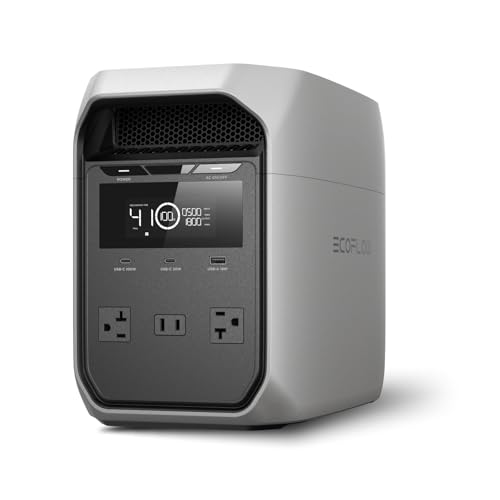
The DELTA 3 Classic targets a broader emergency load than a refrigerator alone. It lists 1,024Wh, 1,800W output, and 3,600W surge, with the manufacturer describing support for refrigerators, microwaves, laptops, and other appliances. That spread is useful when the refrigerator shares a power station with communication gear or small kitchen equipment, but the battery reserve remains in the 1kWh class.
Its stated under-10ms UPS behavior and app features give the station a polished home-backup role. The listing also identifies 500W solar-panel charging in roughly 2.5 hours, though the panel is optional and the figure is a seller claim under stated conditions. Buyers should also notice the expansion limitation: the station is not compatible with DELTA 2 Smart Extra Battery or Delta 3 Series Smart Extra Battery products according to the supplied information.
Pros
- 1,024Wh LiFePO4 battery capacity.
- 1,800W AC output and 3,600W surge claim.
- Stated under-10ms UPS transfer.
- 500W solar charging claim with an optional panel.
- App control for monitoring, schedules, and backup modes.
Cons
- Optional solar panel is not included.
- Supplied information lists incompatibility with specified EcoFlow extra batteries.
This is a sensible choice for a refrigerator that sits within a wider essential-load plan and for users who value app scheduling. Buyers focused on maximum refrigerator duration should move toward the 2kWh or 3.6kWh stations instead.
To buy this product, click here.
7. Jackery HomePower 3600 Plus — Best Higher-Capacity Choice

The HomePower 3600 Plus is the capacity leader in this selection, with 3,584Wh and 3,600W AC output. That larger energy store is valuable for refrigerator backup because it leaves more room for compressor cycling and other essential loads before recharging becomes urgent. The listing also describes 7,200W operation in parallel and dual voltage in parallel, but those capabilities should not be confused with the single supplied unit’s ordinary output.
This is a home-oriented station with wheels and a telescoping handle, rather than a unit intended for casual hand carrying. The listing gives four charging options and claims a two-hour hybrid AC and DC recharge, a 2.5-hour AC recharge, and a four-hour solar recharge. It also describes expansion up to 21kWh per unit or 43kWh with multiple units. Buyers considering connection to household circuits should use only an approved, properly installed transfer arrangement and must never backfeed through a wall outlet.
Pros
- 3,584Wh rated capacity.
- 3,600W AC output.
- Listed wheels and telescoping handle for movement.
- Four charging pathways are described.
- Expansion claims reach 21kWh per unit with compatible hardware.
Cons
- Its larger format is less convenient for frequent campsite transport.
- Parallel and home-connection features require careful installation and compatibility checks.
This model is for buyers who place refrigerator endurance and broader home backup above compactness. It is excessive for a small refrigerator used during short interruptions, and the supplied package should be checked carefully before assuming expansion hardware or a transfer switch is included.
To buy this product, click here.
8. Portable Power Station 500W — Best Smaller Capacity Option

This 519.48Wh station is the smallest serious refrigerator candidate in the selected group, and that distinction needs careful wording. Its 500W pure sine wave AC rating can suit a low-wattage compact refrigerator if the appliance’s startup demand stays within the station’s limits, but it is not an automatic match for a full-size refrigerator. The listing specifically advises against loads above 500W, making the refrigerator’s nameplate and startup requirements especially important.
The port selection is generous for a station in this class. It includes two AC outlets, 60W USB-C PD, three USB-A QC ports, two DC ports, a car port, and wireless charging. Solar charging is described with compatible 100W or 200W panels, while full charging times are listed for wall, car, and solar use. The station must be maintained periodically, and the listing warns that leaving AC output enabled can drain the battery even without another load.
Pros
- 519.48Wh rated capacity.
- 500W pure sine wave AC output.
- 60W USB-C PD and multiple DC outputs.
- Compatible 100W or 200W solar-panel charging is stated.
- Battery management protections are listed by the seller.
Cons
- 500W output leaves limited room for refrigerator startup demand.
- Small capacity is a poor fit for extended full-size refrigerator backup.
Use this model only after checking the refrigerator’s continuous and startup requirements. It works better as a compact backup for a small refrigerator, cooler, router, lights, and personal electronics than as a broad household outage solution.
To buy this product, click here.
9. BROWEY S1600 — Best Built-In Solar Option

The BROWEY S1600 takes a different approach by combining a 1,024Wh battery with a built-in solar panel. Its 1,600W pure sine wave output and 3,200W peak claim give it more appliance headroom than the smaller 500W station, while the listing specifically names refrigerators among its intended loads. The built-in panel may appeal to a buyer who wants an integrated emergency charging feature rather than a separate panel packed alongside the station.
The package also includes an AC adapter, car cable, DC input and output cable, accessory bag, and several DC plug adapters. A 100W USB-C PD port is listed, along with eight total ports. Solar details are limited in the supplied information. The listing refers to the built-in panel, a 40W solar charging claim, and the ability to connect additional panels, but it does not provide enough electrical information here to certify a particular panel arrangement.
Pros
- 1,024Wh rated capacity.
- 1,600W output and 3,200W peak claim.
- Built-in solar panel and MPPT controller are described.
- 100W USB-C PD port and eight listed ports.
- Includes AC, car, DC cables, and accessory adapters.
Cons
- Solar electrical limits and built-in panel rating are not clearly specified.
- Its capacity is smaller than the leading refrigerator-focused stations.
The S1600 suits buyers who value integrated solar capability and a flexible accessory package. It should be treated as a mid-capacity refrigerator option, not a substitute for a larger station when extended outage coverage is the priority.
To buy this product, click here.
Buying Guide
Start With The Refrigerator’s Real Electrical Demand
Find the refrigerator’s rated running draw and look for startup information in its documentation. A compressor may draw more during startup than it uses while running, so a station’s continuous AC output and peak rating serve different purposes. A 500W station should not be treated as interchangeable with a 1,500W station simply because both list a peak figure.
Understand Watt-Hours Versus Runtime
Watt-hours describe the battery’s rated energy, not the exact energy available at an AC outlet. Inverter losses, idle consumption, cutoffs, temperature, and compressor cycling affect the result. A rough idealized calculation can divide rated Wh by an assumed average load, but that result is an upper-bound-style estimate rather than a tested refrigerator runtime.
Choose Capacity Around The Outage Length
The 1,024Wh to 1,152Wh stations are easier to move and can suit short interruptions or a refrigerator with a modest average draw. The 2,010Wh and 2,016Wh options provide a larger reserve, while the 3,584Wh HomePower 3600 Plus is aimed at longer backup and multiple household loads. Expansion capacity should be treated as optional unless the exact package includes the required batteries.
Check UPS Behavior Carefully
A stated 10ms or 20ms transfer time is useful information, but it does not guarantee uninterrupted operation for every refrigerator or electronic control board. UPS, EPS, pass-through charging, and ordinary outlet operation are different features. Confirm the station’s supported mode and the refrigerator’s requirements before leaving the appliance permanently connected.
Plan Solar Charging From Electrical Specifications
Solar input wattage alone does not prove that a panel will work with a station. Verify the station’s voltage, current, input-power, connector, and panel requirements. The Explorer 1000 v2 listing specifically limits solar charging to Jackery panels, while several other products provide only partial solar information in the supplied data. Connector fit is never enough to establish electrical compatibility.
Separate AC Refrigerator Backup From DC Refrigerator Use
A refrigerator with an AC plug should be evaluated through the station’s AC inverter. A 12V refrigerator may offer a different path, but a 12V port is not automatically compatible with every DC appliance. The Anker S2000 does not list a 12V DC port, while the 500W station lists DC and car outputs. Verify voltage, current, connector, and appliance requirements before choosing a DC connection.
Keep Home Connections Conservative
Portable power stations can power an appliance through an appropriate cord and outlet, but they should not be connected to household wiring through a wall outlet. A transfer switch or other home integration equipment requires proper compatibility and qualified installation. For a simple refrigerator setup, a correctly rated direct connection is clearer and easier to evaluate.
Best Portable Power Station for Refrigerator FAQ
What Size Power Station Is Best For A Refrigerator?
A 1,000Wh-class station can suit shorter interruptions or a refrigerator with a relatively low average draw. A 2,000Wh-class unit gives more reserve, while a 3,584Wh station is better suited to longer backup periods and additional household loads. The refrigerator’s running and startup specifications should guide the final choice.
Can A Portable Power Station Run A Full-Size Refrigerator?
Some can, but compatibility depends on continuous draw, compressor startup demand, outlet type, and the station’s output limits. The 1,500W to 1,800W models in this roundup provide more output headroom than the 500W option, but no station should be treated as a guaranteed match without checking the refrigerator documentation.
How Long Will A Power Station Run A Refrigerator?
There is no universal runtime. Compressor cycling, room temperature, door openings, refrigerator size, inverter losses, standby draw, and battery cutoff behavior all matter. Use the station’s rated Wh only for a transparent theoretical estimate, and treat seller runtime claims as model-specific claims rather than promises for every appliance.
Is UPS Important For Refrigerator Backup?
UPS behavior can reduce the interruption between grid power and battery power, which may be useful for an appliance that remains plugged in. Transfer time does not guarantee compatibility with every refrigerator, however. Confirm the station’s operating mode and the refrigerator manufacturer’s requirements before relying on automatic backup.
Can Solar Panels Recharge A Refrigerator Power Station?
Yes, when the panel and station are electrically compatible. Check voltage, current, maximum input, connector, and charging direction. A panel’s rated wattage is its rating under specified conditions, not a guaranteed charging rate, and an optional panel is not included unless the exact package says so.
Is A LiFePO4 Station Better For Refrigerator Backup?
LiFePO4 can be attractive for frequent cycling, and several products here identify LFP batteries. Cycle claims still need to be read with their capacity-retention threshold and test conditions. Battery chemistry alone does not establish refrigerator compatibility, inverter performance, or a guaranteed service life.
Can I Plug A Power Station Into A Wall Outlet To Power My House?
No. Do not backfeed a home through a wall outlet. A portable station can power suitable appliances directly, while a transfer switch or other installed arrangement requires verified compatibility and qualified electrical work.
Final Verdict
The BLUETTI FridgePower is the strongest overall Best Portable Power Station for Refrigerator because its design is built around refrigerator backup rather than general portable electronics. Its 2,016Wh capacity, 1,800W output, slim 75mm form, stated 4W standby draw, and stated 10ms UPS behavior address the practical issues that matter when an appliance stays connected. Its expansion option adds flexibility, although the additional batteries are not confirmed as included.
The Anker SOLIX S2000 is the closest 2kWh alternative, especially for buyers who value 400W solar input and several recharge routes. The Jackery Explorer 1000 v2 and BLUETTI Elite 100 V2 are easier to move, while the BLUETTI AC180 and EcoFlow DELTA 3 Classic suit mixed essential loads with solar or app features. For longer home backup, the Jackery HomePower 3600 Plus offers the largest rated reserve and output in this group. Match the station to the refrigerator’s startup demand, expected outage length, recharge plan, and connection method before buying.
