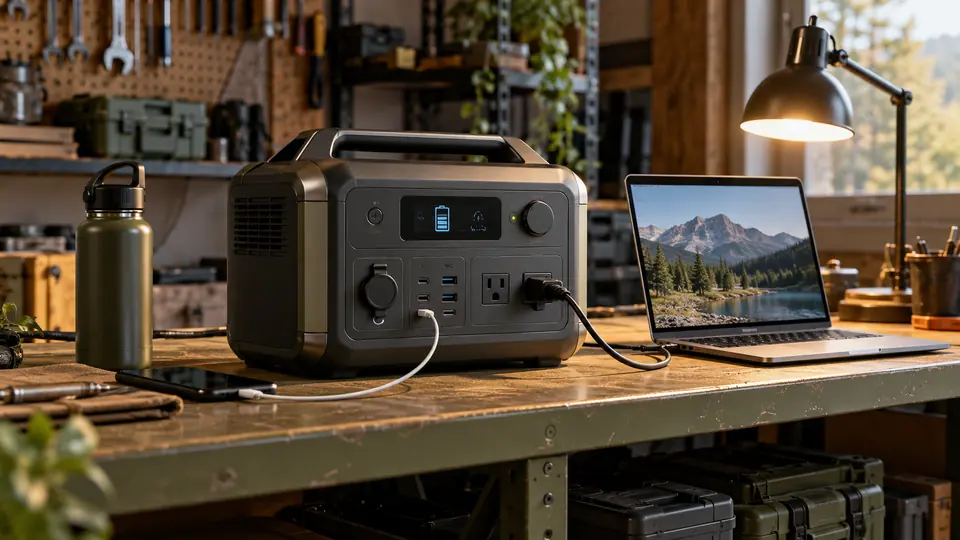
A 1000Wh portable power station sits in a useful middle ground. It has enough stored energy for routers, lights, laptops, cameras, small refrigerators, and campsite essentials, while remaining easier to move than a much larger home-backup unit. The catch is that a battery rating in watt-hours does not tell the whole story. Continuous output, surge capacity, port selection, solar input, recharge options, and weight can matter just as much once the station leaves the garage.
Shoppers often focus on the biggest Wh number or the most dramatic peak-wattage claim, then discover that a station has limited AC output, a slow recharge path, a restricted solar input, or a port that does not match their equipment. A 1000W inverter also does not guarantee compatibility with every refrigerator, kettle, or power tool because startup demand and operating patterns vary. Different buyers have different priorities. The Jackery Explorer 1000 v2 is the strongest overall fit here for its 1,070Wh capacity, 1,500W continuous output, 100W USB-C ports, app controls, and LFP battery claims.
For a compact car-camping setup, a 17-pound 999Wh model may be more appealing than a heavier unit. For home-office backup, a stated UPS transfer time may matter more than portability. Solar users should examine the input details and included cables before assuming a panel will work. The comparison below puts those differences in one place so you can narrow the field quickly.
Quick Answer
- Best Overall: Jackery Explorer 1000 v2 for its 1,070Wh capacity, 1,500W continuous output, LFP battery, app controls, and multiple charging modes.
- Best for Higher Continuous Loads: CTOLITY XP1000 for its stated 1,800W continuous AC output and 1,024Wh capacity.
- Best Lightweight 1000Wh Option: 1000W Portable Power Station 999Wh for its listed 17-pound weight, 999Wh capacity, and 1,000W continuous output.
- Best Compact Option: BLUETTI Elite 30 V2 for its 9.4-pound build, 288Wh capacity, 600W continuous output, and stated 10ms UPS feature.
Best Portable Power Station 1000Wh Comparison Table
| Product | Best For | Capacity | Continuous AC Output | Weight | Solar Input |
|---|---|---|---|---|---|
| Jackery Explorer 1000 v2 | Best overall balance | 1,070Wh | 1,500W | 23.8 lb | Solar charging supported, Jackery panels only |
| CTOLITY XP1000 | Higher continuous loads | 1,024Wh | 1,800W | Not clearly specified | Solar charging supported |
| 1000W Portable Power Station 999Wh | Lightweight capacity | 999Wh | 1,000W | 17 lb | Solar charging with MPPT stated |
| STARYLINE 1000W 1024Wh | Portable home and camping backup | 1,024Wh | 1,000W | 27.73 lb | Up to 300W stated |
| CUBUS 1000 PLUS | 100W USB-C and 1,000W AC output | 960Wh | 1,000W | 23.1 lb | Compatible panels required |
| LIBRIDS 640Wh | UPS-focused smaller setup | 640Wh | 600W | Not clearly specified | Solar charging supported |
| Portable Power Station 519.48Wh | Mid-size portable use | 519.48Wh | 500W | 14.1 lb | 100W or 200W panels stated |
| Jackery Explorer 300 | Light travel and electronics | 292Wh | 300W | 7.5 lb | Jackery panels supported |
| BLUETTI Elite 30 V2 | Compact high-output setup | 288Wh | 600W | 9.4 lb | PV60L panel listed |
The detailed reviews explain where each station fits, what its published specifications support, and which limitations deserve attention before purchase.
1. Jackery Explorer 1000 v2 — Best Overall

The Explorer 1000 v2 offers the most rounded specification set in this group. Its 1,070Wh battery gives it the highest stated capacity among the full-size options here, while the 1,500W continuous AC output leaves more room for appliances than a 1,000W inverter. That combination suits a campsite with several simultaneous loads, a work setup with monitors and networking equipment, or short-duration backup for selected household devices.
Its 23.8-pound weight and foldable handle keep the package movable, though it is still a lift-and-carry unit rather than a backpacking companion. The two USB-C ports include 100W PD charging, and the three pure sine wave AC outlets support common plug-in equipment. Jackery also lists app control, a quiet overnight charging mode, and an emergency one-hour charging mode. The standard charging setting is listed as 1.7 hours, while the one-hour claim requires activating the emergency mode in the app, which is a detail worth remembering.
Pros
- 1,070Wh capacity is the highest listed among the full-size stations reviewed here.
- 1,500W continuous AC output provides more headroom than 1,000W models.
- 100W USB-C PD ports can charge compatible laptops and devices directly.
- LFP battery is listed with 4,000-plus cycles while retaining over 70% capacity.
- App control includes emergency charging, quiet overnight charging, and energy efficiency modes.
Cons
- Solar charging is listed as compatible only with Jackery solar panels.
- The solar panel is not included with the station.
This is the strongest pick for buyers who want one capable 1000Wh-class station without giving up useful controls or higher AC output. It is less attractive for shoppers who already own a different brand of solar panel or want a very light unit for foot travel. Buyers should also verify their appliance startup requirements rather than treating the 3,000W surge figure as a universal motor-start guarantee.
To buy this product, click here.
2. CTOLITY XP1000 — Best for Higher Continuous Loads

The CTOLITY XP1000 is the clearest choice for buyers who care more about continuous AC output than shaving a few pounds. Its published specification lists 1,800W continuous output alongside a 1,024Wh LiFePO4 battery. That gives it a wider stated operating envelope for appliances such as coffee makers, microwaves, refrigerators, and other everyday equipment, provided the actual load remains within the station’s limits.
This model also has a practical charging layout for a busy desk or family campsite. Ten output ports include a 100W USB-C PD port, and the listing describes a 20ms UPS switch for routers, computers, security equipment, and other sensitive electronics. Its AC charging claim is particularly aggressive, reaching 80% in 45 minutes and full charge in one hour according to the published specifications. Charging conditions and mode settings can affect actual results, so treat that as a stated claim rather than a guaranteed field measurement.
Pros
- 1,800W continuous AC output is the highest listed in this roundup.
- 1,024Wh LiFePO4 battery suits substantial portable power needs.
- 100W USB-C PD output supports direct charging for compatible laptops.
- Ten output ports allow several devices to be connected at once.
- Published specifications include a 20ms UPS switching time and solar charging support.
Cons
- Weight is not clearly specified in the supplied product information.
- The listing does not provide detailed solar voltage and current limits.
Choose this station for a vehicle, RV, work area, or emergency cabinet where higher continuous output has real value. It may be excessive for phones, cameras, and a laptop, where a smaller unit would be easier to carry. Anyone planning to connect a solar panel should verify the station’s electrical input limits and the panel’s voltage before making a match.
To buy this product, click here.
3. 1000W Portable Power Station 999Wh — Best Lightweight 1000Wh Option
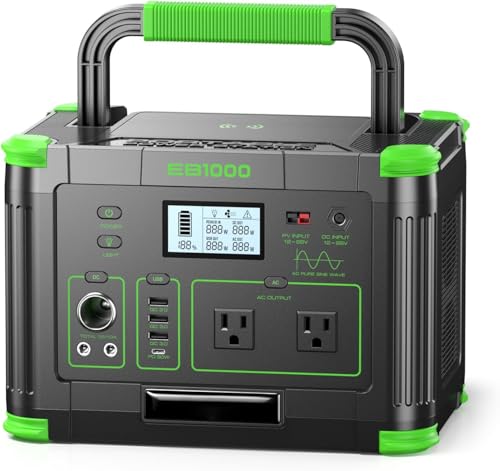
This station makes a compelling capacity-to-weight argument. The listing identifies a 999Wh battery in a 17-pound frame, paired with 1,000W continuous pure sine wave AC output and a 2,000W peak figure. That is a useful package for car camping, van setups, remote work, and emergency storage when a full-size battery reserve matters but a 20-plus-pound case feels cumbersome.
The front panel is unusually flexible for its size. It includes two AC outlets, a 60W USB-C PD port, three USB-A QC 3.0 ports, a wireless charging pad, a 12V car port, and two DC outputs. An LCD shows battery percentage, input and output wattage, and estimated runtime. The station also lists AC, solar, and car charging, plus MPPT solar technology and pass-through charging. Pass-through charging does not by itself establish uninterrupted UPS behavior, so buyers needing computer or medical-device continuity should not treat those features as interchangeable.
Pros
- 999Wh capacity and 17-pound listed weight create a portable full-size combination.
- 1,000W pure sine wave AC output is clearly specified.
- Ten ports include 60W USB-C PD, USB-A QC, wireless, DC, and car outputs.
- MPPT solar charging and three recharge pathways are listed.
- LCD status display and individual module switches support hands-on control.
Cons
- The 60W USB-C output is lower than the 100W output offered by some competing models.
- The listing does not clearly state detailed solar input voltage and current limits.
This is a smart fit for buyers who want close to 1000Wh without accepting the weight of several larger stations. It gives up continuous output compared with the CTOLITY XP1000 and Jackery Explorer 1000 v2, so high-draw appliances need careful checking. Its port variety is especially appealing for mixed DC and USB loads.
To buy this product, click here.
4. STARYLINE 1000W 1024Wh — Best for Portable Home and Camping Backup

The STARYLINE keeps the familiar 1000W and roughly 1,000Wh formula straightforward. Its listed 1,024Wh LiFePO4 battery pairs with 1,000W continuous output, two 110V AC outlets, a 60W USB-C PD port, and two USB-A ports. That mix covers common travel electronics, lighting, routers, and other modest loads without filling the case with specialized connections.
At 27.73 pounds, it is the heaviest listed full-size option here, yet the integrated handle and compact form are intended for one-person carrying. The product information describes 300W maximum solar input and lists Starlink compatibility, though buyers should still verify the exact power pathway and equipment requirements. A claimed 3,000-plus cycle rating with 80% retained capacity is supplied by the listing, as is a six-layer BMS description. Those claims describe the manufacturer’s stated design and should not be read as independent testing.
Pros
- 1,024Wh LiFePO4 capacity fits the requested 1000Wh class closely.
- 1,000W continuous output supports common small appliances and electronics.
- Up to 300W solar input is listed.
- 60W USB-C PD output adds direct laptop and device charging.
- The listing identifies a 3,000-plus cycle claim and six-layer BMS protection.
Cons
- At 27.73 pounds, it is heavier than the other full-size options reviewed here.
- The output layout is less extensive than models offering four AC outlets or ten total ports.
This station suits buyers who want a simple 1,000W home or camping unit and value a relatively high stated solar input. It is less appealing for frequent stair carrying or long-distance transport. The 300W solar figure is a maximum input claim, not a promise of that charging rate under every sunlight or panel condition.
To buy this product, click here.
5. CUBUS 1000 PLUS — Best for 100W USB-C Charging

The CUBUS 1000 PLUS takes a slightly smaller capacity route with 960Wh, but retains 1,000W continuous AC output and a stated 2,000W surge figure. Four pure sine wave AC outlets make it practical for a cluster of chargers, lights, or small appliances, while the 23.1-pound weight and foldable handle keep it manageable for road trips and emergency storage.
Its strongest detail is the two USB-C ports, including a listed 100W PD output. That can reduce the need to carry a laptop power brick for compatible devices. The station also includes two USB-A ports, an XT60 port, and an LED flashlight. The listing says full charging can take 2.2 hours with combined inputs, while also explaining that the fastest charging claims depend on using multiple charging modes and real conditions can vary.
Pros
- 1,000W continuous AC output is paired with four pure sine wave AC outlets.
- Two USB-C ports include a stated 100W PD output.
- 960Wh capacity remains close to the 1000Wh class.
- 23.1-pound weight and foldable handle support vehicle-based portability.
- LiFePO4 battery specifications include a 3,500-plus cycle claim with over 70% retained capacity.
Cons
- Capacity is lower than the 999Wh to 1,070Wh stations in the top tier.
- Solar panels are not included, and exact panel electrical compatibility must be verified.
Consider this model if direct laptop charging and several AC outlets matter more than having the largest battery in the category. It is a practical middle choice for work gear, cameras, and campsite electronics. Buyers should read the charging-mode requirements carefully rather than assuming the advertised shortest time applies to a wall-outlet-only setup.
To buy this product, click here.
6. LIBRIDS 640Wh — Best for UPS-Focused Smaller Setups

The LIBRIDS is below the 1000Wh class, but it remains a legitimate alternative for buyers whose actual loads are routers, laptops, lights, and other moderate devices. Its 640Wh capacity and 600W continuous output create a smaller energy reserve than the leading picks, while four AC outlets and eight total output ports give a tidy layout for a home office or compact campsite.
The product’s headline feature is a stated 10ms UPS switch. That makes it especially relevant for a router, desktop setup, or selected equipment that needs a fast transition during a power interruption. The listing also identifies a 4000-plus cycle LiFePO4 battery, pure sine wave output, a 1,200W surge claim, and 1.5-hour AC charging. The supplied information labels the unit for indoor use and warns against rain, moisture, and wet conditions, so outdoor users need a dry, protected location.
Pros
- Stated 10ms UPS switching supports selected backup electronics.
- 600W continuous output covers many office and campsite loads.
- Four AC outlets and eight output ports offer flexible connections.
- LiFePO4 battery is listed with a 4000-plus cycle claim.
- Pure sine wave output and an LCD showing power information are specified.
Cons
- 640Wh capacity is substantially below the 1000Wh target.
- The listing warns against rain, moisture, and wet outdoor conditions.
This is the sensible pick for buyers who value the stated UPS feature more than maximum stored energy. It should be skipped by anyone planning to run higher-draw appliances or seeking multi-day capacity. Keep it in a dry, ventilated location and verify that the connected equipment tolerates the stated transfer behavior.
To buy this product, click here.
7. Portable Power Station 519.48Wh — Best Mid-Size Portable Option

This 519.48Wh station is a clear step down from the 1000Wh target, yet its 14.1-pound weight makes it easier to move between a vehicle, campsite, boat, or room. The 500W continuous AC rating is appropriate for lighter loads, and the listing specifically warns against appliances above that level. Two pure sine wave AC outlets, a 60W USB-C PD port, three USB-A ports, DC outputs, a car port, and wireless charging create a broad connection menu for its size.
Solar charging is described with compatible 100W or 200W panels, while wall and car charging are also listed. Those panel ratings indicate the intended input class, but the supplied information does not provide the station’s full voltage and current window. That means buyers should check the panel and station specifications together before connecting them. A built-in light with flashlight, strobe, and SOS modes adds useful emergency illumination without changing the station’s modest AC capacity.
Pros
- 14.1-pound weight is easier to carry than full-size 1000Wh models.
- 519.48Wh capacity suits lighter travel and emergency electronics.
- 60W USB-C PD, three USB-A ports, wireless charging, and DC outputs are listed.
- Pure sine wave AC output is specified at two outlets.
- Wall, car, and solar charging pathways are supported.
Cons
- 519.48Wh capacity does not match the requested 1000Wh class.
- 500W continuous output limits appliance selection.
This model makes sense for buyers who value portability and mainly need phones, laptops, lights, routers, cameras, or a small refrigerator within the stated limits. It is a poor fit for high-draw appliances or extended backup. Its broad port selection is useful, but the energy reserve is the trade-off you feel first.
To buy this product, click here.
8. Jackery Explorer 300 — Best for Light Travel

The Explorer 300 belongs in this roundup as a compact alternative rather than a 1000Wh substitute. Its 292Wh capacity, 300W continuous output, and 7.5-pound weight make it far easier to carry for day trips, photography, drones, laptops, and small electronics. A 600W peak figure is listed, but buyers should keep the continuous rating in view when deciding what to connect.
Jackery gives this smaller unit two AC outlets, a 100W USB-C PD port, two USB-A ports, and a 120W car port. The listing also identifies LiFePO4 chemistry with a 4,000-plus cycle claim and solar charging through Jackery panels. A 100W panel is listed as reaching 80% in approximately 2.8 hours, while a 40W panel is described as a slower maintenance option. Those are published charging claims, not universal results for every condition.
Pros
- 7.5-pound weight is the lightest in this roundup.
- 100W USB-C PD output is useful for compatible laptops and tablets.
- Two AC outlets and a 120W car port support varied travel gear.
- LiFePO4 battery is listed with a 4,000-plus cycle claim.
- Jackery solar panel charging options are clearly identified.
Cons
- 292Wh capacity is far below the 1000Wh target.
- 300W continuous output limits larger appliances and tools.
Pick the Explorer 300 for hikes, camera kits, short trips, and electronics where low carry weight matters most. It should not be treated as a home-backup replacement for the larger stations above. The Jackery-only solar approach also narrows panel choice compared with stations that describe broader panel compatibility.
To buy this product, click here.
9. BLUETTI Elite 30 V2 — Best Compact High-Output Option

The BLUETTI Elite 30 V2 has a small 288Wh battery, yet its 600W continuous output gives it more AC headroom than many compact stations. At 9.4 pounds, it remains easy to move for short trips, home-office backup, and basic camping equipment. The listing also describes a Power Lifting Mode with a 1,500W figure, though that mode should not be confused with the standard continuous rating.
Its charging claims are lively for a compact unit. The station lists 380W wall charging, 0 to 80% in 45 minutes, and 0 to 100% in 70 minutes, plus solar and car charging. A 10ms UPS feature is also specified for selected devices such as laptops, routers, and CPAP machines. Medical equipment still requires a careful check of voltage, waveform, transfer behavior, and the device maker’s requirements. The listing identifies compatibility with the PV60L panel, but broader panel matching needs electrical verification.
Pros
- 9.4-pound weight keeps the compact station highly portable.
- 600W continuous output is strong for a 288Wh unit.
- Power Lifting Mode is listed with a 1,500W figure.
- 10ms UPS and multiple charging pathways are specified.
- 380W wall charging and 100% charging in 70 minutes are published claims.
Cons
- 288Wh capacity offers much less stored energy than the full-size models.
- The listing specifically names the PV60L panel, so wider panel compatibility requires checking.
This is the compact specialist for buyers who want more AC output than the Explorer 300 provides without moving into a 20-pound case. It is best for short-duration electronics use, selected tools, and compact emergency loads. Anyone seeking overnight or extended backup should choose a larger-capacity station instead of relying on the lifting-mode figure.
To buy this product, click here.
Buying Guide
Start With Watt-Hours, Then Check Usable Energy
Wh describes the battery’s nominal stored energy. It does not equal the energy delivered through an AC outlet because inverter losses, idle draw, cutoff behavior, and load characteristics affect the result. A 1,024Wh station therefore should not be treated as a guaranteed 1,024Wh AC supply. For a rough theoretical estimate, divide the stated Wh figure by the average load in watts, then treat the result as an upper-bound style calculation rather than a tested runtime.
Separate Continuous Output From Surge Output
Continuous AC output is the number to use for a device’s ordinary operating demand. Surge or peak output may help with a brief startup event, but a larger peak figure does not prove that a refrigerator, pump, kettle, or power tool will start successfully. Check the appliance’s rated draw and startup requirements, then leave room below the station’s continuous limit.
Match Ports to the Actual Equipment
A USB-C connector does not automatically reveal its charging protocol or wattage. These products list outputs ranging from 60W to 100W, so a laptop that expects higher input may still need its normal adapter. Likewise, a 12V car port is not universal proof of compatibility with every DC appliance. Read the voltage, current, connector, and power requirements as a set.
Review Solar Input Before Buying a Panel
Solar input wattage is only one part of a compatible setup. The panel’s open-circuit voltage, operating voltage, current, connector, and the station’s input limits must line up. The Jackery models reviewed here specify Jackery panel compatibility, while other listings use broader language without supplying every electrical limit. Connector shape alone is not enough evidence of a safe match.
Understand Charging Claims
Charging times can depend on the input method, selected mode, charge taper, temperature, and whether several inputs are used together. The CTOLITY XP1000 lists 80% in 45 minutes and full charging in one hour, while the Jackery Explorer 1000 v2 requires an app setting for its one-hour emergency mode. Treat these as published conditions, not universal wall-charging guarantees.
Choose Battery Chemistry and Cycle Claims Carefully
Most of the larger picks here identify LiFePO4 or LFP chemistry, which is useful information for buyers comparing battery platforms. Cycle claims still need their capacity-retention condition and testing context. A statement such as 4,000 cycles while retaining over 70% capacity is different from a guarantee that every unit will deliver a particular service life under every use pattern.
Use UPS Features Within Their Limits
A stated UPS transfer time can matter for routers, computers, and selected electronics, but it does not prove compatibility with every device. Pass-through charging is also different from UPS functionality. For CPAP or other medical equipment, verify the complete setup against the equipment maker’s requirements. Never connect a portable station to a home wall outlet to energize household wiring.
Best Portable Power Station 1000Wh FAQ
Is a 1000Wh portable power station enough for home backup?
It can support selected devices such as lights, routers, laptops, and some small appliances, but it is not automatically a whole-home backup system. Actual runtime depends on the load, AC conversion losses, idle consumption, and whether equipment cycles on and off. Choose individual circuits and devices rather than assuming the station can power an entire house.
What is the difference between 1000Wh and 1000W?
Wh measures stored energy, while W measures the rate at which the station can deliver power. A 1,000Wh battery can be paired with a 500W, 1,000W, 1,500W, or 1,800W inverter, as shown by the products in this roundup. The higher output does not create more stored energy, and the larger battery does not automatically support higher-wattage appliances.
Can these power stations run a refrigerator?
Several listings mention refrigerators or mini-fridges, but compatibility depends on the refrigerator’s operating draw, compressor startup demand, cycling pattern, and the station’s continuous and surge behavior. A published peak number alone is not enough to guarantee startup. Check the appliance specifications and allow room below the station’s limits.
Can I charge a 1000Wh power station with any solar panel?
No. Panel wattage, voltage, current, connector, and the station’s solar input limits all matter. The Jackery Explorer 1000 v2 listing specifies Jackery panels only. Other products mention compatible solar panels without providing every electrical value, so verify the full input requirements before connecting a panel.
Are these stations safe for CPAP machines?
Some listings mention CPAP use, pure sine wave output, or UPS behavior, but those statements do not guarantee operation with every CPAP configuration. Heated humidifiers and hoses can change power demand, while transfer behavior and output requirements vary by device. Confirm the CPAP manufacturer’s electrical requirements before relying on a station overnight.
Does a 2000W peak rating mean the station can run a 2000W appliance?
No. Peak output is a short-duration surge rating, while continuous output governs ordinary operation. A station listed at 1,000W continuous and 2,000W peak should not be treated as a 2,000W appliance supply. The appliance’s rated draw and startup demand must remain within the station’s supported limits.
Which model is easiest to carry?
The Jackery Explorer 300 is the lightest listed option at 7.5 pounds, followed by the BLUETTI Elite 30 V2 at 9.4 pounds. Both have much less capacity than the full-size 1000Wh-class models. The 17-pound 999Wh station offers the strongest capacity-to-weight combination among the larger options listed here.
Final Verdict
The Jackery Explorer 1000 v2 is the strongest overall choice for this 1000Wh-class roundup because it combines 1,070Wh of stated capacity with 1,500W continuous AC output, 100W USB-C PD charging, an LFP battery, app controls, and a manageable 23.8-pound design. Its Jackery-only solar compatibility is a real limitation, and the panel is not included, but the full package is unusually balanced for camping, portable work, and selected home-backup loads.
The CTOLITY XP1000 is the better alternative for buyers who need its higher stated 1,800W continuous output, while the 17-pound 999Wh station is the lighter full-size option. STARYLINE offers 1,024Wh and a listed 300W solar input, and the CUBUS 1000 PLUS is appealing for its 100W USB-C output. For smaller equipment, the BLUETTI Elite 30 V2 and Jackery Explorer 300 are easier to carry, while LIBRIDS gives UPS-focused buyers a lower-capacity path. Match the station to the actual load, solar setup, weight limit, and required backup behavior before choosing.
