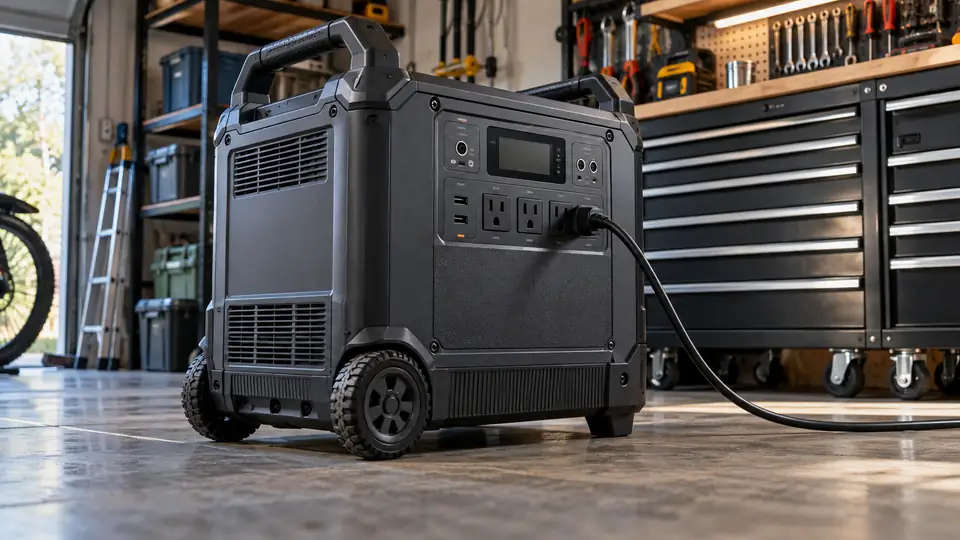
A 2,000Wh-class power station is built for the awkward middle ground between a small travel battery and a full home backup system. It can keep a refrigerator, router, lights, laptops, chargers, and selected appliances running from one portable unit, yet it still fits in an RV storage bay, vehicle, workshop, or emergency closet. The catch is that advertised capacity does not tell the whole story. A station rated around 2,000Wh still loses some energy through its inverter, and a 2,000W peak number cannot be treated as a 2,000W continuous output.
Shoppers often focus on the biggest wattage figure and overlook recharge options, outlet types, weight, included accessories, and the difference between an included battery and optional expansion hardware. A refrigerator also behaves differently from a coffee maker because its compressor cycles and may have a higher startup demand. Solar input matters for off-grid use, while AC charging speed matters if you need to refill the station between outages or travel days. Different buyers will prioritize different details. For broad home and RV use, the PowerMax 3600PE is the strongest overall package here because it combines a roughly 2,000Wh battery with high continuous output, substantial solar input, app control, and an included 200W panel.
The products below range from true 2,000Wh stations to smaller alternatives included because they offer useful high-output, portable, or expandable options within the supplied selection. Treat manufacturer runtime and charging statements as published claims rather than independent test results, and verify your appliance requirements before purchase.
Quick Answer
- Best Overall: 3600W Portable Power Station PowerMax 3600PE for its 2,016Wh capacity, 3,600W continuous output, included 200W solar panel, and broad charging flexibility.
- Best Higher-Capacity Value Alternative: DABBSSON Portable Power Station 2000L for its 2,048Wh battery, 2,200W output, six AC outlets, and optional solar charging.
- Best Expandable Option: Anker SOLIX C2000 Gen 2 for its 2,048Wh base capacity, 2,400W output, and stated expansion path to 4kWh.
- Best Compact High-Output Alternative: OUPES Mega 1 Lite for its 2,000W output, dual 140W USB-C ports, and 26.7-pound weight.
Best Portable Power Station 2000Wh Comparison Table
| Product | Best For | Capacity | Continuous AC Output | Weight | Solar Input |
|---|---|---|---|---|---|
| PowerMax 3600PE | Broad home, RV, and job-site use | 2,016Wh | 3,600W | 24 kg | Up to 1,600W |
| DABBSSON 2000L | High-capacity backup and heavy appliances | 2,048Wh | 2,200W | 41 lb | Up to 800W |
| Anker SOLIX C2000 Gen 2 | Expandable camping and RV power | 2,048Wh | 2,400W | 41.7 lb | Not clearly specified |
| Anker SOLIX S2000 | Compact home-office backup | 2,010Wh | 1,500W | 35.7 lb | Up to 400W |
| OUPES Mega 1 Lite | Portable high-output setups | 1,024Wh | 2,000W | 26.7 lb | Up to 800W |
| CUBUS 1000 PLUS | Lightweight camping and electronics | 960Wh | 1,000W | 23.1 lb | Not clearly specified |
| BLUETTI AC180 | Fast-charging mid-capacity backup | 1,152Wh | 1,800W | Not clearly specified | 500W |
| Jackery Explorer 1000 v2 | Portable travel and emergency power | 1,070Wh | 1,500W | 23.8 lb | Jackery panels only |
| OUPES Mega 1 | Expandable 2,000W output | 1,024Wh | 2,000W | Not clearly specified | Not clearly specified |
The detailed reviews explain where the capacity leaders, compact alternatives, and expandable models make the most sense.
1. 3600W Portable Power Station PowerMax 3600PE — Best Overall

The PowerMax 3600PE is the closest match to the central idea of a portable power station around 2,000Wh without sacrificing appliance flexibility. Its listed 2,016Wh capacity is paired with 3,600W of continuous AC output and a 7,200W peak rating. That gives it considerably more output headroom than most alternatives here, although the peak figure should still be treated as a startup allowance rather than a continuous operating rating. Four AC outlets, four USB-A ports, two USB-C PD ports, a car socket, and two DC5521 outputs let a busy group keep several devices connected at once.
The package also includes a 200W solar panel, which gives this model a clearer off-grid identity than station-only listings. The station accepts up to 1,600W of solar input according to the published specifications, plus AC, car, and combined AC-and-solar charging. Its app supports Wi-Fi and Bluetooth monitoring, charging-speed adjustment, and remote output control. A 24 kg weight is substantial, but reasonable for this capacity and output class. The advertised under-10ms EPS transfer claim may appeal to home-office users, though sensitive equipment should still be checked against its requirements.
Pros
- 2,016Wh capacity fits the requested 2,000Wh class.
- 3,600W continuous output is the highest listed output in this group.
- Includes a 200W solar panel, cables, and vehicle charging cable.
- Supports up to 1,600W solar input and multiple recharge methods.
- Offers 14 listed output ports plus app control and adjustable charging speed.
Cons
- The 24 kg weight still makes frequent stair carrying demanding.
- The included 200W panel is much smaller than the station’s stated maximum solar input.
This is the strongest choice for buyers who want one station to cover RV appliances, tools, refrigerator backup, electronics, and high-draw household equipment. It is less attractive for lightweight travel or simple laptop-and-phone charging, where its size and output capability add bulk that may go unused.
To buy this product, click here.
2. DABBSSON Portable Power Station 2000L — Best for Heavy Loads
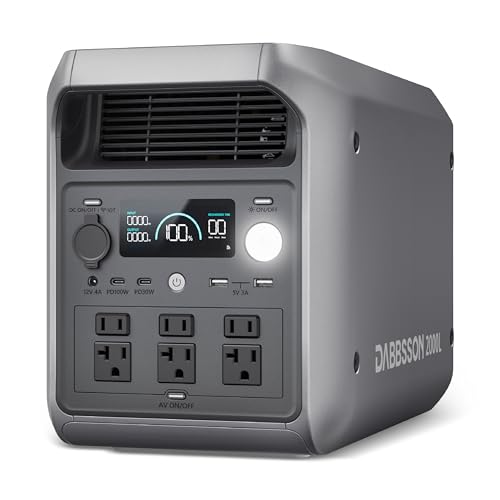
The DABBSSON 2000L lands squarely in the target capacity range with a listed 2,048Wh battery and 2,200W continuous AC output. Six AC outlets make it practical for a family campsite, workshop, or outage kit where several plug-in devices may need attention at the same time. Its 3,300W Power Boost figure provides additional surge headroom, but it should not be confused with the continuous rating for heaters, cooking appliances, or tools.
Its 41-pound body is easier to store than many larger stations, though it is still a two-handed lift for some users. The listing identifies a semi-solid LiFePO4 battery, 4,000-plus deep cycles to 80 percent capacity, and a five-year warranty. AC charging is advertised at one hour, while solar input reaches 800W and car charging is also supported. The app adds schedules, monitoring, and charging-speed control. The exact listing says the solar panel is optional, so buyers should budget space and equipment separately for solar charging.
Pros
- 2,048Wh capacity directly suits a 2,000Wh search.
- 2,200W continuous output supports a broad range of plug-in appliances.
- Six AC outlets simplify multi-device backup.
- Supports AC, solar up to 800W, car charging, and hybrid input.
- Includes app control, a listed under-15ms EPS transfer time, and a five-year warranty.
Cons
- The solar panel is optional rather than included in the listed package.
- At 41 pounds, it is less convenient for frequent hand carrying than smaller stations.
The 2000L is a sensible pick for buyers who want genuine 2,000Wh capacity and strong everyday AC output without stepping up to the PowerMax’s much larger inverter. It may be overkill for small electronics, while its optional panel means off-grid shoppers need to plan the solar side carefully.
To buy this product, click here.
3. Anker SOLIX C2000 Gen 2 — Best Expandable Option
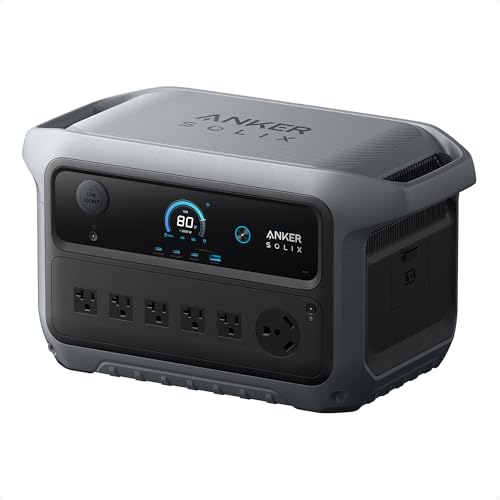
Anker’s SOLIX C2000 Gen 2 takes a different route to 2,000Wh-class usefulness. The base station carries 2,048Wh and provides 2,400W of continuous output with a stated 4,000W peak. That combination gives it more output capacity than the DABBSSON while keeping the battery in the same general class. The published specifications also emphasize low standby consumption, with a listed 9W draw, and claim up to 32 hours of operation for a dual-door refrigerator. That refrigerator figure is a manufacturer claim, not a universal runtime promise, because appliance cycling and startup demand vary.
The most distinctive feature is expansion. An optional battery can take the system to 4kWh, so the C2000 Gen 2 can grow with an RV, workshop, or longer backup plan. The station is listed at 41.7 pounds and measures 18.1 by 9.8 by 10.1 inches, giving buyers useful placement information before purchase. AC and solar charging are advertised at a full charge in 58 minutes, while an 800W alternator charger can refill it from a vehicle in three hours. The listing confirms several recharge methods, though it does not provide the solar voltage and current limits needed to certify a specific panel arrangement.
Pros
- 2,048Wh base capacity meets the target class.
- 2,400W continuous output exceeds many similarly sized stations.
- Optional expansion can raise total capacity to 4kWh.
- Listed 9W standby draw may help reduce idle consumption.
- Includes an 800W alternator-charging option for vehicle-based use.
Cons
- The expansion battery is optional and does not form part of the base capacity.
- Panel-specific solar compatibility cannot be confirmed from the supplied electrical details.
This model suits buyers who expect their energy needs to grow and prefer adding capacity later instead of replacing the station. It is a strong RV and basecamp candidate, but buyers who need an included solar panel or the highest continuous output should look toward the PowerMax package.
To buy this product, click here.
4. Anker SOLIX S2000 — Best Compact 2,000Wh Station
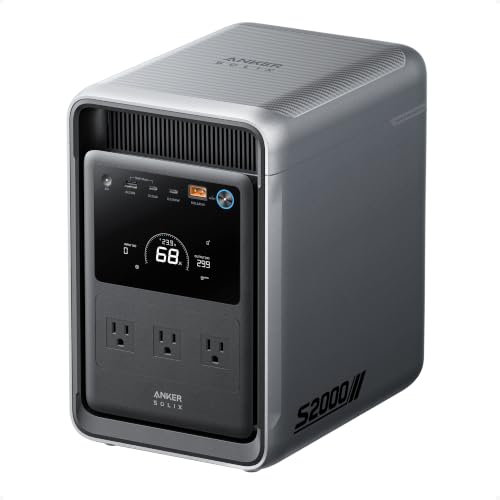
The S2000 is a particularly interesting match for buyers who want 2,000Wh capacity but do not need a 2,000W-plus inverter. It lists 2,010Wh of energy, 1,500W continuous output, and a 3,000W peak rating. That output profile is better suited to refrigerators, routers, computers, lights, and everyday essentials than sustained high-wattage cooking or heating appliances. The published listing claims up to 35 hours of refrigerator backup, but actual operation depends on the specific refrigerator, cycling pattern, temperature, and other connected loads.
At 35.7 pounds and 8.2 by 11.1 by 12.7 inches, the S2000 is among the easier 2,000Wh options to place in a closet, office, or vehicle. Its stated 6W idle draw and front-and-rear outlet layout are useful for a tidy home-office setup. It supports up to 400W solar input and six recharge methods, while the listing identifies a sub-10ms home-office UPS switchover. One notable limitation is the absence of a 12V DC port, so buyers with car refrigerators or other DC loads should check their connection needs before choosing it.
Pros
- 2,010Wh capacity provides the requested energy class.
- 35.7-pound weight is comparatively manageable for this capacity.
- Listed 6W idle draw is useful for long standby periods.
- Supports up to 400W solar input and six recharge methods.
- Front and rear outlets help separate everyday and always-on devices.
Cons
- 1,500W continuous output is lower than the other 2,000Wh leaders.
- The listing specifies no 12V DC port.
The S2000 is a smart fit for home-office and refrigerator-focused backup where capacity matters more than running large heating or cooking loads. Buyers planning to power heavy tools, kettles, or microwaves for long periods should choose a higher-output model instead.
To buy this product, click here.
5. OUPES Mega 1 Lite — Best Portable High-Output Alternative

The OUPES Mega 1 Lite is below the requested capacity class at 1,024Wh, but it earns a place as a high-output alternative for buyers who value portability more than all-day energy storage. Its 2,000W continuous AC output and 4,500W surge rating are unusually assertive for a 26.7-pound station. That means it can be a handy companion for coffee makers, selected power tools, and other high-wattage devices, provided their actual operating demand remains within the continuous rating and the battery has enough energy for the task.
Its two 140W USB-C PD ports are especially useful for laptops and other USB-C equipment because they reduce the need for bulky AC adapters. The unit supports up to 800W solar input and lists a 46-minute full AC recharge claim, while the included package contains AC and car cables but no solar panel. App control, a selectable 700W slow-charge mode, and a listed under-20ms UPS transfer add flexibility. The smaller battery means it should not be mistaken for a 2,000Wh replacement, but the lighter body is easier to move between a vehicle, campsite, and work area.
Pros
- 2,000W continuous AC output in a 26.7-pound body.
- Two USB-C PD ports are rated at 140W each.
- Supports up to 800W solar input.
- Includes app control and adjustable charging speeds.
- Uses a listed LiFePO4 battery with more than 3,500 cycles to 80 percent capacity.
Cons
- Its 1,024Wh capacity is about half that of the leading 2,000Wh stations.
- The solar panel is not included in the listed package.
This is the right kind of compromise for a camper, creator, or contractor who needs serious AC output in a lighter package and can recharge more often. It is a poor match for buyers whose main goal is extended refrigerator or home backup runtime.
To buy this product, click here.
6. CUBUS 1000 PLUS — Best Lightweight Mid-Capacity Option

The CUBUS 1000 PLUS is another capacity compromise, with 960Wh and 1,000W continuous AC output. Its appeal is straightforward: a 23.1-pound body, foldable handle, four AC outlets, two USB-C ports, two USB-A ports, an XT60 port, and a built-in flashlight. For laptop charging, lights, camera equipment, small coolers, and moderate campsite loads, that combination is much easier to carry than a 2,000Wh system.
The listing states that the battery uses LiFePO4 cells and supports more than 3,500 cycles while retaining over 70 percent capacity. It also lists a 2.2-hour charging time when all charging inputs are combined, with AC, car, and compatible solar charging available. The product instructions specifically warn against appliances or tools rated above 1,000W and explain that leaving AC output switched on drains the battery. Those details matter because this model’s compact footprint does not make it suitable for every appliance a larger station can handle.
Pros
- 23.1-pound weight is manageable for vehicle and campsite use.
- Provides 960Wh capacity with 1,000W continuous output.
- Includes four AC outlets, USB-C, USB-A, XT60, and a flashlight.
- Supports AC, car, and compatible solar charging.
- Foldable handle simplifies carrying and storage.
Cons
- It is well below 2,000Wh capacity.
- The published instructions limit connected appliances and tools to 1,000W or less.
The CUBUS is worth choosing only if the 2,000Wh target is flexible and portability is central to the plan. It works better as a practical travel station than as a long-duration home backup unit, especially for buyers who mostly run electronics and modest DC loads.
To buy this product, click here.
7. BLUETTI AC180 — Best Fast-Charging Mid-Size Option

The BLUETTI AC180 sits below the target capacity with a 1,152Wh LiFePO4 battery, yet its 1,800W continuous output gives it more appliance flexibility than its capacity alone suggests. Two AC outlets and eight total outlets are listed, while the app can raise output to 2,700W through a power-lifting mode. That mode should be treated as a special operating feature rather than a replacement for the 1,800W continuous rating.
Charging is the headline feature. The AC180 lists 1,440W AC input and a full-charge claim of one hour, plus up to 500W solar input. The supplied specifications give a solar-only charging estimate of 2.8 to 3.3 hours and identify a 20ms emergency backup transfer time. Those claims are useful for planning, though real charging and runtime can vary with conditions and connected loads. The package includes AC, car, and solar charging cables, which is convenient for buyers building a mobile kit from the start.
Pros
- 1,152Wh LiFePO4 battery offers more energy than the smaller travel models.
- 1,800W continuous output supports many everyday appliances.
- App-enabled power lifting raises the stated output to 2,700W.
- Supports up to 500W solar input.
- Includes AC, car, and solar charging cables.
Cons
- Its capacity is substantially below 2,000Wh.
- The listed 20ms transfer time should not be treated as universal medical or computer-device compatibility.
The AC180 is best for buyers who would rather have strong output and rapid recharge than maximum stored energy. It makes sense for shorter outages, mobile work, and camping appliances, but a true 2,000Wh station remains the better fit for extended loads.
To buy this product, click here.
8. Jackery Explorer 1000 v2 — Best Portable 1,000Wh-Class Option

The Explorer 1000 v2 is not a 2,000Wh station, but it is one of the more practical smaller alternatives in this selection. Its 1,070Wh battery, 1,500W continuous AC output, and 3,000W surge rating cover a useful range of campsite and emergency devices. The 23.8-pound weight and foldable handle make it far easier to load into a car or move around a campsite than the larger stations.
Jackery lists three AC outlets, two USB-C ports, one USB-A port, a DC car port, and LED lights. The USB-C ports support 100W PD, which suits laptops and smaller electronics without using an AC adapter. The app offers an emergency one-hour charging mode, but the default full-charge mode is listed at 1.7 hours for battery-health purposes. Solar charging is restricted to Jackery solar panels according to the supplied information, and a panel is not included with this listing.
Pros
- 1,070Wh capacity is useful for mobile power without a 2,000Wh station’s bulk.
- 1,500W continuous output covers many common appliances.
- 23.8-pound weight and foldable handle support vehicle travel.
- Two USB-C ports provide listed 100W PD charging.
- App includes emergency, quiet overnight, and energy-efficiency modes.
Cons
- Capacity is roughly half the target 2,000Wh class.
- The listing specifies compatibility only with Jackery solar panels for solar charging.
This station suits campers, travelers, and emergency-kit owners who need a portable power hub more than extended energy storage. It should be skipped by buyers who expect to run a refrigerator or multiple appliances for long periods without recharging.
To buy this product, click here.
9. OUPES Mega 1 — Best Expandable 2,000W Alternative

The OUPES Mega 1 shares the 1,024Wh base capacity and 2,000W continuous output class of the Mega 1 Lite, but the two listings serve different priorities. This version emphasizes expansion, supporting up to two B2 Extra Batteries and a stated maximum capacity of 5,120Wh. That expanded figure is not included battery capacity, so the base station should be evaluated as a 1,024Wh unit unless the additional batteries are purchased separately.
The station lists a 4,500W surge rating, dual 100W USB-C PD ports, four QC3.0 USB-A ports, 12V DC outputs, and Bluetooth app control. It also claims 0 to 80 percent AC charging in 36 minutes and 26 minutes with AC and solar combined. Since the supplied material does not identify the solar electrical limits or panel package, buyers should verify the exact input requirements before planning an array. A listed under-20ms UPS feature adds office and workstation appeal, but transfer claims do not guarantee compatibility with every device.
Pros
- 2,000W continuous output suits high-demand plug-in equipment.
- Supports optional expansion up to a stated 5,120Wh total capacity.
- Includes dual 100W USB-C PD ports and four QC3.0 USB-A ports.
- Provides specialized 12V DC outputs for compatible equipment.
- Offers app control and a listed under-20ms transfer time.
Cons
- The base capacity is 1,024Wh, not 5,120Wh.
- The supplied information does not clearly identify solar input limits or included solar equipment.
The Mega 1 is compelling for buyers who want to build toward a larger stationary or RV setup over time and need 2,000W output immediately. It is a weaker standalone choice for long-duration backup, where the 2,000Wh models provide substantially more stored energy without requiring expansion purchases.
To buy this product, click here.
Buying Guide
Start With Energy, Then Check Output
Wh describes stored energy, while W describes how much power the station can deliver at a moment. A 2,016Wh station with a 1,500W inverter may store plenty of energy but still be unsuitable for a device that continuously needs more than 1,500W. A station with 3,600W output may run a larger appliance, yet the battery can still drain quickly under a heavy load. Match the battery capacity to how long the equipment must run, then match continuous output to the equipment’s operating demand.
Do Not Treat Peak Output as Continuous Output
Peak or surge ratings describe short-duration headroom under stated conditions. They may help with startup demands, but they do not turn a 2,000W station into a continuous 4,500W power source. For heaters, kettles, microwaves, and power tools, use the continuous AC rating as the starting point. Refrigerators and other motor-driven devices also require attention to startup demand, which cannot be confirmed from a peak number alone.
Understand What 2,000Wh Means in Practice
The capacity printed on the station is a nominal battery rating. Energy delivered through AC outlets can be lower because the inverter consumes power and the system may reserve energy for battery protection. A simple calculation such as 2,000Wh divided by a 100W load is an idealized upper-bound estimate, not a tested runtime. Intermittent appliances create another variable. A refrigerator cycles rather than drawing its rated wattage continuously, and its actual result depends on the model, temperature, startup demand, and other loads.
Compare Solar Input Carefully
A higher solar-input wattage can shorten refill time under suitable conditions, but it does not guarantee that a panel will deliver that amount. Panel voltage, current, connector, and the station’s input limits all need to match. Connector shape alone does not prove electrical compatibility. The PowerMax includes a 200W panel while listing a much higher maximum solar input, and the Jackery listing limits solar charging to Jackery panels. For every other station, verify the exact panel requirements before buying a separate array.
Separate Included Capacity From Expansion Capacity
The Anker C2000 Gen 2 lists 2,048Wh in its base station and an optional route to 4kWh. The OUPES Mega 1 lists 1,024Wh in the base unit and a possible expanded total of 5,120Wh with additional batteries. Those expansion figures describe a future configuration, not what arrives in the base package. Read the included-items list carefully, especially if your plan depends on extended refrigerator, RV, or workstation operation.
Check Ports Before Choosing a Station
USB-C, car sockets, DC5521 outputs, XT60 ports, and AC outlets serve different purposes. A USB-C connector does not automatically prove a particular Power Delivery profile, while a 12V outlet does not guarantee compatibility with every 12V appliance. The OUPES Mega 1 Lite lists 140W USB-C PD ports, the Jackery Explorer 1000 v2 lists 100W USB-C PD, and the Anker S2000 specifically lacks a 12V DC port. Those distinctions can matter more than an extra outlet or a larger peak number.
Treat UPS and EPS Claims as Device-Specific
Several products list EPS, UPS, or transfer times between roughly 10 and 20 milliseconds. That information can be useful for routers, computers, and office equipment, but it does not prove zero-interruption operation with every device. Medical equipment requires special care, including checking voltage, power draw, humidifier settings, and the equipment manufacturer’s requirements. These portable stations are plug-in backup devices. They should not be connected to household wiring through a wall outlet or used to backfeed a home.
Best Portable Power Station 2000Wh FAQ
Is a 2,000Wh power station enough for home backup?
It can cover selected essentials such as a refrigerator, router, lights, phones, laptops, and smaller appliances, but it will not automatically run an entire home. Actual duration depends on the connected load, inverter losses, refrigerator cycling, and whether other devices remain plugged in. A station should be connected to individual appliances as intended, not backfed into household wiring.
What is the difference between 2,000Wh and 2,000W?
2,000Wh is an energy-storage rating. It describes the nominal amount of energy held by the battery. 2,000W is a power-output rating. It describes the approximate continuous load the inverter can deliver when the specification uses that rating. A station can have 2,000Wh of capacity and either more or less than 2,000W of continuous output.
Which 2,000Wh power station has the highest output here?
The PowerMax 3600PE lists 3,600W of continuous AC output and 2,016Wh capacity, making it the highest-output station among the full-capacity options in this roundup. The Anker SOLIX C2000 Gen 2 lists 2,400W continuous output, while the DABBSSON 2000L lists 2,200W. Peak ratings are separate and should not replace continuous-output comparisons.
Can I run a refrigerator from a 2,000Wh power station?
The listed 2,000Wh-class stations are intended for appliance use, and some listings provide refrigerator runtime claims. Still, compatibility and runtime depend on the refrigerator’s operating draw, startup demand, compressor cycling, temperature, and other connected equipment. Check the refrigerator’s electrical requirements and use the station’s continuous and surge ratings as separate limits.
Does a portable power station include solar panels?
Some do and some do not. The PowerMax 3600PE listing includes a 200W solar panel. The DABBSSON 2000L, Anker SOLIX C2000 Gen 2, and the smaller alternatives are listed as station packages without an included panel or with solar equipment treated separately. Jackery’s Explorer 1000 v2 listing also states that a panel is not included and identifies Jackery-panel compatibility for solar charging.
Can I use any 200W solar panel with these stations?
No. The panel’s wattage is only one part of the match. Voltage, current, connector, and the station’s solar input limits must also be compatible. The supplied product information does not provide enough electrical details to certify every third-party panel arrangement. Verify the exact station and panel specifications before connecting them.
Are these stations suitable for CPAP machines?
Some listings mention CPAP use, but that does not guarantee a specific device will run for a full night. Heated humidifiers and heated hoses can substantially alter power demand. Check the CPAP manufacturer’s input requirements, determine whether the station’s AC or DC output is appropriate, and verify expected runtime without treating a general product claim as medical-device approval.
Final Verdict
The PowerMax 3600PE is the strongest overall choice for this group because it combines a 2,016Wh battery with 3,600W continuous output, a broad port selection, app control, multiple recharge methods, and an included 200W solar panel. It is a substantial piece of equipment, but that bulk buys more appliance flexibility than the smaller alternatives. Buyers should still treat its runtime, charging, and EPS statements as published specifications and check their own load requirements before relying on it for backup.
The DABBSSON 2000L and Anker SOLIX C2000 Gen 2 are the strongest true-capacity alternatives. The DABBSSON brings six AC outlets and 2,200W output, while the Anker adds 2,400W output and optional expansion. The Anker S2000 is a lighter 2,000Wh choice for office and refrigerator-focused use. For buyers who prefer portability over stored energy, the OUPES Mega 1 Lite and Jackery Explorer 1000 v2 offer easier handling, with the tradeoff of roughly half the capacity. Choose according to the load, recharge path, port requirements, and carrying situation you actually have.
