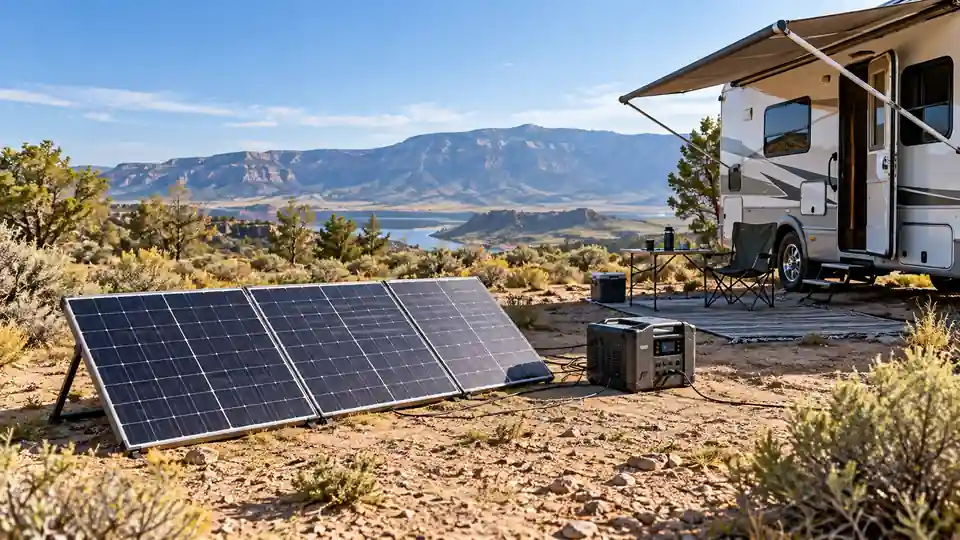
Boondocking turns a power station into part of the RV, not a gadget that gets used once and forgotten in a garage. It may need to keep a refrigerator cold, support water pumps, recharge phones, run lights, and handle the occasional higher-draw appliance while sunlight changes from hour to hour. That makes a solar generator with a useful battery reserve, practical charging options, and RV-friendly outputs far more important than a big peak-wattage number on the box.
A common mistake is comparing only the advertised wattage. Capacity in watt-hours affects how long energy may last, while continuous AC output affects which appliances can run at the same time. Solar input, car charging, DC ports, portability, and the exact contents of the kit matter too. A compact 300W unit can be sensible for phones and laptops, while a 3,840Wh station is better suited to a larger rig with refrigeration and heavier loads. The EBL 2400W kit is our top overall pick because its RV-focused design combines substantial AC output, two included solar panels, car charging, load control, and a stated UPS function.
Different travelers need different kinds of backup. A weekend camper may value a light station that slides into a storage compartment, while a full-time boondocker may prefer expandable capacity, a 30A RV connection, strong solar input, or a larger panel array. The products below cover those distinct jobs, but buyers should verify appliance startup demands and solar electrical limits before connecting equipment.
Quick Answer
- Best Overall: EBL 2400W Portable Power Station + 2×200W Solar Panels for RV-oriented power delivery, included solar capacity, and car charging.
- Best Higher-Capacity Option: ABOK Ark3600 with 3×200W Solar Panels for its 3,840Wh base capacity, 3,600W output, and expandable design.
- Best Compact Setup: DaranEner 300W Portable Power Station for its 5.84-pound body, 192Wh capacity, and included 30W panel.
- Best Midrange RV Option: Jackery HomePower 3000 for its 3,072Wh capacity, 3,600W output, TT-30 RV port, and dual 100W USB-C ports.
Best Solar Generator for RV Boondocking Comparison Table
| Product | Best For | Capacity | Continuous AC Output | Solar Setup | RV-Relevant Feature |
|---|---|---|---|---|---|
| EBL 2400W Portable Power Station | Overall RV boondocking | Not clearly specified | 2,400W | 2×200W panels | Car input, UPS, load control |
| Jackery HomePower 3000 | Large RV and mixed use | 3,072Wh | 3,600W | 2×200W panels | TT-30 RV port, UPS |
| ABOK Ark3600 with 400W Panel | Expandable off-grid setups | 3,840Wh | 3,600W | 400W panel, 2,000W solar input | 15 ports, app, wheels |
| ABOK Ark3600 with 3×200W Panels | Higher solar collection | 3,840Wh | 3,600W | 3×200W panels | TT-30 RV port, expandable |
| PowerMax 3600 PE | High-output RV users | 2,016Wh | 3,600W | 200W panel, 1,600W max input | Car, solar, and AC charging |
| BROWEY 1600W | Built-in solar convenience | 1,024Wh | 1,600W | Built-in panel, 40W solar charging | 100W USB-C PD |
| EnginStar 300W | Small RV electronics | 296Wh | 300W | 60W foldable panel | 6.5-pound body, car input |
| DaranEner 300W | Lightweight travel | 192Wh | 300W | 30W panel | 60W USB-C PD, flashlight |
| MARBERO M823 | Small-device camping | 237Wh | 300W | 60W foldable panel | 12V DC output, flashlight |
The detailed reviews explain how each station fits into an RV power plan, from lightweight electronics kits to expandable systems for longer stays away from hookups.
1. EBL 2400W Portable Power Station + 2×200W Solar Panels — Best Overall

The EBL package is unusually well matched to the basic rhythm of RV boondocking. Its 2,400W AC output is specified for loads such as RV refrigerators, water pumps, small air conditioners, and onboard media equipment, giving it a broader role than a small electronics power bank. The package also includes two 200W foldable monocrystalline panels, so the solar hardware arrives as part of the setup rather than as a separate shopping project.
That RV focus continues with car cigarette-lighter charging, adjustable fast and slow charging modes, and independent output control. In practical terms, you can shut down lower-priority loads while reserving stored energy for refrigeration or water equipment. The listing also identifies a built-in UPS and a low-self-discharge sleep mode. The battery capacity is not clearly supplied in the listing, so buyers should check the station display and manual before estimating overnight runtime.
Pros
- 2,400W stated AC output suits a broad range of RV loads.
- Includes two foldable 200W monocrystalline solar panels.
- Supports car charging for cloudy-day or travel-day top-ups.
- Independent output control helps prioritize essential loads.
- Listing identifies UPS functionality and low-self-discharge sleep mode.
Cons
- Battery capacity in watt-hours is not clearly specified in the supplied listing.
- The listing does not provide the solar voltage and current limits needed to certify additional panel configurations.
This is the strongest all-around choice for an RV owner who wants a ready-to-use solar kit with substantial output and several replenishment paths. It is less suitable for buyers who need a clearly stated battery capacity before planning exact runtimes or who want a very small station for occasional phone charging.
To buy this product, click here.
2. Jackery HomePower 3000 and 2×200W Solar Panels — Best for Mixed RV and Home Use

The HomePower 3000 brings a large 3,072Wh battery and 3,600W AC output to an RV setup, which gives it plenty of headroom for several moderate loads running together. Its built-in TT-30 RV port is especially relevant for campers who want a direct RV connection rather than relying entirely on individual household-style outlets. Dual 100W USB-C PD ports also suit a modern rig loaded with tablets, laptops, cameras, and drones.
Solar charging is paired with two SolarSaga 200W panels, while the station can also recharge through a 12V car charger or a gas generator according to the listing. A stated UPS transfer time of 20 milliseconds adds appeal for selected electronics, although buyers should verify compatibility with sensitive equipment. The station and panels ship separately, so the package may arrive in more than one box, a small detail that matters if the RV is leaving soon.
Pros
- 3,072Wh stated battery capacity provides a substantial energy reserve.
- 3,600W AC output and 7,200W surge claim support higher-demand use.
- Built-in TT-30 RV port simplifies connection to compatible RV equipment.
- Includes two 200W SolarSaga panels in the listed kit.
- Offers dual 100W USB-C PD ports and car charging.
Cons
- Panels and station ship separately and may arrive at different times.
- The listing does not establish that every RV appliance or medical device will work with its UPS behavior.
This model suits RV owners who want one station to cover travel and home backup duties, especially those who value the TT-30 outlet and high AC output. Its larger body and home-oriented feature set may be excessive for a minimalist camper who mainly charges personal electronics.
To buy this product, click here.
3. ABOK Ark3600 Portable Power Station with 400W Solar Panel — Best Expandable Option

The Ark3600 targets travelers who have outgrown small camping batteries. Its published 3,840Wh capacity and 3,600W rated output create a strong foundation for an RV with refrigeration, lighting, water equipment, and occasional AC loads. The listing states that capacity can expand to 11,520Wh, though the additional hardware is not identified as included in this package, so the base unit should be the starting point for any energy plan.
Solar input is rated at up to 2,000W, and the kit includes a 400W solar panel. AC, photovoltaic, and car charging are all supported, with the listing claiming combined AC and solar charging as fast as 1.29 hours under its stated conditions. Fifteen output ports include a 30A AC port, USB connections, DC outputs, an XT60 port, and a cigarette-lighter outlet. The Bluetooth app and wheels make a large station easier to manage around a campsite.
Pros
- 3,840Wh base capacity is among the largest in this roundup.
- 3,600W rated output and 4,500W peak output are clearly identified.
- Supports up to 2,000W of stated solar input.
- Includes a 30A AC port and 15 total output ports.
- Expandable capacity and Bluetooth monitoring suit longer stays.
Cons
- Expansion batteries are not identified as included in this package.
- The included 400W panel does not approach the station’s stated maximum solar input by itself.
This is a compelling fit for full-size RVs and travelers planning longer stretches without hookups. It is a poor match for buyers who want a lightweight station or who will rarely use more than a few hundred watt-hours per day.
To buy this product, click here.
4. ABOK Ark3600 Portable Power Station with 3×200W Solar Panels — Best Station-and-Panel Kit

This Ark3600 configuration shares the same stated 3,840Wh base capacity and 3,600W output as the other package, but its included solar hardware is different. Three 200W panels provide a 600W rated panel bundle, making this version more attractive to an RVer who wants a larger included array for stationary daytime charging. The package also lists a TT-30 RV port, four 20A AC outlets, USB ports, DC outputs, and a 12V cigarette-lighter connection.
The station supports expansion up to 11,520Wh, while its combined AC and solar input is listed at up to 3,500W. The seller claims 0 to 80 percent charging in 1.1 hours under optimal conditions, but that figure is not a guarantee for every campsite, panel angle, or battery state. An app adds charging schedules and monitoring, and the package listing identifies a 5-year support arrangement along with UL 2743 testing claims for the portable power pack.
Pros
- Includes three 200W panels for a 600W rated solar bundle.
- 3,840Wh capacity and 3,600W rated output suit larger RV loads.
- Built-in TT-30 RV port is useful for compatible RV connections.
- Expandable capacity provides a path for longer off-grid stays.
- App scheduling, monitoring, and multiple output types add flexibility.
Cons
- The listing does not provide enough panel electrical detail to certify every possible array configuration.
- Expansion capacity is a maximum supported figure, not included battery capacity.
Select this version over the 400W-panel package if the included solar bundle is the deciding factor. It makes the most sense for a stationary boondocking camp with room to position several panels, while the extra panel count may be inconvenient for quick overnight stops.
To buy this product, click here.
5. PowerMax 3600 PE with 200W Solar Panel — Best for Higher Continuous Loads

The PowerMax 3600 PE puts continuous output ahead of battery size. Its 3,600W rated AC output and 7,200W peak claim give it a useful place for RV owners who need to run higher-demand equipment, while the 2,016Wh battery is smaller than the large-capacity ABOK and Jackery options. That distinction matters: output determines what a station may run, but capacity determines how long stored energy can last.
The package includes a 200W solar panel and supports up to 1,600W of stated solar input. AC, car, and solar charging can be used through its multi-mode system, and the listing identifies 14 output ports, an app, and an EPS switchover claim of under 10 milliseconds. The station weighs 24 kilograms, or about 52 pounds, so its wheels help with movement but do not turn it into a lightweight backpacking battery.
Pros
- 3,600W continuous AC output supports demanding loads within stated limits.
- 2,016Wh battery offers a useful middle ground between compact and large stations.
- Includes a 200W solar panel.
- Supports up to 1,600W stated solar input and triple-input charging.
- Includes app control, 14 output ports, and an EPS feature.
Cons
- The 52-pound listed weight is substantial for frequent lifting in and out of an RV.
- The included 200W panel uses only part of the station’s stated solar-input capability.
This is a sensible choice for RV owners who care more about running higher-wattage equipment than carrying the largest possible battery reserve. Buyers focused on multi-day refrigeration or quiet electronics use may prefer a higher-capacity station instead.
To buy this product, click here.
6. BROWEY 1600W Portable Power Station with Built-in Solar Panel — Best Built-In Solar Design

The BROWEY S1600 takes a different approach to campsite charging by integrating a solar panel into the station. That can be handy in an RV storage bay where loose folding panels and cables tend to become a tangled drawer of gear. Its 1,024Wh capacity and 1,600W pure sine wave output place it in the middle of this group, with enough stated output for refrigerators, tools, and other moderate loads within the station’s limits.
The listing also identifies a 100W USB-C PD port, eight total ports, car charging, and the ability to connect other solar panels. Built-in solar charging is listed at 40W, which is convenient for gradual replenishment but modest beside the 400W to 600W panel bundles elsewhere here. The LiFePO4 battery is advertised at more than 3,000 cycles to 80 percent capacity, a claim that should be read alongside its stated testing conditions rather than treated as a guaranteed service life.
Pros
- Built-in solar panel reduces the amount of loose charging gear.
- 1,024Wh capacity and 1,600W output fit many medium-duty RV tasks.
- Offers pure sine wave AC output according to the listing.
- Includes a 100W USB-C PD port and eight output ports.
- Can charge through a car outlet and connect with additional panels.
Cons
- The built-in solar charging rate is listed at 40W, much lower than the station’s AC output.
- The published specifications do not clearly detail external-panel voltage and current limits.
This model works well for campers who value an integrated, tidy package and moderate output. It should be skipped by RV owners planning to harvest substantial daytime solar energy or run large loads for extended periods.
To buy this product, click here.
7. EnginStar 300W Power Station with 60W Foldable Solar Panel — Best for Small RV Electronics

The EnginStar is aimed at the other end of the RV spectrum. Its 296Wh capacity, 300W AC output, and listed 6.5-pound weight make it easier to place beside a laptop, camera bag, or small campsite refrigerator than a 50-pound high-output station. Two AC outlets, regulated DC outputs, USB-A, and 18W USB-C cover the ordinary collection of personal devices that accumulates during a travel day.
The included 60W monocrystalline panel folds to a compact size and is listed with 23 percent conversion efficiency. The station also accepts AC and 12V car charging, with a stated maximum charging speed of 65W. Its pure sine wave AC output and battery-management protections are useful features, but a 300W limit rules out high-draw heating appliances, many compressors, and water pumps that need more startup power.
Pros
- Listed weight is 6.5 pounds, making it easy to move around an RV.
- Includes a 296Wh battery and 60W foldable solar panel.
- Provides two pure sine wave AC outlets.
- Offers regulated DC outputs, USB-A, and 18W USB-C.
- Supports wall, car, and compatible solar charging.
Cons
- 300W output is too limited for many RV appliances and higher-startup loads.
- The listed lithium-ion chemistry and 1,000-plus cycle claim offer less stated cycle capacity than the LFP options here.
Choose this kit for phones, laptops, cameras, lights, and other modest electronics in a small RV or van. It is a poor substitute for a main boondocking bank if the refrigerator, microwave, pump, or air conditioner is part of the power plan.
To buy this product, click here.
8. DaranEner 300W Portable Power Station with 30W Solar Panel — Best Compact Setup

At 5.84 pounds and 192Wh, the DaranEner is the easiest model here to tuck into a narrow RV cabinet, car trunk, or tent corner. It provides two 300W AC outlets, a 60W USB-C PD port, a second 30W USB-C port, a 12V car socket, and DC outputs. That layout is useful for a travel day filled with phones, tablets, cameras, and a laptop, where portability matters more than running appliances.
The included 30W solar panel connects through the station’s built-in MPPT controller, and the station can also accept up to 90W from AC or 60W through a car socket. Its LFP battery is advertised at more than 3,500 cycles to 80 percent capacity. A four-mode LED flashlight is a welcome emergency extra, although the small battery and 300W output keep this firmly in the electronics category.
Pros
- Listed weight of 5.84 pounds suits compact RV storage.
- 192Wh capacity and 300W output cover small electronic loads.
- Includes a 30W solar panel and built-in MPPT controller.
- Provides 60W USB-C PD, a second USB-C port, and a 12V socket.
- Includes four flashlight modes for campsite and roadside use.
Cons
- 192Wh is a small reserve for refrigeration or multi-day boondocking.
- The included 30W panel is intended for gradual charging rather than rapid replenishment.
This is a good companion battery for an RV traveler who already has a larger electrical system or needs a separate power source for personal electronics. It should not be treated as the primary station for an appliance-heavy rig.
To buy this product, click here.
9. MARBERO M823 237Wh Solar Generator — Best for Basic DC and USB Loads

The MARBERO M823 is a small solar kit for campers who need modest, direct power rather than a full RV electrical replacement. Its 237Wh battery and 300W rated pure sine wave AC output can support small electronics, while the 12V DC output, USB-A ports, and 18W USB-C port reduce the need to use the inverter for every device. That can be useful in a compact rig where phones and lights are the everyday loads.
A 60W foldable panel is included, and the listing gives a panel conversion range of 21.5 to 23.5 percent. The package also includes a DC cable and adapters for connecting the panel to the station. A three-mode flashlight adds a little practical value at camp, but the manufacturer warns against loads above 300W, particularly heating elements. Buyers should verify the adapter and voltage requirements of each connected device.
Pros
- 237Wh capacity is suitable for small electronics and short trips.
- Includes a 60W foldable solar panel.
- Offers two AC outlets, USB-A, USB-C, and a DC output.
- 300W rated pure sine wave AC output is clearly identified.
- Includes flashlight, strobe, and SOS modes.
Cons
- 300W output and 237Wh capacity limit its usefulness for major RV appliances.
- The listing warns that loads above 300W, especially heating devices, may damage the unit.
The M823 is a sensible low-demand kit for lights, phones, tablets, and occasional laptop charging. Choose a larger station for refrigeration, pumps, cooking appliances, or repeated multi-day use away from hookups.
To buy this product, click here.
Buying Guide
Match Battery Capacity to Your RV Routine
Watt-hours describe stored energy, while watts describe the amount of power a station can deliver at a given time. A 3,840Wh station has a larger stated energy reserve than a 237Wh model, but neither figure guarantees the same amount of energy at an AC outlet. Inverter losses, idle consumption, battery cutoffs, temperature, and changing appliance loads affect the result.
List your daily loads before shopping. Separate essentials such as refrigeration, lighting, water equipment, and communications from occasional loads such as coffee makers or hair dryers. For a rough theoretical estimate, divide the station’s stated Wh capacity by an assumed average load in watts. Label that result as an idealized estimate, not tested runtime, because the published capacity is not the same as usable AC energy.
Prioritize Continuous Output Over Peak Numbers
Continuous AC output is the more useful starting point for RV planning. A 3,600W rating describes the sustained output claim, while a 7,200W peak figure describes a temporary surge claim under specified conditions. A larger peak number does not prove that a refrigerator compressor, pump, air conditioner, or power tool will start successfully.
Check the appliance label and manual for running and startup requirements. Keep the total running load below the station’s continuous rating, and leave room for devices that switch on unexpectedly. The EBL, Jackery, ABOK, and PowerMax models offer much more output headroom than the 300W compact units.
Study Solar Input Before Adding Panels
Panel wattage alone does not certify compatibility. A proper match may require the panel’s open-circuit voltage, operating voltage, current ratings, connector details, and the station’s permitted solar voltage, current, and wattage. A connector that fits physically can still be electrically unsuitable.
The included panels in these kits should be treated as the supplied charging hardware. If you plan to add panels, use the exact station documentation to confirm the configuration. Do not assume that two panels can be wired in series or parallel simply because their wattage appears convenient.
Use DC Outputs Where They Fit
RV life often includes 12V equipment, USB devices, and laptops. Running an appropriate device through a direct DC or USB-C connection may avoid the extra conversion step associated with an AC adapter, but a 12V socket is not automatically compatible with every 12V appliance. Check voltage, current, connector, and polarity requirements.
The Jackery HomePower 3000 includes a TT-30 RV port, the ABOK packages list 30A connections, and the compact DaranEner and MARBERO models provide smaller DC outlets. Those features can be useful, but port presence alone does not prove compatibility with every RV circuit or appliance.
Separate UPS, EPS, and Pass-Through Features
Several listings describe UPS or EPS behavior. Those labels are not interchangeable with a guarantee that every computer, refrigerator, network device, or medical device will continue operating without interruption. Transfer time, device sensitivity, operating mode, and the complete electrical arrangement all matter.
Use these functions only after checking the station documentation and the requirements of the connected equipment. A portable station is a plug-in power source, not permission to backfeed an RV or home through an outlet. Any installed transfer equipment or wiring work requires the appropriate product guidance and qualified electrical help.
Plan Around Weight, Storage, and Panel Space
A large station can reduce charging anxiety, but it also occupies storage space and may require wheels or two-person handling. The PowerMax listing gives a weight of 24 kilograms, while the DaranEner and EnginStar listings give weights below 7 pounds. Those are very different ownership experiences inside a moving RV.
Think about where the station will sit, how panels will be stored, and whether cables can reach a sunny location without creating a trip hazard. Foldable panels are easier to pack, while three-panel bundles may collect more solar energy but require more room at camp.
Best Solar Generator for RV Boondocking FAQ
What size solar generator is suitable for RV boondocking?
There is no single correct capacity. A 192Wh to 296Wh station can suit phones, laptops, cameras, and lights, while a 1,024Wh to 2,016Wh model offers a broader reserve for moderate loads. Stations rated around 3,000Wh or more are better candidates for larger energy budgets, but appliance demand and charging conditions still determine actual runtime.
Can these power stations run an RV refrigerator?
Several listings identify refrigerators among supported uses, including the EBL, BROWEY, Jackery, and ABOK products. That does not guarantee operation for every refrigerator. Check the refrigerator’s running draw, startup demand, plug requirements, and cycling pattern against the station’s continuous and peak specifications.
Is a 300W power station enough for an RV?
It can be enough for a limited electronics setup. The EnginStar, DaranEner, and MARBERO models can suit phones, tablets, cameras, lights, and similar modest loads. Their 192Wh to 296Wh capacities and 300W output are poor matches for air conditioners, water pumps, heating elements, microwaves, or other high-demand appliances.
Are the included solar panels automatically compatible?
The included panel and station are presented as a kit, but buyers should still follow the product documentation. For additional panels, compatibility cannot be confirmed from wattage or connector shape alone. Verify voltage, current, polarity, connector, and the station’s solar-input limits before making a connection.
Can a solar generator charge from an RV alternator?
The products here list car or cigarette-lighter charging, which may allow charging from a suitable vehicle outlet. That is different from proving direct alternator integration. Use the supplied charging cable and follow the station’s input limits. Do not improvise wiring to a vehicle electrical system.
Are larger power stations better for every boondocking trip?
No. Larger stations bring more capacity and output, but they also take more storage space and can be harder to move. A compact DaranEner or EnginStar may be the better companion for a traveler who has modest loads and already owns an RV electrical system. Larger ABOK, Jackery, EBL, and PowerMax models make more sense when the station is expected to carry a major share of the RV’s energy needs.
Can I run an air conditioner from a portable power station?
The EBL listing references small air conditioners, and the larger stations provide substantially more continuous output than the compact models. Still, air conditioners have startup and running requirements that vary by model. Check both figures and confirm that the station’s output, battery capacity, and cooling duration fit the specific unit.
What should I check before using a station for CPAP equipment?
Confirm the CPAP manufacturer’s input requirements, the station’s output voltage and connector, and whether the machine uses a humidifier or heated hose. A listing that mentions CPAP does not establish guaranteed overnight operation or medical-device compatibility. Verify the complete setup before relying on it away from shore power.
Final Verdict
The EBL 2400W kit is the strongest overall choice for RV boondocking in this group because its stated features are tied directly to RV use. It provides 2,400W of AC output, includes two 200W foldable solar panels, accepts car charging, offers independent output control, and identifies UPS functionality. Its missing published watt-hour capacity means buyers should confirm the energy reserve before planning exact runtimes, but the combination is unusually practical for a ready-to-use travel setup.
For maximum stored energy and expansion potential, the ABOK Ark3600 packages are the more ambitious alternatives, with 3,840Wh, 3,600W output, 30A connections, and either a 400W or 600W included panel bundle. The Jackery HomePower 3000 is a strong mixed-use option with a TT-30 port and dual 100W USB-C outputs, while the PowerMax favors high continuous output. For small electronics and tight storage, the EnginStar, DaranEner, and MARBERO kits keep the load expectations modest and the physical footprint easier to manage.
