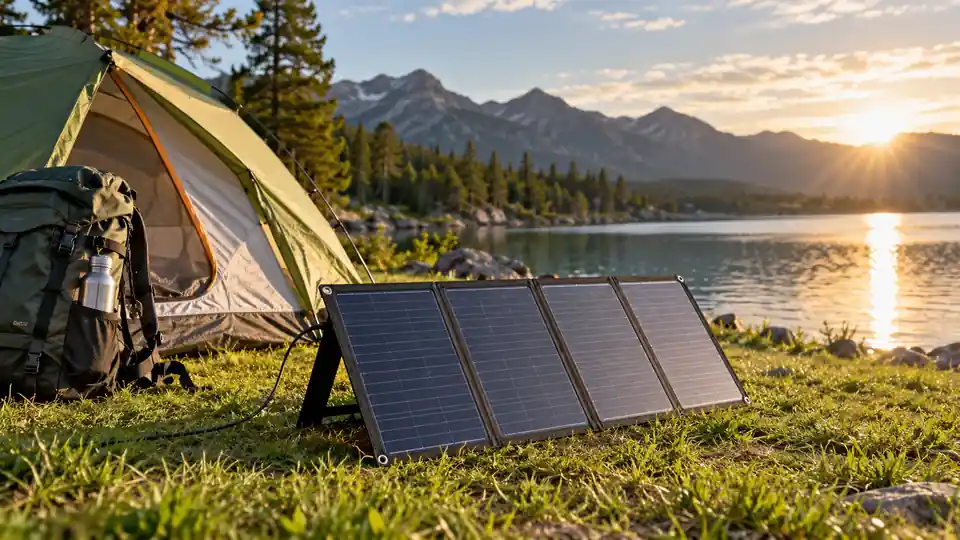
A campsite power setup can be wonderfully simple until a phone, camera, GPS, and portable power station all need charging at once. That is why shoppers look for the best Portable Solar Panel for Camping. A foldable panel can turn a sunny patch beside a tent, van, or picnic table into a useful charging point, but the wrong model may be awkward to carry, short on ports, or electrically mismatched with a power station.
The common mistake is to judge a panel by wattage alone. A 100W rating does not guarantee 100W of real charging, and a connector that physically fits a station does not prove that the voltage and current are suitable. Weight, folded size, cable length, kickstands, output ports, weather-rating details, and the exact input limits of the device being charged all matter. A backpacker may prefer a 40W or 45W panel, while a car camper may gladly carry a larger 100W model for broader charging flexibility.
For the strongest balance of rated output, portability, included adapters, and direct-device charging, the FlexSolar 100W Foldable Portable Solar Panel is the leading option here. The ZOUPW 100W model is especially appealing for buyers who need a broad connector set, while the FlexSolar 40W panel makes more sense for a lighter electronics-only kit.
If you want a quick overview before reading the full reviews, the table below compares the nine camping-focused options at a glance.
Best Portable Solar Panel for Camping Comparison Table
| Product | Best For | Rated Power | Folded Weight | Outputs or Connectors | Weather Detail |
|---|---|---|---|---|---|
| FlexSolar 100W Foldable Portable Solar Panel Charger | Best overall balance | 100W | 4.1 lb | 100W DC, 45W USB-C, 18W USB-A, 4-in-1 cable | IP67 listed |
| ZOUPW 100W Portable Solar Panel | Multiple power-station connectors | 100W | 9.48 lb | 5-in-1 cable, USB-C PD, two USB-A | IP67 listed |
| CTOLITY 100W Portable Solar Panel | Expandable panel setups | 100W | Not clearly specified | XT60, 19.8V output | IP65 listed |
| DOKIO 100W Foldable Solar Panel Kit | 12V battery charging | 100W | 6 lb | Separate PWM controller, USB ports | Not clearly specified |
| FlexSolar 60W Foldable Portable Solar Panel | Lightweight car camping | 60W | 2.6 lb | 60W DC, 40W USB-C, 18W USB-A | IP65 specified in details |
| 45W Portable Solar Panel for Camping | Compact camping kits | 45W | 3.3 lb | DC, USB-C, USB-A | IP67 listed |
| FlexSolar 40W Foldable Solar Panel | Backpack-friendly charging | 40W | 1.76 lb | 40W DC, 18W USB-C, 18W USB-A | IP67 listed, junction box caution |
| ZeroKor 300W Power Station With 60W Panel | Complete station-and-panel kit | 60W panel | Not clearly specified | DC, USB-A, USB-C, AC outlets | Panel junction box not waterproof |
| SOARAISE 48000mAh Solar Power Bank | Small-device charging | Solar charging panels built in | Not clearly specified | Built-in cables, USB-C, USB-A, wireless pad | Not clearly specified |
The detailed reviews explain how each panel handles portability, charging flexibility, connectors, and the practical limitations that matter at camp.
1. FlexSolar 100W Foldable Portable Solar Panel Charger — Best Overall

The FlexSolar 100W model is the most balanced choice in this group for campers who want substantial panel output without dragging around a particularly bulky setup. The published weight is 4.1 pounds, and the folded dimensions are listed as 12.99 by 10.43 by 2.17 inches. That combination gives it a useful shape for a vehicle kit, road trip, or campsite where the panel may need to move from a shaded table to a brighter patch of ground.
Its output arrangement is unusually practical for a panel in this class. The listing identifies a 100W DC output, a USB-C port rated up to 45W, and an 18W USB-A port, along with a four-in-one charging cable using DC5521, DC7909, Anderson, and XT60 connectors. That does not certify compatibility with every power station, so buyers still need to compare the panel’s electrical specifications with their station’s input limits. Still, the mix is convenient for a camp where a power station, tablet, and phone may all be in the charging queue.
Pros
- 100W rated panel output suits larger camping charging setups.
- Published weight is 4.1 pounds, supporting easier transport than heavier 100W options.
- Includes 45W USB-C, 18W USB-A, and 100W DC outputs.
- Four-in-one cable includes DC5521, DC7909, Anderson, and XT60 connectors.
- The listing identifies an IP67 waterproof and dustproof design.
Cons
- The published material does not provide Voc, Vmp, Isc, or Imp figures for electrical matching.
- Connector inclusion does not prove compatibility with a particular power station.
This panel is a strong fit for car campers, RV travelers, and anyone who wants one foldable panel for both a solar generator and smaller USB devices. A backpacker counting every ounce may prefer the 40W or 60W FlexSolar models, while a buyer with a station capped at a lower solar-input wattage will not receive the full benefit of the 100W rating. Check the station’s voltage, current, connector, and maximum solar input before connecting it.
To buy this product, click here.
2. ZOUPW 100W Portable Solar Panel — Best for Connector Variety

The ZOUPW 100W panel is aimed at campers who move between different power stations rather than keeping one fixed charging ecosystem. Its included five-in-one cable lists DC8020, XT60, Anderson, DC7909 or 8mm, and DC5521 connectors. That range can reduce adapter clutter in a family camping bin, although the named compatibility claims still need to be checked against the exact input requirements of the station you own.
This is a more substantial piece of kit than the lightweight FlexSolar alternatives. The listing gives a folded size of 24.13 by 21.06 by 1.77 inches and a weight of 9.48 pounds, with a magnetic carry handle and two adjustable kickstands. The longer 10-foot solar cable can help place the panel in a sunny area while the power station stays in a more convenient spot. Direct-device charging is also built in through one USB-C port identified as PD 15V/3A and two USB-A ports, one of which is listed with QC3.0 support.
Pros
- 100W rated output is suitable for larger portable power stations.
- Five-in-one cable includes several common connector formats.
- 10-foot cable provides more flexibility for panel placement.
- Built-in USB-C and two USB-A ports support direct small-device charging.
- The listing identifies IP67 waterproof ETFE-coated panel construction.
Cons
- At 9.48 pounds, it is considerably heavier than the 40W and 60W options reviewed here.
- The listing warns that a station with a lower input limit will restrict the panel’s usable charging input.
This model makes sense for car camping, RV use, and gear closets shared by several power stations. It is less attractive for a short hike from the parking area to a remote tent because the weight and broad folded footprint become part of the daily carry. Also, treat the five connectors as a convenience rather than a universal compatibility promise. Voltage, current, polarity, and the station’s solar-input range still need to match.
To buy this product, click here.
3. CTOLITY 100W Portable Solar Panel — Best for Expandable Panel Setups

CTOLITY takes a straightforward approach to camping solar: a foldable 100W panel with an XT60 output, a stated 19.8V output, adjustable kickstands, and reinforced loops for hanging from a tent or RV setup. The hanging loops are a nice practical touch for a vehicle campsite where the panel may need to sit against a support rather than on the ground. The listing also describes the panel as suitable for portable power stations, 12V batteries, RVs, boats, and emergency power use.
Its most distinctive feature is the stated ability to connect two panels in series or parallel for an expanded system. That possibility is useful for a stationary basecamp, but it should not be treated as an automatic wiring recommendation. The station’s voltage and current limits, the panel’s complete electrical specifications, and the manufacturer’s connection guidance must all be checked first. The listing provides a 23.7% efficiency claim and an IP65 rating, but those claims describe the supplied product information rather than independent output testing.
Pros
- 100W rated output gives it a strong role in vehicle-based camping.
- XT60 output is clearly identified in the published specifications.
- Adjustable kickstands help angle the panel toward available sunlight.
- Reinforced loops allow hanging on tents or RV structures.
- The listing describes series and parallel expansion support.
Cons
- The supplied material does not clearly state the panel’s folded weight or dimensions.
- Series or parallel use requires careful verification of the connected station’s electrical limits.
Choose this model if your camping setup is likely to grow and you value mounting flexibility more than a very compact packed size. It is a weaker fit for shoppers who need a complete adapter assortment because only the XT60 output is clearly identified here. Buyers should also preserve the IP65 rating exactly and avoid assuming that every cable, connector, or connected power station shares the panel’s environmental rating.
To buy this product, click here.
4. DOKIO 100W Portable Foldable Solar Panel Kit — Best for 12V Battery Charging

The DOKIO 100W panel is built around a different camping scenario than the direct USB chargers above. It weighs 6 pounds, folds to 19 by 26 by 0.5 inches, and includes a 9.84-foot cable plus a separate PWM controller. That arrangement suits a 12V battery setup in an RV, van, or basecamp, where the panel can sit in direct sun while the battery and controller remain in a more protected position.
The controller is central to this kit’s appeal. The listing says it provides reverse-polarity, overcharge, overload, and short-circuit protection for a 12V system, and USB ports are available for phones, lights, and small electronics when connected to a battery. The published warning about power-station input limits is useful too. A 100W panel cannot force a station to accept 100W if that station is capped at 60W. That is a system limitation, not a sign that the panel is defective.
Pros
- 100W rated output suits larger 12V camping and RV setups.
- Published weight is 6 pounds, with a relatively slim 0.5-inch folded thickness.
- Includes a 9.84-foot cable for flexible panel placement.
- Separate PWM controller is supplied for 12V battery charging.
- USB ports can support phones, lights, and small devices through a connected battery.
Cons
- The PWM controller is a different charging approach from a direct power-station connection and may require more setup.
- The supplied material does not clearly state an IP weather-resistance rating for the full kit.
This is a sensible pick for campers who already use a 12V battery or are building a simple van and RV charging arrangement. It is less convenient for someone who wants to unfold a panel and connect directly to a modern station using a selection of proprietary adapters. Confirm the battery and controller requirements before use, and do not assume that the USB outputs or cable will suit every battery or station.
To buy this product, click here.
5. FlexSolar 60W Foldable Portable Solar Panel — Best Lightweight Midrange Option

The FlexSolar 60W panel occupies a useful middle ground. Its listed weight is 2.6 pounds, and it folds to 9.8 by 12 by 1 inch, which is close to the footprint of a laptop bag rather than a large equipment case. That makes it appealing for car camping, driving trips, and emergency kits where a 40W panel feels limited but a 100W panel feels excessive.
The port layout is well suited to a small camp electronics setup. The listing identifies a 60W DC output at 20V to 28V, a 40W USB-C output, and an 18W USB-A output. It also says the built-in chip identifies connected devices and includes an LED charging indicator. There is no kickstand, so users need to lean or position the six-fold panel manually. The listing describes 60W under direct sunlight and 30W to 40W in somewhat cloudy conditions, but those are seller-provided output descriptions rather than independent testing.
Pros
- 60W rated output is a practical step above small phone-only panels.
- Published weight is 2.6 pounds.
- Folds to 9.8 by 12 by 1 inch for easier storage.
- Includes 40W USB-C, 18W USB-A, and 60W DC outputs.
- The built-in charging indicator and device-identification chip add convenience.
Cons
- The panel does not include a kickstand.
- The junction box is identified as not waterproof, and a controller is required for lead-acid battery charging.
This panel fits campers who want to charge phones, tablets, cameras, or a smaller power station without carrying a heavy 100W board. The long, narrow unfolded shape may need more ground or table space than its folded dimensions suggest. Check the input limits of the intended station, and keep the junction box protected rather than treating the panel’s stated IP65 detail as protection for the entire assembly.
To buy this product, click here.
6. 45W Portable Solar Panel for Camping — Best Compact 45W Choice

This 45W camping panel aims at the buyer who wants a little more headroom than a basic phone charger while keeping the packed kit manageable. The listed folded dimensions are 14.5 by 9.8 by 0.6 inches, and the weight is 3.3 pounds. That profile can fit into a compact camping tote or larger backpack, although the weight is higher than the 40W FlexSolar model and the output rating is lower than the 60W and 100W panels.
Three outputs keep the setup simple: one DC port with a stated 5A maximum, USB-C, and USB-A. Built-in kickstands help the panel sit on a flat surface, which is handy when the campsite table is the only convenient place to aim it. The listing describes monocrystalline cells, ETFE coating, and a conversion-efficiency claim of up to 23.5%. It also includes a solar connector, a two-in-one USB cable, two carabiners, and an 18-month warranty according to the supplied product information.
Pros
- 45W output offers more capacity than the smallest direct-device panels.
- Folded dimensions are listed as 14.5 by 9.8 by 0.6 inches.
- Includes DC, USB-C, and USB-A outputs.
- Built-in kickstands support angled placement on a flat surface.
- The listing identifies an IP67-rated panel design and includes two carabiners.
Cons
- At 3.3 pounds, it is heavier than the 1.76-pound FlexSolar 40W option.
- The supplied information does not clearly specify the USB-C output profile or full DC voltage range.
Pick this model for compact car camping, day trips, and basic off-grid charging where built-in stands are more useful than maximum wattage. Buyers who need to refill a 100W-class power station efficiently should move up to a 100W panel, while backpackers should compare the 3.3-pound weight with the smaller 40W alternative. As always, match the panel’s electrical output to the intended device instead of relying on the connector shape alone.
To buy this product, click here.
7. FlexSolar 40W Foldable Solar Panel — Best for Minimal Carry Weight

For a lightweight camping electronics kit, the FlexSolar 40W is one of the easiest options here to justify. It weighs 1.76 pounds and folds to 8 by 11.1 by 1.8 inches, so it can slip into an emergency bag or a day-trip pack without taking up the space of a larger 100W panel. That compactness comes with a lower power ceiling, but it is a reasonable trade for phones, power banks, tablets, and small stations.
The panel provides a 40W DC port plus USB-A and USB-C outputs listed at up to 18W each. The seller recommends prioritizing one port for peak efficiency, while the smart IC is described as identifying connected devices. Built-in overcurrent, overheating, and short-circuit protection are also listed. The panel surface carries an IP67 description, yet the junction box is specifically identified as not fully waterproof, so the electrical enclosure needs protection during heavy rain.
Pros
- Published weight is only 1.76 pounds.
- Folded dimensions are listed as 8 by 11.1 by 1.8 inches.
- Includes 40W DC, 18W USB-C, and 18W USB-A outputs.
- Smart IC and listed protective functions support easier direct-device charging.
- Includes two carabiners for flexible placement.
Cons
- 40W rated output is less suitable for larger power stations or several demanding loads.
- The junction box is not fully waterproof, despite the panel surface’s IP67 description.
This is the panel to pack when a few ounces and inches matter more than refilling a large battery. It works best for an electronics-first camp, an emergency kit, or a short trip where a phone and power bank are the main loads. The limited output and port-sharing guidance make it less suitable for a power-hungry basecamp, and the junction box should stay dry rather than being left exposed to a downpour.
To buy this product, click here.
8. ZeroKor 300W Portable Power Station With 60W Solar Panel — Best Complete Station-and-Panel Kit

The ZeroKor package is different from the other panel-first products because it includes a portable power station alongside a 60W foldable solar panel. For a camper starting from scratch, that complete arrangement can be more convenient than buying a panel and then searching for a compatible battery station. The station is listed with two 300W maximum AC outlets, a DC port rated from 9V to 12.6V and up to 10A, three standard USB ports, a quick-charge USB port, and a flashlight with reading and SOS modes.
The included panel is identified as a 60W monocrystalline model with an 18V, 3.3A DC interface, plus USB-A and USB-C outputs. The station can also be charged from household AC power, a car connection, or a solar panel through its DC5521 input, which gives campers several ways to prepare before leaving home. The listing warns against loads above 300W and says the panel’s junction box is not waterproof. It also does not provide a battery watt-hour figure in the supplied information, so buyers cannot fairly compare its stored energy with the 100W panels above.
Pros
- Includes a 300W maximum portable power station and a 60W solar panel.
- Provides AC, DC, USB-A, and USB-C charging outlets.
- Supports household AC, car, and solar charging pathways.
- Includes a flashlight with reading and SOS modes.
- The station’s listed protections include short-circuit, over-current, over-voltage, overload, and overheating protection.
Cons
- The supplied product data does not clearly state the station’s battery capacity in watt-hours.
- The included panel’s junction box is not waterproof, and loads above 300W are specifically cautioned against.
This kit suits a camper who wants a panel and station together for phones, tablets, cameras, lights, and other small camping equipment. It is less suitable for buyers who already own a station or need to compare solar panels by raw portability and panel wattage. Buyers planning to run an appliance should verify its continuous demand and startup behavior against the station’s limits rather than assuming the 300W maximum covers every device.
To buy this product, click here.
9. SOARAISE 48000mAh Solar Power Bank — Best for Personal Electronics

The SOARAISE unit is a solar power bank rather than a foldable panel for a portable power station. That distinction matters, but it can be useful for campers whose main goal is keeping phones and small personal electronics alive without carrying a separate battery and charging hub. The listing identifies a 48,000mAh lithium-polymer battery, four built-in solar panels, two USB-A outputs, one USB-C input/output, four built-in cables, and a wireless charging pad.
Its compact charging approach is convenient around a tent or picnic table. A camper can use the built-in USB-C, phone, USB-A, or Micro cable instead of searching through a pouch of loose cords, and the wireless pad offers another way to charge compatible devices. The listing also claims 5V/3A USB-C charging and support for up to seven devices, though simultaneous charging behavior and the actual solar charging rate are not clearly established in the supplied data. It should be viewed as a personal-device battery with solar capability, not a substitute for a 60W or 100W panel feeding a larger station.
Pros
- Listed 48,000mAh internal battery provides stored energy for personal electronics.
- Four built-in solar panels support direct solar charging.
- Includes four built-in cable types for common devices.
- Provides two USB-A outputs, USB-C input/output, and a wireless charging pad.
- The listing identifies 5V/3A USB-C charging.
Cons
- It is a power bank, not a 60W or 100W foldable panel for a larger power station.
- The supplied information does not clearly state its weight, solar wattage, or weather-resistance rating.
This option makes sense for tent campers who mainly need phone, earbuds, camera, or GPS charging and appreciate having cables built into the battery. It is a poor match for anyone planning to replenish a portable power station, run AC equipment, or build a modular solar setup. The 48,000mAh figure is a battery charge-capacity claim, not a directly comparable watt-hour rating, so do not place it beside the panel wattages as though both describe the same thing.
To buy this product, click here.
Buying Guide
Start With the Device You Need to Charge
A phone, camera, and GPS unit place very different demands on a campsite than a portable power station. Small direct-device panels such as the FlexSolar 40W or the 45W camping panel provide USB outputs for personal electronics, while 100W models are more appropriate for feeding a larger station, provided the station accepts the panel’s voltage and current. Write down the devices you expect to use, then identify whether each one needs USB-A, USB-C, DC, or an AC outlet from a separate battery station.
Rated Watts Do Not Equal Guaranteed Charging Watts
A panel’s 100W, 60W, 45W, or 40W rating describes its stated maximum panel output under specified conditions. It does not promise that the panel will produce that amount at every campsite. Shade, clouds, panel angle, cable losses, device limits, and the station’s own solar-input ceiling can reduce the accepted power. The ZOUPW listing makes this clear by explaining that a station capped at 60W will draw no more than 60W from a 100W panel.
Check Electrical Compatibility Before Using an Adapter
Connector shape is only one part of a solar connection. XT60, DC5521, Anderson, DC7909, and similar connectors can be physically familiar while still having different voltage, current, and polarity requirements. The supplied listings do not provide every panel’s Voc, Vmp, Isc, and Imp figures, so buyers should compare the exact panel information with the station’s solar-input voltage range, maximum current, maximum wattage, and connector requirements. A cable that plugs in is not proof of a safe electrical match.
Choose Portability Based on How Far the Panel Travels
Weight and folded dimensions matter most when the panel travels on foot. The FlexSolar 40W is listed at 1.76 pounds, the FlexSolar 60W at 2.6 pounds, and the 45W camping panel at 3.3 pounds. The FlexSolar 100W weighs 4.1 pounds, while the ZOUPW 100W reaches 9.48 pounds. That heavier design may be reasonable beside an RV or vehicle, but it becomes a meaningful burden on a long walk to a remote campsite.
Look for Stands, Loops, and Cable Length
Small setup details affect whether a panel stays aimed at the sun or ends up flat in the dirt. The FlexSolar 100W and 45W panel include built-in kickstands, while the CTOLITY model lists adjustable kickstands and reinforced loops for hanging. The DOKIO kit includes a 9.84-foot cable, and the ZOUPW panel includes a 10-foot cable. The FlexSolar 60W listing specifically says it has no kickstand, so it requires a table, support, or careful placement.
Read Weather Ratings by Component
An IP rating should be applied only to the component and scope described in the listing. The FlexSolar 40W details identify the junction box as not fully waterproof, and the FlexSolar 60W details also say its junction box is not waterproof. The ZeroKor panel kit includes a similar junction-box warning. The CTOLITY panel is listed with IP65 details, while several other listings identify IP67 panel construction. None of those statements automatically make a power station, cable, controller, or connector waterproof.
Know Whether You Need a Panel or a Complete Power System
A panel produces electricity while sunlight is available, but it does not store that energy. The ZeroKor package includes both a power station and a 60W panel, making it a complete starting point, while the DOKIO kit is aimed at charging a 12V battery through a supplied PWM controller. A panel-only product requires a compatible battery, station, or direct-use device. Buyers should also keep the station’s continuous and surge limits separate from the panel’s wattage because a panel cannot increase an inverter’s output rating.
Best Portable Solar Panel for Camping FAQ
What size solar panel is best for camping?
The best size depends on the equipment. A 40W or 45W panel is suitable for lighter phone, camera, and small power-bank charging. A 60W panel offers more headroom for a compact station, while a 100W panel is better suited to larger stations or several charging tasks. The station’s maximum solar-input rating still controls how much power it can accept.
Is a 100W solar panel better than a 40W panel for camping?
A 100W panel provides a higher rated output, but it is usually larger or heavier than a 40W model. It is a better fit for a car campsite, RV, or larger power station. A 40W panel can be the smarter choice for a short walk or a personal electronics kit because it reduces the carried weight and packed size.
Can I connect any portable solar panel to any power station?
No. The connector must fit, but the panel’s voltage, current, polarity, and rated output must also fall within the station’s solar-input limits. Compare the panel’s electrical specifications with the exact station model before connecting it. The supplied ZOUPW listing names several compatible connector types, but it also instructs buyers to check the power station’s input limit.
Do foldable solar panels work in cloudy weather?
Foldable panels can still produce power in cloudy conditions, but the output will vary and may be lower than the rated maximum. The FlexSolar 60W listing describes 30W to 40W in somewhat cloudy conditions, but that is a seller-provided description rather than an independent test. Panel angle, shade, cloud thickness, and the connected device’s limits all affect the result.
Do portable solar panels store electricity?
The foldable panels in this roundup produce electricity but do not store it by themselves. Storage requires a compatible power station, 12V battery system, or a device with its own battery. The SOARAISE product is different because it is a solar power bank with a built-in 48,000mAh battery, while the ZeroKor listing includes a power station and panel together.
Can I leave the junction box in the rain?
Not unless the listing specifically rates that junction box for the conditions involved. The FlexSolar 40W, FlexSolar 60W, and ZeroKor product details identify their junction boxes as not fully waterproof or not waterproof. A panel’s IP rating should not be extended automatically to its cables, controller, connectors, or power station.
Is USB-C on a solar panel enough to charge a laptop?
USB-C alone does not establish laptop compatibility. The port’s power-delivery profile, voltage, current, and the laptop’s input requirements must match. The FlexSolar 100W listing identifies a 45W USB-C output, and the ZOUPW listing identifies USB-C PD at 15V/3A, but buyers should compare those details with the exact laptop or other device before relying on the connection.
Do I need a solar charge controller?
It depends on the charging arrangement. The DOKIO product includes a separate PWM controller for 12V battery charging. The FlexSolar 60W details say a controller is needed for lead-acid batteries and that one is not included. A panel connected to a compatible power station may use the station’s internal charging circuitry, but that does not make every direct battery connection safe or suitable.
Final Verdict
The FlexSolar 100W Foldable Portable Solar Panel is the strongest overall choice in this group because it combines a 100W rating with a published 4.1-pound weight, a compact folded profile, 100W DC output, 45W USB-C, 18W USB-A, and a four-in-one cable. Those details give it broad usefulness for car camping and power-station charging without the 9.48-pound carry weight of the ZOUPW panel. Buyers still need to verify exact electrical compatibility, since the supplied data does not provide every voltage and current specification needed to certify a match with a particular station.
Different camping setups point to different alternatives. The FlexSolar 40W is the lightest panel in this group, the FlexSolar 60W adds useful output while staying at 2.6 pounds, and the ZOUPW 100W is appealing for its five-connector cable and long lead. Choose the DOKIO kit for a 12V battery arrangement, the ZeroKor package for a station-and-panel starting point, or the SOARAISE power bank for personal devices rather than a larger solar generator. Before packing, compare the panel’s rated output, connector, voltage and current limits, weather details, and folded weight with the equipment you actually plan to use.

The perspective outlined regarding “best portable solar panel for camping” provides meaningful clarity on the subject. Looking forward to reading more of your insightful perspectives and follow-up work on this topic!