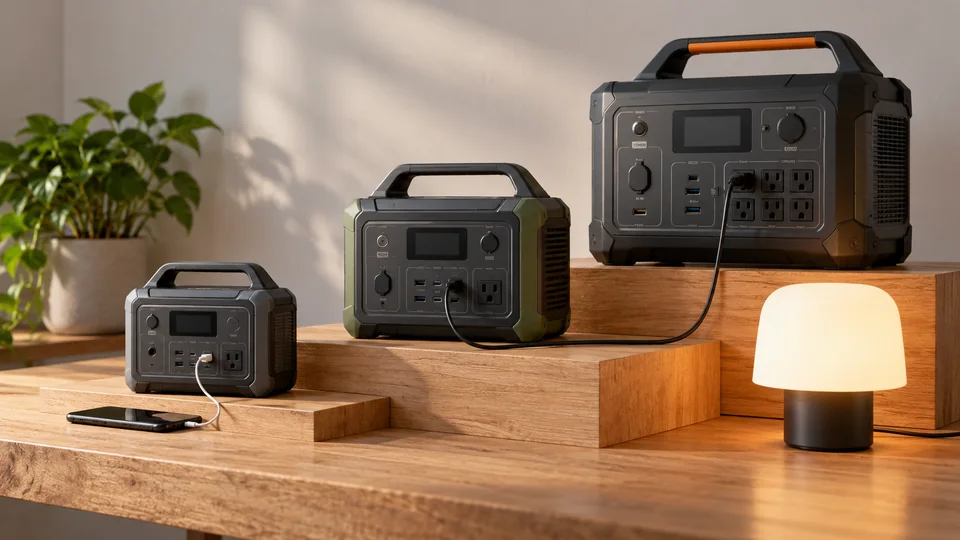
The portable power station size you need depends on two separate measurements: watts (W) for the equipment running at one time and watt-hours (Wh) for the energy used over a period. A station with roughly 300 to 700Wh may suit phones, lights, cameras, and short laptop use. Camping setups with several small devices often fit in the 500 to 1,000Wh range. Refrigerator backup, medical equipment, cooking appliances, and longer outages can require 1,000Wh or more. These are planning ranges, not guarantees. Calculate your actual load before choosing a capacity. If your estimate points toward a larger reserve, compare the output and charging options in our 1,000Wh power station guide.
Start With Your Power Requirements
First, list every device you expect to use. Record its operating watts, how many hours it will run, and whether it has a motor, compressor, heating element, or other startup demand.
| Requirement | What It Tells You |
|---|---|
| Continuous output in W | How much power the station can supply at one time |
| Surge or peak output in W | Whether the inverter may handle a brief startup demand |
| Battery capacity in Wh | How much stored energy the battery contains nominally |
| Output type | Whether AC, DC, USB-C, or another connection matches your device |
Do not treat watts and watt-hours as interchangeable. A 1,000W inverter describes power delivery. It does not mean the station stores 1,000Wh. A 1,000Wh battery may have a lower or higher AC output rating, depending on the model.
Calculate How Many Watt-Hours You Need
For each device, use this basic calculation:
Energy use in Wh = Power in W × Operating time in hours
For multiple devices, calculate each one separately and add the results. A hypothetical camping load might look like this:
- A laptop averaging 60W for 4 hours uses about 240Wh.
- LED lighting using 20W for 5 hours uses about 100Wh.
- A small communications device averaging 10W for 6 hours uses about 60Wh.
The calculated total is 400Wh. That is an energy-use estimate, not a recommendation to buy a station advertised at exactly 400Wh. A station loses some energy through its inverter and other conversion circuits. The battery may also reserve energy for protection and shutdown behavior.
For a rough planning estimate, you can use:
Runtime in hours ≈ Nominal battery capacity in Wh ÷ Average load in W
This is an ideal upper-bound calculation. For a more realistic illustration, assume that 80% of the nominal capacity reaches an AC load:
Runtime ≈ Nominal capacity × 0.80 ÷ Average load
The 0.80 value is an explicit example assumption, not a universal efficiency rating. The actual usable fraction varies by station, output type, load size, temperature, battery age, and operating mode. A station’s own idle consumption can also reduce runtime, especially with small loads.
Choose Capacity Based on the Use Case
Phones, Cameras, Lights, and Small Electronics
A compact station in the 200 to 500Wh range may be sufficient for charging phones, cameras, tablets, lights, and other low-power electronics over a short trip. Check the available USB ports and charging protocols before relying on the AC inverter. A USB-C socket does not automatically provide USB Power Delivery or a particular wattage.
For this type of use, port selection can matter as much as capacity. Direct USB or DC charging may avoid some inverter losses. Match voltage, current, connector, polarity, and protocol to each device.
Laptops and Work Equipment
Estimate the laptop’s average consumption rather than using the largest number printed on its charger as guaranteed energy use. The charger rating describes its possible input requirement, while actual consumption changes with screen brightness, processor activity, battery charging, and connected accessories.
If a laptop averages 60W and runs for 6 hours, the ideal energy calculation is 360Wh. A nominal 500Wh station could provide a reasonable starting point for that single load, but actual runtime may be shorter after conversion losses and the station’s idle draw. Add other equipment, such as a monitor, router, lighting, or communications hardware, separately. For a closer look at this capacity range, see our 500Wh power station recommendations.
Car Camping and Short Trips
A 500 to 1,000Wh station may cover several small electronics, lighting, camera batteries, and occasional DC equipment for a short trip. The required size rises quickly if you add a portable refrigerator, electric blanket, cooking appliance, or frequent AC charging. Once you have estimated those loads, our camping power station comparison can help you weigh battery capacity against carrying weight and charging options.
Separate the energy budget from the output requirement. A device may use modest daily energy yet need a high startup surge. A compressor or motor can briefly demand more power than its normal running rating. Check both the station’s continuous output and its surge specification. A surge number does not guarantee that every motor or compressor will start successfully.
Portable Refrigerators and Household Refrigerators
Refrigerator sizing requires more information than the wattage printed on the appliance. A compressor cycles on and off, so its average energy use differs from its running wattage multiplied by 24 hours. Ambient temperature, insulation, thermostat setting, door openings, food load, and startup behavior affect the result.
A 12V portable refrigerator also differs from a household AC refrigerator. Check the exact input voltage, connector, current requirement, and protection behavior. For a household unit, verify the compressor startup demand and use a measured daily energy figure where possible. If no measured figure is available, treat any estimate as hypothetical and leave extra capacity for uncertainty. Our refrigerator power station guide compares options with these startup and energy requirements in mind.
CPAP and Other Medical Devices
Medical equipment requires a more careful calculation. Identify the exact device, power adapter, operating mode, humidifier setting, heated tubing setting, and approved AC or DC power options. A CPAP that runs without heated accessories may use a different amount of energy from the same machine with humidification and heated tubing enabled.
Check the medical-device manufacturer’s approved power methods and the power station’s output specifications. Test the complete setup before relying on it overnight or during an outage. Essential medical equipment should have a dependable backup plan that does not depend on an untested runtime estimate. For a comparison of potential backup choices, see our CPAP power station guide and verify the exact machine and power setup before relying on any station.
Heaters, Kettles, Microwaves, and Other High-Wattage Loads
Heating and cooking appliances can require a large inverter and substantial battery capacity. A hypothetical 1,500W heater running for one hour consumes about 1,500Wh before system losses. A 1,000Wh station cannot be expected to operate that load for a full hour.
Check the appliance’s continuous input power, startup behavior where relevant, and the station’s continuous AC rating. A large Wh number does not compensate for an inverter that cannot supply the required watts. Short operation may be possible with a suitable station, but the energy budget still needs to support the load.
Size the Inverter Separately From the Battery
Add the continuous wattage of devices that may run at the same time. The result should remain below the station’s continuous AC output, with reasonable room for variation.
For example, a 100W monitor, a 60W laptop, and 20W of lighting create a 180W simultaneous load. A station rated for 200W continuous output may be too close to its limit once charger losses and load changes are included. Startup loads from refrigerators, pumps, fans, and tools require a separate check against the surge rating.
Pure sine wave AC may be appropriate for some sensitive electronics, motor-driven devices, and equipment with specific power requirements, but the label alone does not guarantee compatibility. Follow the device and station documentation.
Plan for Charging and Recharge Time
A larger battery takes more energy and time to recharge. Check the station’s supported AC, vehicle, USB-C, and solar input methods separately. Input ratings describe charging power, while output ratings describe what the station can supply to connected devices.
Solar panel wattage is a nameplate rating under defined test conditions. Actual charging varies with sunlight, angle, shading, temperature, cable losses, controller behavior, and the station’s input limits. Before connecting a panel, verify its Voc, Vmp, Imp, connector, polarity, and maximum current against the station’s solar input range. A matching connector shape does not prove electrical compatibility.
A rough ideal solar estimate uses:
Recharge time in hours ≈ Energy to replace in Wh ÷ Charging input in W
This assumes constant charging input and excludes conversion losses and charging taper. Actual solar charging can take longer. Loads operating during charging also reduce the energy going back into the battery.
Account for Conditions That Reduce Usable Capacity
Nominal capacity is measured under specified conditions. Delivered energy can be lower because of:
- AC inverter and DC conversion losses.
- The station’s own display, cooling, and control-system consumption.
- Battery reserve and low-voltage cutoff behavior.
- Cold or hot operating conditions.
- Battery age and accumulated cycle aging.
- High loads that create greater voltage drop or thermal limits.
- Charging devices while the station is also powering other equipment.
Leave additional capacity when the station supports an essential load, an intermittent appliance, uncertain device specifications, or several days without reliable recharging. A small reserve also reduces the chance of reaching a low-battery shutdown at an inconvenient time.
A Practical Sizing Process
- List the devices. Include every AC, DC, USB, and USB-C load.
- Record operating watts. Use the device manual, power label, or a suitable meter when available.
- Estimate operating hours. Use average power for cycling devices such as refrigerators.
- Calculate daily energy. Multiply watts by hours for each device, then add the results.
- Add a planning margin. Account for conversion losses, uncertain consumption, aging, and reserve capacity.
- Check simultaneous power. Add the devices that may run together and compare that total with continuous output.
- Check startup demand. Review compressors, pumps, motors, and other loads with surge requirements.
- Verify each connection. Match AC voltage and frequency, DC voltage, current, connector, polarity, and USB protocol.
- Review recharge options. Confirm AC, vehicle, or solar input limits before planning repeated use.
Quick Sizing Examples
| Planned Use | Starting Capacity Range | What Still Needs Checking |
|---|---|---|
| Phones, tablets, lights, and camera batteries | About 200 to 500Wh | Port types, charging sessions, and trip length |
| Laptop and small electronics for a workday | About 500 to 1,000Wh | Average laptop load and monitor or router use |
| Several camping devices for one or two days | About 500 to 1,000Wh or more | Refrigeration, cooking, heating, and recharge access |
| Refrigerator or extended outage support | Often 1,000Wh or more | Measured daily energy, compressor startup, and recharge plan |
| High-draw heating or cooking equipment | Capacity and inverter size can both be substantial | Continuous watts, runtime, surge, and outlet limits |
These ranges are general planning points rather than promises for every setup. The correct portable power station size is the one whose usable energy covers your planned Wh demand and whose output can safely handle the highest simultaneous and startup loads. Calculate both figures before relying on the station for camping, travel, work, or emergency power.
