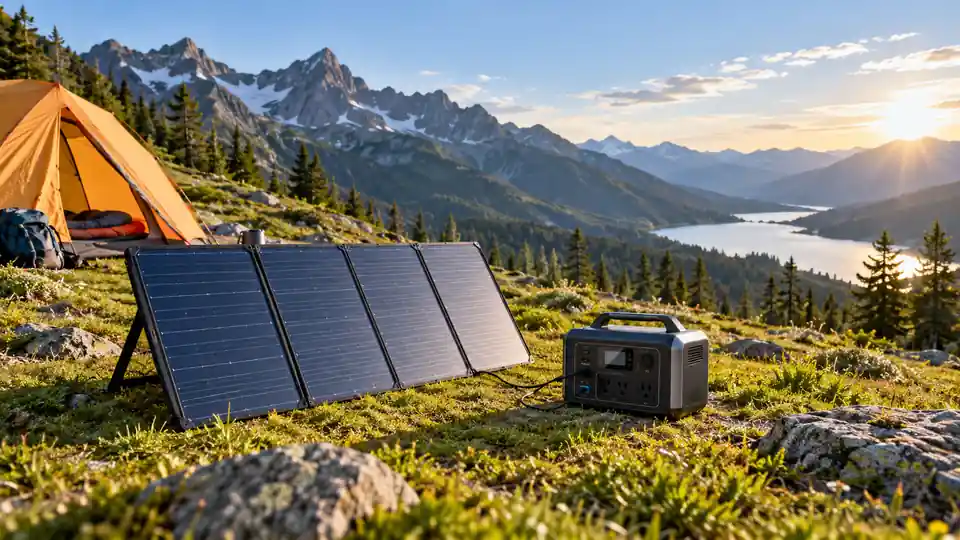
A camping power station has to do more than sit in a gear closet looking impressive. It needs to carry enough energy for the devices you actually bring, fit the way you travel, and recharge through a practical path once you are away from an outlet. A small unit may be perfect for phones, cameras, lights, and a laptop, while a family basecamp or RV setup may need 1,000Wh or more and substantially higher continuous AC output.
The common mistake is shopping by peak wattage or battery capacity alone. Peak output is not continuous output, nominal watt-hours are not the same as usable AC energy, and a solar panel’s connector does not prove electrical compatibility with every station. Weight, included panel, charging options, port types, and the difference between a complete kit and a station-only package all matter. Different campers have very different priorities, so this list includes lightweight electronics stations, compact solar kits, and larger options for demanding loads.
The Jackery Solar Generator 1000 v2 takes the top spot because its 1,070Wh capacity, 1,500W AC output, 23.8-pound weight, 200W panel, and app-controlled charging modes form a particularly useful middle ground for car camping and larger basecamps. Smaller kits below make more sense for short trips or lighter loads, while the 2,042Wh Jackery is the better fit for campers who need substantial reserve energy.
If you want a quick overview first, the table below compares the nine strongest options by capacity, output, weight, and solar setup.
Quick Answer
- Best Overall: Jackery Solar Generator 1000 v2 and 200W Solar Panel for its combination of 1,070Wh capacity, 1,500W continuous AC output, and manageable 23.8-pound weight.
- Best for Higher Loads: BROWEY 1600W Portable Power Station for its 1,024Wh capacity and 1,600W output.
- Best High-Capacity Kit: Jackery Explorer 2000 v2 and 2x200W Solar Panels for its 2,042Wh battery and 2,200W AC output.
- Best Compact Kit: Jackery Solar Generator 300 and 40W Solar Panel for a 7.5-pound package with 292Wh of stated capacity.
Best Solar Generator for Camping Comparison Table
| Product | Best For | Capacity | Continuous AC Output | Weight | Solar Setup |
|---|---|---|---|---|---|
| Jackery Solar Generator 1000 v2 | Overall camping use | 1,070Wh | 1,500W | 23.8 lb | 200W panel included |
| BROWEY 1600W Portable Power Station | Higher continuous loads | 1,024Wh | 1,600W | Not clearly specified | Built-in panel, 40W charging listed |
| Jackery Explorer 2000 v2 | Large basecamps | 2,042Wh | 2,200W | 39.5 lb | Two 200W panels included |
| EBL 1000W Portable Power Station | Complete 1,000Wh kit | 999Wh | 1,000W | Not clearly specified | 200W panel included |
| BLUETTI Elite 30 V2 | Compact higher-output station | 288Wh | 600W | 9.4 lb | Solar supported, panel not included |
| EnginStar 300W Power Station | Lightweight 300W kit | 296Wh | 300W | 6.5 lb | 60W panel included |
| ZeroKor 300W Power Station | Basic tent-camping kit | Not clearly specified | 300W | Not clearly specified | 60W panel included |
| MARBERO M823 | Small-device charging | 237Wh | 300W | Not clearly specified | 60W foldable panel included |
| Jackery Solar Generator 300 | Compact electronics | 292Wh | 300W | 7.5 lb | 40W panel included |
The detailed reviews below explain how these stations differ in portability, output, capacity, and included solar equipment.
1. Jackery Solar Generator 1000 v2 and 200W Solar Panel, Best Overall

The Jackery 1000 v2 hits a useful camping sweet spot. Its stated 1,070Wh capacity gives a much deeper reserve than the compact 237Wh to 296Wh units in this roundup, while the 1,500W continuous AC rating opens the door to more demanding campsite equipment. Three pure sine wave AC ports, two USB-C ports, one USB-A port, and a car port also make it easier for a group to charge cameras, laptops, lights, and small appliances from one station.
Car campers will appreciate the 23.8-pound weight and foldable handle, especially when the station only needs to travel from a vehicle to a picnic table. The supplied 200W solar panel is listed to charge the station to 80% in about six hours, while the app provides a one-hour emergency charging mode and a quieter 30 dB overnight mode. The fast setting requires activation, and the normal full-charge mode defaults to 1.7 hours, so those details matter before a trip.
Pros
- 1,070Wh stated battery capacity.
- 1,500W continuous AC output with 3,000W peak output listed.
- 23.8-pound body with a foldable handle.
- Two USB-C ports, including 100W USB-C PD.
- 200W solar panel included in the listed kit.
Cons
- The one-hour full-charge claim requires emergency charging activation in the app.
- The station and panel may ship separately.
This is the strongest all-around choice for campers who want to run more than small electronics without moving into the size of a 2kWh station. Backpackers should look elsewhere, but car campers, road trippers, and basecamp users get a capable balance of reserve energy, output, and carrying weight.
To buy this product, click here.
2. BROWEY 1600W Portable Power Station with Built-in Solar Panel, Best for Higher Continuous Loads
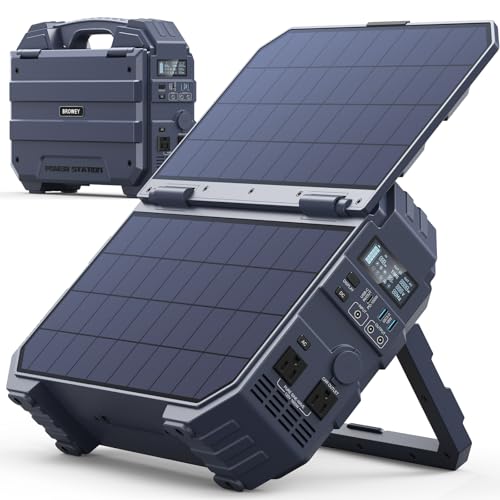
The BROWEY S1600 is aimed at campers who would rather have extra output than the smallest possible carry. Its published 1,024Wh capacity sits close to the Jackery 1000 v2, but its 1,600W pure sine wave output is rated higher. That makes it a more compelling candidate for equipment with substantial running demand, provided the appliance remains within the station’s stated limits and its startup behavior is suitable.
The built-in solar design is the unusual feature here. The listing describes integrated solar panels and MPPT control, plus the ability to connect additional panels. It also lists 40W solar charging, so buyers should read the charging specifications carefully rather than assume the built-in panel will recharge a 1,024Wh battery quickly. The station includes a 100W USB-C PD port, eight total ports, and LiFePO4 cells, giving it a broad camping role.
Pros
- 1,024Wh stated capacity.
- 1,600W continuous and 3,200W peak output listed.
- Pure sine wave AC output is specified.
- Built-in solar panels and MPPT controller are listed.
- 100W USB-C PD port supports higher-power USB-C charging.
Cons
- Weight is not clearly specified in the supplied listing.
- The listed 40W solar charging figure is modest for a 1,024Wh station.
Choose this model for vehicle-based camping where 1,600W output and integrated solar hardware matter more than verified carry weight. It is less attractive for hikers or anyone who wants a clearly documented, high-wattage external panel setup, but it offers a distinctive alternative to conventional panel-and-station kits.
To buy this product, click here.
3. Jackery Explorer 2000 v2 and 2x200W Solar Panels, Best High-Capacity Kit

For a large family campsite, a long vehicle trip, or a basecamp with several power-hungry devices, the Jackery Explorer 2000 v2 brings a different level of reserve. The stated 2,042Wh capacity is the largest here, and its 2,200W AC output gives it considerably more headroom than compact camping stations. Three AC ports and a 100W USB-C PD port help spread charging across several devices without relying on a pile of small adapters.
The tradeoff is physical size. At 39.5 pounds, this is portable in the car-camping sense, not a station for long walks from a trailhead. The kit includes two 200W solar panels, with a listed six-hour solar charging time, and the station can reach 80% through AC charging in 66 minutes according to the supplied claim. Buyers should verify the included cables and use the specified straight DC8020 plug when connecting the Jackery panels.
Pros
- 2,042Wh stated capacity.
- 2,200W AC output with three AC ports.
- Two 200W solar panels are listed in the kit.
- 100W USB-C PD port is included.
- 20ms switching and UL1778 certification are stated for UPS use.
Cons
- 39.5 pounds makes it unsuitable for carried-in camping.
- The station and panels may ship separately.
This is the serious basecamp pick for buyers who understand that higher capacity brings more bulk. It is excessive for a weekend of phone charging, yet its larger reserve and higher output make sense for a campsite supporting several people, larger electronics, or longer stays near a vehicle.
To buy this product, click here.
4. EBL 1000W Portable Power Station with 200W Portable Solar Panel, Best Complete 1,000Wh Kit

The EBL package is appealing because the station and panel arrive as a clearly defined off-grid kit. Its 999Wh battery and 1,000W pure sine wave output suit campers who need more energy than a compact electronics station can offer, while the 200W monocrystalline panel provides a meaningful solar input option. The listing also identifies built-in MPPT control, which is intended to optimize the panel’s solar input, though actual charging depends on sunlight and the station’s limits.
Port selection is generous for a shared campsite. Two AC sockets, a 60W USB-C PD port, three USB-A QC 3.0 ports, a wireless charging pad, a 12V car port, and two DC outputs are listed. The product can support up to ten devices within the 1,000W total limit, so a family can spread out lights, cameras, phones, and laptops. The panel is described as weather-resistant, but that claim should not be treated as proof that the entire station or every connector is weatherproof.
Pros
- 999Wh stated battery capacity.
- 1,000W pure sine wave output with 2,000W peak output listed.
- 200W monocrystalline solar panel included.
- 60W USB-C PD, wireless charging, AC, USB, DC, and car outputs.
- MPPT control is listed for solar charging.
Cons
- Station weight is not clearly specified.
- The 1,000W limit excludes higher-wattage heating and power tools.
For campers who want a complete 1,000Wh-class kit without assembling a separate panel system, EBL is a practical candidate. It is better suited to a vehicle or established campsite than a long carry, and buyers should keep the AC output switched off when unnecessary because the listing warns that it can drain the battery without an active load.
To buy this product, click here.
5. BLUETTI Elite 30 V2 Portable Power Station, Best Compact Higher-Output Station

The BLUETTI Elite 30 V2 is small in capacity but unusually strong in output for its class. Its stated 288Wh battery is close to the compact Jackery units, yet continuous AC output is listed at 600W, with a 1,500W Power Lifting mode. That extra output can be useful for selected camping equipment, although Power Lifting does not turn the 288Wh battery into a larger energy reserve or guarantee compatibility with every appliance.
At 9.4 pounds, it remains manageable beside a tent, in a car, or on a picnic table. The listing specifies 380W wall charging, 0 to 80% in 45 minutes, and 0 to 100% in 70 minutes, plus solar and car charging support. A 10ms UPS switch is also advertised. The included package contains the station, AC cable, car cable, and manual, but no solar panel is listed, so this is a station-only purchase.
Pros
- 288Wh stated capacity in a 9.4-pound package.
- 600W continuous AC output is listed.
- 1,500W Power Lifting mode is included.
- 380W adjustable wall charging is specified.
- 10ms UPS switching is advertised.
Cons
- No solar panel is listed in the included package.
- The 288Wh capacity limits longer use of high-wattage appliances.
This BLUETTI suits campers who value output, quick wall charging, and a stated UPS mode more than deep solar reserve. Pair it with a compatible panel only after checking the station’s electrical requirements. For simple phone and light duty, a lighter 300W kit may be easier to justify.
To buy this product, click here.
6. EnginStar 300W Power Station with 60W Foldable Solar Panel, Best Lightweight 300W Kit

EnginStar keeps the camping package relatively light. The station is listed at 6.5 pounds, with a 296Wh capacity and 300W AC output. That profile works for a camper carrying a camera, laptop, drone, phone, and lights rather than trying to power a kettle or other high-demand heating device. Two AC outlets, regulated DC outputs, USB-A, and USB-C provide useful variety around a tent or vehicle.
The included 60W monocrystalline panel folds to a compact size and weighs four pounds according to the listing. It includes DC, USB-A, and USB-C outputs, while the station can also charge from an AC outlet or a 12V car socket. The listing states a maximum charging speed of 65W and advises recharging every two to three months, a useful storage detail for seasonal campers.
Pros
- 6.5-pound station with 296Wh capacity.
- 300W AC output and two pure sine wave AC outlets are listed.
- 60W foldable solar panel is included.
- 12V and 24V regulated DC outputs are specified.
- AC, solar, and car charging options are listed.
Cons
- 300W output limits the choice of campsite appliances.
- The solar panel weighs four pounds, adding to the carried kit.
EnginStar is a smart fit for short trips where every pound matters but a phone-sized battery is too limiting. It gives campers a real AC outlet and a foldable panel without stepping up to a heavy 1,000Wh station. Check the power rating of every appliance before plugging it in, especially devices with heating elements or compressors.
To buy this product, click here.
7. ZeroKor 300W Power Station with 60W Solar Panel, Best for Basic Tent Camping

ZeroKor focuses on the basic camping kit: a 300W power station, a 60W panel, multiple USB outputs, and a flashlight with reading and SOS modes. The published information does not clearly state the battery’s watt-hour capacity, so buyers should avoid assuming it matches other 300W stations in this roundup. Still, the output selection is useful for phones, tablets, laptops, headphones, and small camping electronics.
The station can recharge from a wall outlet, car port, or a 13V to 23V solar input, with built-in MPPT control listed. The foldable monocrystalline panel is rated at 60W and provides USB-A, USB-C, and DC outputs. Its junction box is specifically described as needing to stay dry. That small detail matters at a campsite, where a panel may be outside while the station and connectors remain protected.
Pros
- 300W maximum AC output is listed.
- 60W foldable solar panel is included.
- Wall, car, and solar charging pathways are provided.
- Multiple USB outputs and a quick-charge port support small devices.
- Flashlight includes reading and SOS modes.
Cons
- Battery capacity in watt-hours is not clearly specified.
- The panel junction box should be kept dry.
This is a reasonable choice for electronics-focused tent camping when the included panel and lighting functions are useful. It is harder to compare precisely against 292Wh and 296Wh competitors because the published capacity is unclear, so buyers with a defined runtime requirement should select a station with a stated Wh rating instead.
To buy this product, click here.
8. MARBERO M823 237Wh Solar Generator, Best for Small-Device Charging

The MARBERO M823 is built around a 237Wh battery and a broad collection of small-device outputs. Two AC outlets, two QC 3.0 USB-A ports, two standard USB-A ports, an 18W USB-C port, and a DC output give a group several ways to charge phones, cameras, tablets, and small accessories. Its 300W AC rating is useful for modest loads, but the supplied warning about heating devices means this should remain an electronics and lighting station.
The kit includes a 60W foldable solar panel, and the listing identifies a 21.5% to 23.5% conversion-rate range for the panel. It also includes a three-mode flashlight with standard, strobe, and SOS functions. Setup uses the supplied DC cable and the appropriate adapter, so the panel should be connected according to the included instructions rather than treated as a universal plug-in source for unrelated stations.
Pros
- 237Wh stated battery capacity.
- 300W rated and 375W peak output are listed.
- 60W foldable solar panel is included.
- Multiple USB-A, USB-C, AC, and DC outputs are provided.
- Three flashlight modes support campsite illumination.
Cons
- 237Wh is a smaller reserve for extended camping.
- The 18W USB-C port is limited for larger USB-C devices.
MARBERO makes sense for a camper who wants a compact panel kit for phones, tablets, lights, and occasional laptop charging. It is less suitable for large appliances or long off-grid stays, but its output variety and flashlight make it a tidy companion for short trips and fishing or hiking camps with nearby vehicle access.
To buy this product, click here.
9. Jackery Solar Generator 300 and 40W Solar Panel, Best Compact Jackery Kit

This Jackery package is a compact, clearly specified option for campers who value easy carrying. The Explorer 300 has a stated 292Wh capacity, 300W rated output, and 7.5-pound weight. Its two AC outlets, 100W USB-C PD port, two USB-A ports, and 120W car port cover the usual mix of phones, cameras, laptops, and lights without forcing a larger station into the vehicle.
The included 40W Air Solar Panel is the main difference between this kit and the station-only Explorer 300 package. The listing says the panel can bring the station to 80% in about 7.5 hours, while a 100W Jackery panel is listed at about 2.8 hours to 80%. That makes the bundle convenient for maintaining small electronics over time, but less compelling for rapid replenishment after heavy AC use.
Pros
- 7.5-pound station with 292Wh capacity.
- 300W rated output and 600W peak output are listed.
- 100W USB-C PD port is included.
- 40W solar panel is included in this package.
- LiFePO4 chemistry and over 4,000 cycles to 70% capacity are stated.
Cons
- The included 40W panel has a longer listed charging time than a 100W panel.
- The generator and panel may ship separately.
This kit is a strong match for compact car-camping loads and campers who want a recognizable, lightweight setup with a panel included. It cannot compete with the 1,000Wh-class stations for appliance use, yet its low carry weight and useful USB-C output keep it relevant for electronics-first trips.
To buy this product, click here.
Buying Guide
Match Watt-Hours to the Camping Load
Watt-hours describe stored energy, while watts describe the power a station can deliver at a given moment. A 292Wh station can be excellent for phones, cameras, lights, and a laptop, but it does not offer the same reserve as a 1,070Wh or 2,042Wh model. Actual AC runtime will be lower than a simple capacity division because inverter losses, idle draw, battery limits, and load behavior affect delivery.
Separate Continuous Output from Peak Output
Use continuous AC output as the main compatibility figure. Peak output may help with a brief startup demand, but it does not mean a station can run that load continuously. A 300W model belongs with small electronics and modest equipment, while the 1,500W to 2,200W options provide more headroom. Check the appliance’s running and startup requirements before relying on any portable station.
Inspect the Solar Package Carefully
A kit may include a 40W, 60W, or 200W panel, or it may include no panel at all. A higher panel rating does not guarantee that the station will receive that much power, and connector fit does not prove electrical compatibility. Check the station’s solar voltage, current, input-power limits, connector, and the panel’s electrical specifications before adding a different panel.
Choose AC, DC, or USB Based on the Gear
AC outlets are useful for standard chargers and appliances, but using an inverter can consume additional energy. DC and USB outputs may be more efficient for compatible electronics. A USB-C port also needs a stated power-delivery rating before it can be treated as suitable for a larger laptop or other higher-demand device. The Jackery 1000 v2 lists 100W USB-C PD, while the MARBERO lists an 18W USB-C port, a meaningful distinction.
Think About Weight and Camp Layout
A 7.5-pound or 9.4-pound station can move easily from a vehicle to a tent table. The 23.8-pound Jackery 1000 v2 is still practical for car camping, but it is a different proposition from a compact kit. The 39.5-pound Explorer 2000 v2 is best treated as vehicle-supported equipment. Also account for the panel, cables, and adapters, since the complete kit weighs more than the station alone.
Read Battery and UPS Claims Precisely
LiFePO4 chemistry and cycle figures can indicate the seller’s stated battery design, but cycle counts do not guarantee a specific service life under every condition. Likewise, a listed UPS or transfer time deserves attention, but it does not prove compatibility with every computer, router, or medical device. Verify the requirements of critical equipment separately, and never connect a portable power station to household wiring through a wall outlet.
Best Solar Generator for Camping FAQ
What size solar generator is suitable for camping?
It depends on the load and trip length. A 237Wh to 296Wh station suits phones, lights, cameras, and occasional laptop use. A 999Wh to 1,070Wh station gives a larger reserve for groups and longer stays, while a 2,042Wh unit is better for substantial basecamp demand. Since usable AC energy is lower than nominal battery capacity, leave headroom rather than planning around the full Wh number.
Is a 300W power station enough for camping?
A 300W station can handle many electronics, lights, chargers, and selected small devices. It is not automatically suitable for coffee makers, hair dryers, water pumps, or other heating and motor loads. Check both continuous and startup requirements. The 300W rating describes the station’s output limit, not the amount of energy stored in its battery.
Should I buy a station with a solar panel included?
A kit is convenient because the station and panel are presented together, but you still need to check electrical compatibility and panel size. A 40W panel may be useful for slowly maintaining a compact station, while a 200W panel is a better match for larger batteries. A station-only package may offer more flexibility if you already own a compatible panel.
Can a camping solar generator run a refrigerator?
Some larger stations list enough continuous output for certain refrigerators, but compatibility depends on the refrigerator’s running draw, compressor startup demand, cycling pattern, and the station’s output limits. Do not assume that a higher peak number guarantees startup success. The 1,000Wh-class and larger stations in this roundup offer more electrical headroom, but the appliance requirements still need to be checked.
How long will a camping power station run a device?
A rough upper-bound calculation divides nominal watt-hours by the device’s average watt draw. That result does not account for inverter losses, idle consumption, cutoffs, temperature, or changing loads, so it should not be treated as tested runtime. Devices that cycle, such as refrigerators, need an estimate based on their actual operating pattern rather than a constant nameplate draw.
Are portable power stations safe for CPAP machines?
A station’s AC, DC, or USB output may appear suitable, but CPAP requirements vary by model and may change significantly with humidification and heated tubing. The published product data alone does not establish guaranteed overnight operation or medical-device suitability. Verify the CPAP’s input requirements, expected draw, and backup needs with the device documentation.
Can I leave a solar panel outside in rain?
Do not assume the entire charging setup is weatherproof. The ZeroKor listing specifically says its panel junction box should remain dry, and other listings describe panel features without establishing protection for every connector, cable, or power station. Keep connections sheltered and follow the supplied instructions unless an exact weather-resistance rating covers the component in question.
Final Verdict
The Jackery Solar Generator 1000 v2 is the strongest overall choice for camping because it combines a stated 1,070Wh capacity with 1,500W continuous AC output, a 23.8-pound body, a 200W panel, multiple USB-C and AC ports, and useful app-controlled charging modes. It has enough headroom for more than basic electronics without becoming as cumbersome as a 2,042Wh system.
Smaller trips favor the 7.5-pound Jackery 300 kit or the 6.5-pound EnginStar package, while the BLUETTI Elite 30 V2 makes sense for campers who want 600W output in a compact station. For larger basecamps, the BROWEY offers 1,600W output and the Jackery Explorer 2000 v2 supplies the deepest stated reserve. Match the final choice to the actual loads, panel requirements, carrying distance, and charging plan rather than choosing by peak wattage alone.

This is an exceptionally well-articulated discussion on “best solar generator for camping”. Looking forward to reading more of your insightful perspectives and follow-up work on this topic!