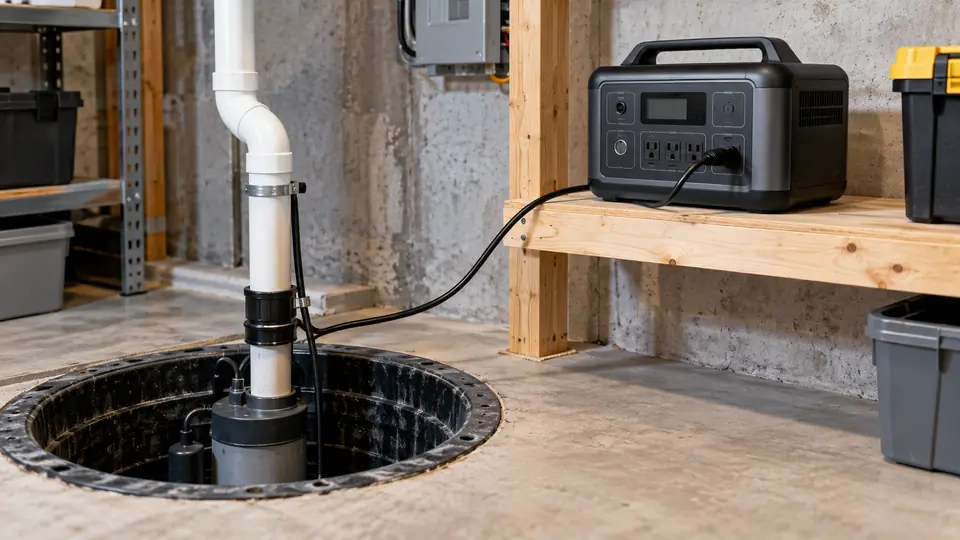
A sump pump is a motor load with an important startup demand. A backup battery must start that exact pump, support its running power, and have enough reserve for the duty cycle during the outage. A utility pump or a batteryless inverter is not another portable power station.
S2000 and FridgePower provide substantial integrated battery reserves, while larger-output alternatives give demanding pumps more candidates to compare. The nine stations below are complete battery systems; none is presented as universally compatible with every pump motor.
A pump drawing 600W for five minutes uses 50Wh per cycle. Six such cycles require 300Wh before losses. This arithmetic example does not establish startup compatibility; the motor's inrush must be checked separately.
Quick Answer
- Best Overall: Anker SOLIX S2000 Portable Power Station, 2,010Wh, 1,500W — 2,010Wh storage; 1,500W normal AC output.
- Best Slim Backup: BLUETTI FridgePower Portable Power Station — 2,016Wh storage; 1,800W normal AC output.
- Best for a Movable Higher-Output Pump Candidate: BLUETTI Elite 100 V2 — 1,024Wh storage; 1,800W normal AC output.
- Best Large-Reserve Standalone Alternative: EBL Acc2400 Portable Power Station — 1,843.2Wh storage; 2,400W normal AC output.
Best Portable Power Station for Sump Pump Comparison Table
| Product | Best For | Capacity | Continuous AC Output | Weight | Solar / Recharge Details |
|---|---|---|---|---|---|
| Anker SOLIX S2000 Portable Power Station, 2,010Wh, 1,500W | Best Overall | 2,010Wh | 1,500W | Verify current specification | Verify current specification |
| BLUETTI FridgePower Portable Power Station | Best Slim Backup | 2,016Wh | 1,800W | Verify current specification | Verify current specification |
| BLUETTI Elite 100 V2 | Best for a Movable Higher-Output Pump Candidate | 1,024Wh | 1,800W | 25 lb | 1,000W; 12–60V, 20A |
| BLUETTI AC180 | Best for a 1kWh-Class Pump Reserve | 1,152Wh | 1,800W | About 35.3 lb | 500W; 12–60V, 10A |
| EcoFlow DELTA 3 Classic | Best AC-Only Compact Backup Candidate | 1,024Wh | 1,800W | About 26.7 lb | 500W maximum |
| Jackery Explorer 1000 v2 | Best for a Lower-Demand Verified Pump Pairing | 1,070Wh | 1,500W | 23.8 lb | 400W maximum; approved panel/cable |
| Jackery HomePower 3600 Plus | Best for a Larger Household Pump Reserve | 3,584Wh | 3,600W | Verify current specification | Verify current specification |
| Anker SOLIX F3800 | Best for a High-Output Backup Plan | 3,840Wh | 6,000W | Verify current specification | Verify current specification |
| EBL Acc2400 Portable Power Station | Best Large-Reserve Standalone Alternative | 1,843.2Wh | 2,400W | 55 lb | Verify current specification |
The detailed reviews below separate full portable power stations from the dedicated inverter and cordless-pump alternatives, so you can match the backup arrangement to your sump setup.
1. Anker SOLIX S2000 Portable Power Station, 2,010Wh, 1,500W — Best Overall
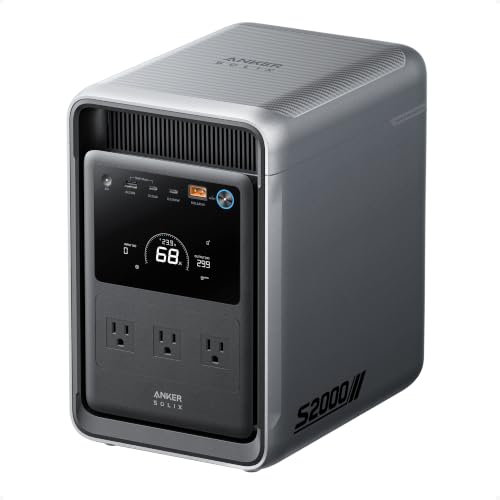
The Anker SOLIX S2000 is the most balanced option here for a household that wants one battery station to cover a sump pump and other essential loads. Its published 2,010Wh capacity gives it a much deeper reserve than compact camping units, while the 1,500W continuous AC rating is the figure that matters most for sustained operation. The listing also identifies a 3,000W peak output, although pump startup compatibility still depends on the specific motor and its demand.
Its stated UPS switchover of under 10ms makes the S2000 especially interesting for a pump that needs to remain connected rather than being manually moved to a battery after the power fails. The unit has eight outlets, front and rear placement, and up to 400W solar input. At 35.7 pounds, it is portable in the broad sense, though it is better suited to a basement shelf, utility area, or storage spot than frequent hand carrying. The absence of a 12V DC port may matter if your backup plan includes direct-current equipment.
Pros
- 2,010Wh capacity provides a substantial energy reserve.
- 1,500W continuous AC output suits many household loads.
- Published 3,000W peak output may help with some startup demands, subject to pump requirements.
- Stated UPS switchover is under 10ms.
- Supports up to 400W solar input and six listed recharge methods.
Cons
- No 12V DC port is listed.
- The 35.7-pound weight is less convenient for frequent relocation.
This is the strongest starting point for buyers who want a full portable station rather than a bare inverter or a small emergency battery. Check the sump pump’s running and startup requirements before buying, because the published wattage figures do not prove compatibility with every motor. Buyers who need direct 12V operation or a dedicated installed battery system may prefer a different format.
To buy this product, click here.
2. BLUETTI FridgePower Portable Power Station — Best Slim Backup

BLUETTI positions this FridgePower model as a purpose-built refrigerator backup unit, yet its published 1,800W output also makes it relevant for a sump pump, chest freezer, fish tank, or selected kitchen appliance. The 2,016Wh battery is close in size to the Anker S2000, and the listing claims an ultra-low 4W standby draw. Those features point toward a station intended to remain connected in one place rather than a compact battery for occasional travel.
The 75mm slim profile is the unusual attraction. It can be placed behind a refrigerator, beside a cabinet, or wall-mounted with the included brackets, which may be useful in a crowded utility area. BLUETTI also lists a 10ms battery transfer feature and four UPS modes. Optional BlueCell 200 expansion batteries can raise the stated capacity to 8,064Wh, but those expansion batteries are not included in the base package described here. The storm alerts and voice-control features add convenience, although they do not replace checking the pump arrangement itself.
Pros
- 2,016Wh capacity is suitable for extended backup planning.
- 1,800W continuous output is higher than the Anker S2000’s stated continuous rating.
- 75mm slim design supports wall or narrow-gap placement.
- Published 10ms transfer feature and four UPS modes.
- Optional expansion is listed up to 8,064Wh.
Cons
- Expansion batteries are optional rather than included in the listed package.
- The published specifications focus on refrigerator backup, so pump-specific compatibility still needs checking.
Choose this model if placement and semi-permanent connection matter as much as raw battery capacity. It makes particular sense for a basement or utility area where a deep, conventional power station would be awkward. A buyer who wants a simple grab-and-go unit, direct 12V outputs, or a pump-specific battery system may find its specialized shape less useful.
To buy this product, click here.
3. BLUETTI Elite 100 V2 — Best for a Movable Higher-Output Pump Candidate

Elite 100 V2 supplies a 1,800W continuous AC rating with 1,024Wh of storage. It is a complete battery candidate to compare with a sump pump’s documented input, unlike a batteryless inverter or a pump that happens to be sold with its own packs.
Its 25-pound weight makes relocation more manageable than the largest systems. The transfer claim does not prove motor startup: confirm the pump’s inrush, running demand, and operating cycle before using this as the backup arrangement.
Pros
- 1,024Wh battery capacity with 1,800W rated AC output
- 10ms UPS switchover is listed for routers and PCs
- 25-pound design with a hidden handle
- 1200W TurboBoost AC charging reaches 80% in approximately 45 minutes according to the listing
- LiFePO4 battery, app control, and 11 ports
Cons
- Solar panels are not included
- Its solar input accepts up to 1,000W within 12–60V and 20A; panel choice and useful sunlight still govern actual replenishment.
Retain it only after the exact pump passes the electrical compatibility check.
To buy this product, click here.
4. BLUETTI AC180 — Best for a 1kWh-Class Pump Reserve

AC180 gives a sump-pump plan 1,152Wh of nominal storage and 1,800W continuous output. It is worth examining for a pump whose running and startup requirements fall inside its documented capability; those requirements cannot be replaced by the pump’s horsepower label alone.
The approximately 35.3-pound unit needs a dry, ventilated location and a suitable charging plan. Its solar capability can help replenishment, but it is not a guarantee of backup duration during bad weather.
Pros
- 1,152Wh nominal capacity provides reserve for compatible loads.
- 1,800W continuous output supports substantial AC loads.
- 500W solar input is explicitly listed.
- AC, car, and solar charging cables are included.
- LiFePO4 battery chemistry and a five-year warranty are stated.
Cons
- At approximately 35.3 pounds, AC180 favors a vehicle-supported or stationary setup over frequent long carries.
- Power Lifting is a conditional resistive-load mode, not 2,700W continuous output.
A controlled pump-start check comes before relying on the reserve.
To buy this product, click here.
5. EcoFlow DELTA 3 Classic — Best AC-Only Compact Backup Candidate
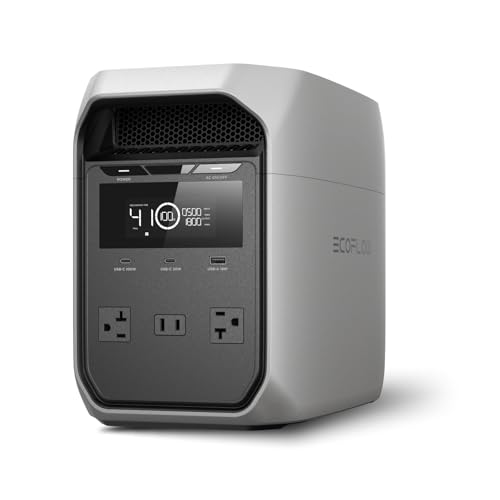
DELTA 3 Classic offers 1,024Wh and 1,800W through its AC outlets. That output route is relevant to an AC sump pump, with the actual pump’s startup demand still deciding whether the pair can be used.
Its 10ms transfer feature describes a mode rather than universal motor compatibility. Do not confuse the Classic’s 1,400W AC charging input with its 1,800W output, or assume features from another DELTA model.
Pros
- 1,024Wh LiFePO4 battery capacity.
- 1,800W AC output and 3,600W surge claim.
- Stated under-10ms UPS transfer.
- 500W solar charging claim with an optional panel.
- App control for monitoring, schedules, and backup modes.
Cons
- Optional solar panel is not included.
- Supplied information lists incompatibility with specified EcoFlow extra batteries.
Consider Classic for a verified AC pump pairing and a finite outage budget.
To buy this product, click here.
6. Jackery Explorer 1000 v2 — Best for a Lower-Demand Verified Pump Pairing

Explorer 1000 v2 brings 1,070Wh of nominal storage and 1,500W continuous output. It is the lower-output choice among these substantial candidates, so a sump-pump buyer needs to establish that both running power and inrush fit before considering the carrying convenience.
The manufacturer identifies a 20ms backup transfer, with restrictions for high-performance UPS loads. That is not pump-start proof. The 23.8-pound weight is useful only after the electrical pairing has passed.
Pros
- 1,070Wh capacity and 1,500W continuous AC output
- 23.8-pound body with a foldable handle
- Two USB-C ports, including stated 100W PD support
- LFP battery rated at over 4,000 cycles to 70% capacity
- App modes for emergency, quiet overnight, and efficient charging
Cons
- Solar panels are not included
- Solar charging is specified as compatible only with Jackery solar panels
This is a conditional choice for a documented lower-demand pump.
To buy this product, click here.
7. Jackery HomePower 3600 Plus — Best for a Larger Household Pump Reserve

HomePower 3600 Plus holds 3,584Wh and provides 3,600W output. The greater reserve can matter when a pump cycles repeatedly through a long interruption, while the higher inverter rating broadens the class of pump to examine.
A household connection still needs the supported equipment and installation route. Estimate reserve from the pump’s measured running time per cycle, then verify startup separately; this battery is not presented as universal flood protection.
Pros
- 3,584Wh base capacity for a larger home energy reserve
- 3,600W AC output with stated 120V and 240V capability in parallel
- Expansion support up to 21kWh per unit is listed
- Wheeled luggage-style body with telescoping handle
- Supports hybrid AC and DC, AC, solar, and gas-generator charging methods
Cons
- The published specifications do not clearly state the unit’s weight
- Home connection through an MTS requires careful installation planning and is not the same as plugging into a household outlet
Its size is justified by a substantial, verified backup demand.
To buy this product, click here.
8. Anker SOLIX F3800 — Best for a High-Output Backup Plan

SOLIX F3800 combines 3,840Wh with a 6,000W system output. It is a much larger backup-platform purchase than a compact pump battery and is relevant when the power plan includes other household essentials as well as the pump.
Its connection and transfer equipment need to match the installation. A large system rating still does not establish the exact pump’s startup behavior, and expanded storage should not be counted unless the extra batteries are purchased.
Pros
- 3,840Wh base capacity with 6,000W continuous AC output
- Stated 120V/240V dual-voltage output
- Expansion support up to 26.9kWh with additional battery packs
- Listed NEMA 14-50 and L14-30 connections for stated RV applications
- Wi-Fi and Bluetooth app control with a 5-year warranty listed
Cons
- Its large output and expansion ecosystem make it a substantial home-backup purchase
- The published specifications does not clearly state the unit’s weight or exact transfer time
Use it for a broader, deliberately specified household backup plan.
To buy this product, click here.
9. EBL Acc2400 Portable Power Station — Best Large-Reserve Standalone Alternative
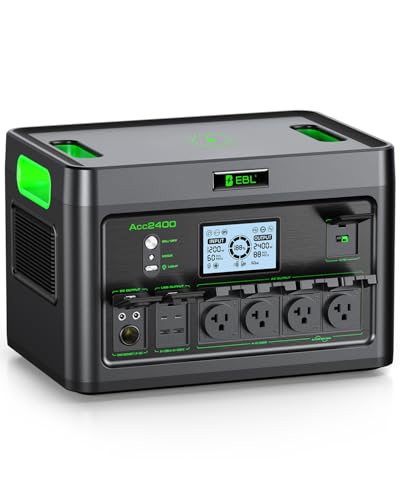
Acc2400 adds 1,843.2Wh of storage and 2,400W output to a pump-backup comparison. It has more nominal reserve than the approximately 1kWh stations without being an expansion-system purchase.
At 55 pounds, position it near the intended connection rather than expecting frequent hand carrying. Pump startup and transfer requirements remain unverified until the complete arrangement is checked; battery size alone cannot resolve either.
Pros
- 1,843.2Wh capacity provides substantial stored energy for a cabin.
- 2,400W AC output supports a broad range of listed household and workshop loads.
- Twelve output options make it useful for group charging and mixed devices.
- 55-pound weight and dual-side handles give the unit a clear stationary or basecamp role.
- LiFePO4 chemistry and a stated 3,500-plus cycle claim suit repeated use.
Cons
- At 55 pounds, it is cumbersome for a cabin reached on foot.
- The listing information does not clearly specify solar input wattage or electrical limits.
A suitable role is stationary support for a confirmed pump pairing.
To buy this product, click here.
Buying Guide
Start With Motor Inrush
Use the sump pump's voltage, running demand, and startup requirements. A station can have enough steady output yet fail to start the motor. A quoted peak rating needs its duration and operating conditions before it can support a pairing decision.
Choose the Output Connection
Check the outlet voltage and individual socket rating, especially on larger systems such as F3800. The system's headline wattage does not necessarily describe what one receptacle delivers. Use the pump's approved connection method.
Calculate From the Duty Cycle
A pump that cycles occasionally has a different reserve requirement from one running nearly continuously. Measure the actual operating pattern and multiply watts by time, then account for station losses and a practical reserve.
Evaluate Transfer Behavior
S2000 and FridgePower advertise short transfer times, but that does not certify every pump. Verify how the pump restarts and how the station behaves during loss and restoration of AC input.
Keep the Battery Above Water
Position the station and connections where rising water cannot reach them. The slim FridgePower form can help with placement, but shape is not water protection. Leave ventilation space and follow both manufacturers' instructions.
Distinguish Base Capacity From Expansion
FridgePower and selected larger systems support optional reserve expansion. Compare the supplied base capacity first, then price and plan the exact supported batteries. DELTA 3 Classic does not support energy expansion.
Arrange a Dependable Refill
AC charging is usually the predictable preparedness route. Solar is useful only with a suitable electrical pairing and available sunlight. The existence of a solar port does not establish a pump's ability to run indefinitely during an outage.
Best Portable Power Station for Sump Pump FAQ
What size station does a sump pump need?
There is no universal size. Determine the specific pump's startup and steady requirements, then its duty-cycle energy budget. These are separate checks.
Are all nine stations guaranteed to start my pump?
No. They are integrated battery candidates with different output limits. Even a high-output station needs verification with the exact motor, outlet, and operating conditions.
Why compare a larger battery if the inverter rating is similar?
More nominal storage can support a longer duty-cycle budget. It does not increase an inverter's continuous output or prove motor startup compatibility.
Is FridgePower relevant despite its name?
Its 2,016Wh reserve and 1,800W AC output make it a candidate for selected loads. Refrigerator-oriented marketing and a 10ms transfer claim still do not certify a particular sump pump.
Does a short UPS transfer time prove pump operation?
No. Transfer time describes one part of backup behavior. Starting the motor and keeping it operating through the outage require their own checks.
Can I feed household wiring from a wall outlet?
No. Use the approved plug-in connection or a manufacturer-supported transfer arrangement installed appropriately. A portable station is not permission to backfeed a wall outlet.
When is a dedicated pump backup preferable?
A fixed backup can suit a permanent installation or a pump that falls outside the portable stations' documented limits. Compare the complete system and installation requirements rather than buying by peak watts alone.
Final Verdict
S2000 is the first candidate to compare when its documented startup and running limits match the pump. FridgePower offers another complete battery system, but refrigerator-oriented features do not certify sump-pump startup.
Test the exact pump and backup arrangement before an outage. Larger-output models are worth comparing when startup exceeds the smaller candidates, but the pump's inrush, outlet requirements, and duty cycle still decide suitability.
